When picking mooncakes, trust your taste buds for flavor—but read the manufacturer and seller on the back of the package to give your gift more certainty.
A box of mooncakes carries the remembered taste of home.
The thoughtfulness of the Mid-Autumn Festival is often hidden in the details of choosing a gift. Bring your parents a box of the five-kernel mooncakes they are used to, and pick a new flavor your friends have never tried.
From selection to the first bite, this thoughtfulness still passes through several stages: production, sales, and delivery. Who made the mooncakes, and which company is the seller in the order? The businesses behind the gift box also deserve to be seen.
When choosing mooncakes for elders, remember the flavors they are used to; when sending a holiday gift to friends, you are also willing to spend time finding a new flavor with local characteristics. Before deciding which box to give, flavor, portion size, packaging, and delivery time often need to be weighed repeatedly.
The more carefully gifts are chosen, the more the producers and sellers behind the gift box also deserve a place on this gift-selection list.
One box of mooncakes holds the flavors of north and south
Although mooncakes are small, they can hold the different Mid-Autumn celebrations of the north and south.
Cantonese-style mooncakes have soft crusts, and lotus seed paste, red bean paste, and five-kernel fillings each have their followers; Suzhou-style mooncakes are known for their many layers of flaky pastry, and both sweet and savory fillings can be flavorful; Beijing-style mooncakes include Zilaihong and Zilaibai, which retain the plain look of traditional pastries;
Yunnan-style mooncakes, with flavors such as Yunnan ham, let sweet and savory meet in a single bite. Different local products and production techniques have left their own tastes for the same festival of reunion.
Behind these distinctive local flavors is an industrial map extending to production, sales, and supporting links. Data from Tianyancha shows that as of September 2026, there are more than 21,000 existing mooncake-related business entities in China, mainly distributed in Guangdong, Guangxi, and Shaanxi.
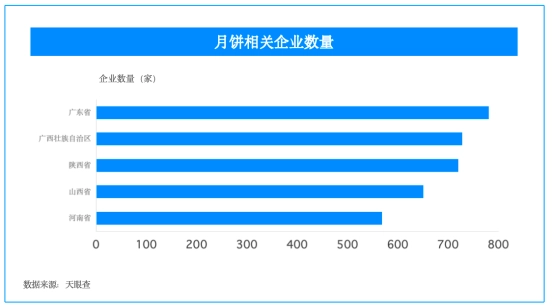
Distribution of mooncake-related enterprises | The data chart follows the core draft, with statistics as of September 2026.
In addition to the widely known Cantonese-style mooncakes, Hepu in Guangxi also provides a window for observing the mooncake industry. Around the "Hepu big mooncake," the local area has built a mooncake town, combining traditional baking, mooncake culture, and cultural tourism experiences, and driving the development of related food industries such as sea duck eggs. A mooncake extends from a local specialty to an industrial calling card, linking ingredient processing, food manufacturing, and consumer experience.
According to a Xinhua News Agency report, the town has gathered 19 mooncake production enterprises and more than 90 upstream and downstream supporting enterprises; some enterprises have also incorporated aquatic ingredients such as fresh shrimp and dried oysters into mooncakes, making coastal products a festival flavor that can be taken away.
A mooncake thus connects a longer chain: fillings require ingredient supply, gift boxes require packaging support, and local flavors going to other places cannot do without sales and logistics. For consumers, what they receive is a box of holiday gifts; for the place of origin, this bite on the reunion table is also connected to local breeding, processing, and business operations.
Know the flavor you like, and also see clearly the name on the back of the packaging
From offline counters to e-commerce stores, consumers have more channels for buying mooncakes. After identifying the flavor you like, it is also worth flipping over the packaging and taking a look at the order to understand who produced this box of mooncakes and who sold it.
Flavor schools are not equal to the actual place of production. The brand on the gift box, the producer on the back of the packaging, and the seller in the order may correspond to different entities.
The brand is the name that is easy to remember when shopping, the production enterprise corresponds to the actual production link, and the seller connects ordering, payment, and after-sales service. The three have different roles and may also be undertaken by different companies. Matching these names is more useful than only remembering the mark on the front of the gift box to explain who produced and who sold the product you bought.
The State Administration for Market Regulation's special supervisory sampling of mooncakes before Mid-Autumn Festival 2025 covered 500 batches of products, involving 198 brands and 332 production enterprises, with a pass rate of 98.80%. Beyond the overall sampling situation, the enterprise names and batches of specific products are also key to understanding the sampling information. For example, in September 2025, the Shaanxi Provincial Administration for Market Regulation reported that one batch of "Jianxing Brand Golden Five-Kernel (Suzhou-style Mooncake)" sold by Hanzhong Jiajiale Commerce and Trade Co., Ltd. and nominally produced by Hanzhong Jianxing Food Co., Ltd. had a peroxide value that did not meet the national food safety standard.
This notice lists the seller, the nominally producing enterprise, and the product name separately. Only by looking up the names on the packaging and order can one piece of information be linked to a specific product, rather than making a judgment based only on a similar brand name.
In another notice from the Hainan Provincial Administration for Market Regulation in September 2025, the bean paste mooncakes produced and sold by Hainan Yexiangyuan Food Co., Ltd. had test values for dehydroacetic acid and its sodium salt that did not comply with national food safety standards; the four-head flaky taro egg yolk mooncakes produced and sold by Lin Gao County Xinying Xiao Yijia Guanxiang Bakery had test values for amaranth red and brilliant blue that did not comply with the regulations. The notice made clear that the published results were preliminary test conclusions.
These cases involve different products and different testing items, and also show that "seeing the enterprise clearly" and "checking the product" need to work together: the enterprise name helps identify the producer or seller, while sampling information must correspond to the product and batch. The result of a single historical batch cannot be expanded into a judgment about all products of an enterprise or all mooncakes in a region.
Enterprise information inquiries can supplement the basis for understanding a seller, but ingredients, production date, shelf life, and storage requirements still need to come back to the product itself. When ordering online, the product page and the packaging received can be checked against each other; when shopping offline, besides looking at flavors and asking about prices, it is also worth taking another look at the producer information on the back.
Choose the thoughtfulness properly, and also understand the seller clearly
When choosing gifts for family, learn a little more about the producer; when purchasing for an organization, also verify the seller, contract, and payee. Beyond flavor and packaging, these details are also worth attention.
During the event, users can enter the Tianyancha App Mid-Autumn Gift Festival event page, select "Check Mooncakes," and enter the full enterprise name on the packaging or order to learn relevant enterprise information about the brand owner, manufacturer, and seller.
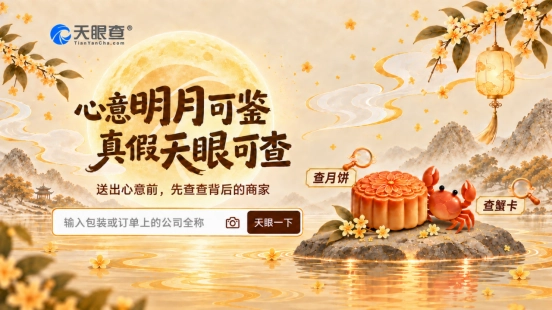
Tianyancha Mid-Autumn Gift Festival event page | Select "Check Mooncakes" to query the corresponding enterprise.
If the brand owner on the packaging is not the same as the production enterprise, they can be searched separately; if the seller in the order is yet another name, verification can also continue.
The thoughtfulness of a box of mooncakes lies both in remembering what family members like and in being willing to learn a little more for this gift.
Check it, and give this thoughtfulness a firmer footing.