Tastien launches 5 million yuan training arm for franchisees
Tastien has set up a wholly owned training and consulting firm to certify franchisees on its hand-rolled dough process and open a new fee stream as it nears 10,000 stores.
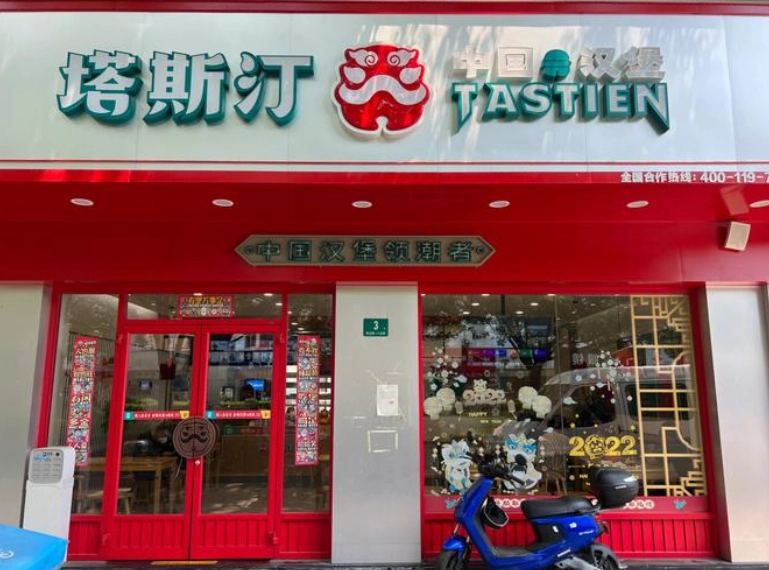
Tastien has set up a 5 million yuan (about $700,000) management consulting subsidiary to train its franchisees, as the Chinese burger chain shifts from breakneck expansion to defending store-level survival.
The new company, Fuzhou Xingshi Workshop Management Consulting Co Ltd, is wholly owned by Fuzhou Tastien Catering Management Co Ltd, according to corporate records database Tianyancha. Its legal representative is Yang Bing, one of the three co-founders known as the Lion Triangle. The filing formalizes training, certification and consulting as a standalone business — and a possible new profit stream from the franchise network.
Tight control from the top
The registration details show a 5 million yuan capital base and full ownership by the parent, giving Tastien's core leadership direct control of the unit that will oversee franchisee standards and training. Xingshi Workshop takes its name from the lion dance, the brand's best-known cultural symbol.
Its approved business scope covers the usual corporate management consulting and catering management. It also lists business training, education consulting, and experiential team-building activities and planning, alongside a catering service licence.
Yang is already legal representative and manager of the parent company and has shaped Tastien's operations and standardization since its early years. Unlike KFC and McDonald's, which run company-owned stores or strict franchising, Tastien expanded from a few hundred outlets to several thousand — closing in on 10,000 — largely by mobilizing franchisee capital in lower-tier cities and rural markets. At that scale, managing franchisees and keeping their operations consistent has become the chain's central risk.
The dough problem
Tastien's main selling point against Western fast food is that its buns are rolled, seeded and baked in the store rather than shipped frozen. That difference underpins its retro-Chinese (guochao) appeal, but it also makes the back kitchen heavily dependent on staff.
Dough fermentation depends on temperature and humidity, the rolling must be evenly thick, and baking must hit the right heat and doneness — all of it resting on the muscle memory of young frontline workers. Poor training can produce buns that are hard, undercooked or, at worst, a food-safety problem.
The old model, in which regional supervisors mentored staff on the job, has not kept pace with store turnover. The new entity is meant to turn hand-rolled, freshly baked dough into a quantified certification system, requiring prospective franchisees and store managers to complete off-site training and hold a certificate before they run a store.
From cost center to profit center
In chain restaurants, the early money comes from franchise fees. Later, the bulk comes from supply contracts — chicken, sauces, packaging — bought centrally and resold at a markup. As store-level margins come under pressure from cutthroat competition, pushing more margin onto ingredients meets growing resistance, including franchisees quietly sourcing cheaper supplies elsewhere.
By packaging consulting, team-building and staff certification into a separate legal entity, Tastien can issue compliant invoices to thousands of franchisees for technical advice, off-site staff training and outdoor exercises. It also moves what was a cost center — human resources and training — into a business that earns fees across the franchise network.
A second business beyond burgers
The addition of experiential team-building and management consulting hints at broader ambitions: exporting Tastien's playbook for lower-tier markets.
Many small and mid-sized restaurant brands face the same gaps in standardization and management outside big cities. Yang's team could sell courses on site selection and store layout, the in-store baking workflow and low-cost local advertising on Douyin, to suppliers, distributors and chains in other food categories. That would take Tastien from selling burgers to training the franchise industry.
Two tests ahead
Franchisees' suspicion of new fees
Franchisees are wary of new charges that look like a second cut of their revenue. In some tier-2 and tier-3 cities, falling average tickets and steep delivery-platform commissions have left operators highly sensitive to any added fee.
If the advanced courses and team-building camps are widely seen as a disguised levy rather than practical help in lifting sales per square meter and repeat visits, the plan could stir resentment across the franchise community. In a worst case it would speed up closures and switches to rival brands.
The gap between the classroom and the counter
Courses can be polished and exercises can be energetic, but daily basics decide whether a restaurant survives: whether the cold chain thaws properly each morning, whether oil-temperature logs are faked, whether labels on near-expiry ingredients are quietly changed.
If Xingshi Workshop becomes a matter of attendance sheets and certificates for sale, and cannot use digital store audits and unannounced inspections to keep outlets disciplined, it will not build a real food-safety barrier for Tastien.
The filing is done; the test has just begun
The registered capital and parent-company ownership traceable on Tianyancha mark an attempt by a fast-rising chain to tighten management after a period of rapid, loose growth. Yang and Tastien have built a formal base for training and consulting over a vast franchise empire. With consumers more cautious and store survival rates under real pressure, the question is whether that workshop can turn franchisees into genuine partners with a shared stake in the business.