Dong Mingzhu steps down as legal representative of Gree E-Commerce, marking the exit of her personal IP and a shift in channel reform toward refined operations.
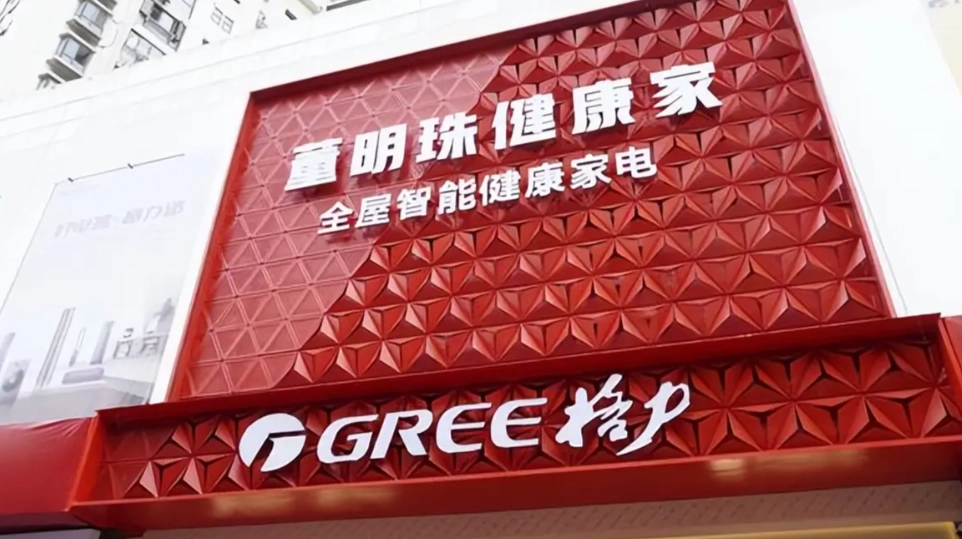
As a key piece that Gree Electric has placed on its new retail experimental field, Gree E-Commerce Co., Ltd. quietly completed a transition of its legal representative and core management positions after the Start of Autumn. Dong Mingzhu, who has steered Gree for many years, officially stepped down as the company's legal representative and executive director, with Zhang Xinglei, a backbone executive promoted from within the Gree system, fully taking over as legal representative and leading the company's day-to-day operations and management.
In public perception, Dong Mingzhu and Gree's online channels have long formed a deeply personalized bond. From personally entering the fray in the early years to ignite billions of yuan in livestream sales, to the high-profile launch of online private-domain systems bearing her personal imprint such as "Dong Mingzhu Healthy Refrigerator & Washer," every public appearance by Dong Mingzhu has been directly equated with the charge call of Gree's e-commerce. This time, handing over the legal person of a core e-commerce entity that has been established for nearly seven years and is wholly controlled to a new-generation professional manager appears on the surface to be a conventional governance de-escalation and business registration burden reduction by a large manufacturing enterprise. But at a time when the air-conditioning industry has entered a battle of attrition in a stock market and Gree's traditional offline dealer game has entered deep waters, this change looks more like a rational correction of the online channel's narrative of individual heroism.
Tracing through the underlying business registration to penetrate the capital foundation of this e-commerce hub, its blood relationship with the parent entity is clearly documented in Tianyancha archives. Tianyancha business registration data shows that Gree E-Commerce Co., Ltd. was established in November 2019, its legal representative has been changed to Zhang Xinglei, its registered capital reaches 100 million yuan, and its enterprise type is a limited liability company (a sole legal-person investment or controlled enterprise not invested or controlled by a natural person).
The equity map penetrated by Tianyancha shows that this entity is directly 100% wholly owned by Zhuhai Gree Electric Appliances Co., Ltd., a main-board listed company on the Shenzhen Stock Exchange.
Among its approved business scope, core functions such as internet sales, domestic trade agency, supply chain management, and special equipment sales are clearly listed. A capital scale of 100 million yuan at the paid-in level means it is by no means an ordinary outsourced online store operation company, but rather the central hub responsible for distributing Gree's entire white goods empire to Tmall, JD.com, Douyin, and its self-operated Dong Mingzhu Store.
This seemingly uneventful business registration change directly reflects three strategic shifts in Gree's e-commerce after a period of aggressive experimentation.
The first is the retreat of the super personal IP from the front stage and the return of the channel to public ownership. Gree's original intention in establishing this e-commerce entity at the end of 2019 was to break the original channel hierarchy barriers and squeeze out the markup charged by agents at all levels through a factory-to-consumer model. Dong Mingzhu personally took command and concurrently served as legal person, bringing unparalleled traffic dividends and public opinion volume to Gree's e-commerce in the early stage, with several national tour livestreams creating sales legends of tens of billions of yuan.
However, excessively parasitizing a massive online sales system on the founder's personal appeal not only gradually narrowed the brand's online perception into a single internet-celebrity effect, but also made it difficult to cope with today's fragmented traffic competition across multiple platforms and touchpoints. Handing operations to young technical and management backbone executives means Gree's online system is fully shifting from the early "persona-driven" stage to an institutionalized stage driven by algorithms, supply chain efficiency, and refined operations.
The second is the traditional offline dealer system moving from fierce confrontation to a deeper rebalancing of interests. Over the past few years, the strong rise of Gree's e-commerce once triggered strong backlash and even public defection by established core dealers in places such as Hebei and Henan, and provincial sales companies in many regions were thrown into turmoil because e-commerce diverted sales through low prices. At present, the offline market remains the fundamental base for installation services and shipments of high-end air conditioners. How to preserve online incremental growth without completely crushing the survival space of offline stores is the most thorny problem in Gree's channel transformation.
Dong Mingzhu's stepping down as legal person and creating a physical separation in her roles objectively dilutes the gunpowder smell of the parent entity's highest level competing for profits with frontline channels, leaving more flexible room for maneuver for reconstructing the interests of the online-offline dual-track system.
The deeper test lies in the pressure to break through when facing consumption downgrading across the entire white goods market and online strangulation by competitors.
When the online air-conditioning market is tightly defended by competitors such as Midea and AUX with extreme cost-effectiveness and a mature online OEM ecosystem, Gree's previous channel model relying on high premiums and high rebates faces an extremely severe test of sell-through. The marginal utility of simply selling goods through livestream discounts is declining sharply, and Gree E-Commerce must solve the real challenge of truly turning diversified categories beyond air conditioners, such as refrigerators, washing machines, and small lifestyle appliances, into online hit products.
What the new operator takes over is not just a legal person seal, but also a heavy burden of reconstructing Gree E-Commerce's product strength and fulfillment efficiency in an environment where traffic dividends across the entire internet have peaked.
This business registration and position handover occurring from midsummer to early autumn sends the clearest signal to China's entire home appliance manufacturing industry: the era of relying on one Iron Lady to prop up internet-wide traffic will eventually end, and channel transformation in manufacturing must ultimately return to the professional track of refined supply chains and modern professional managers. Gree E-Commerce, having shed its personal halo, must polish its digital internal strength brick by brick in places without the spotlight.