Yang Zhilin's Leverage: The Agent Sovereignty Battle Behind KimiClaw
Moonshot AI has registered the KimiClaw trademark, using browser automation to bridge AI from reading to execution and seize the initiative in the Year of the Agent.
While the domestic large model track is still obsessively competing on long-text parameters, Moonshot AI has quietly extended its reach into a more aggressive territory. Recently, Tianyancha intellectual property information showed that Beijing Moonshot AI Technology Co., Ltd. has applied to register multiple "KimiClaw" trademarks, covering categories such as scientific instruments and website services. This is not a routine brand defense, but rather a land-grab campaign centered on "execution capability" that this large model upstart has set its sights on for early 2026.
If long-text capabilities earned Kimi the respect of readers in 2024, then KimiClaw is the key lever Yang Zhilin is using to push AI from "reader" to "executor."
From Reading to Grabbing: The Deeper Rationale Behind KimiClaw
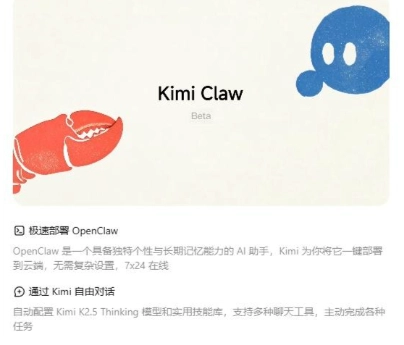
KimiClaw did not emerge out of thin air. As a cloud-based OpenClaw product launched by Moonshot AI in February this year, its core logic lies in integrating the originally complex browser automation operations into Kimi's ecosystem with a disruptive, top-down approach.
Behind this strategic pivot lies a cold commercial logic: the first half of the large model race is about who can better process existing information, while the decisive battle in the second half is about who can more efficiently break down the information silos between web pages and apps. OpenClaw itself, as an open-source web interaction framework, has its capability ceiling defined by simulating all human behaviors in a browser. By cloudifying it and branding it with the Kimi name, Moonshot AI is essentially building an "operating protocol" for the AI era.
When Kimi gains this pair of "claws," it is no longer just a chatbot interface. Through KimiClaw, the large model can be deployed directly in the cloud, autonomously completing complex web data scraping, form filling, and even cross-platform task scheduling. This marks a shift for Moonshot AI under Yang Zhilin's leadership, from being a pure algorithm company to becoming a technology hub with control over traffic distribution.
The Elite Logic Behind the Registered Capital and the Agent Ambition
Looking at the business registration data disclosed by Tianyancha, Beijing Moonshot AI Technology Co., Ltd. was established in April 2023, with Yang Zhilin as the legal representative. Although the registered capital is listed as one million RMB, this is merely a typical "lean" facade for high-growth tech companies. In the eyes of top technologists like Yang Zhilin, Zhou Xinyu, and Wu Yuxin, who come from Google, Meta, and Cyclone Intelligence, that one million in leverage moves billions in computing resources and data assets.
The international classification of these trademark applications precisely targets scientific instruments and communication services, revealing KimiClaw's true position in the large model industry in 2026: it is not a plugin, but an underlying tool.
2026 is widely recognized in the industry as the "Year of AI Agents." In this year, text-to-text generation alone can no longer satisfy the capital markets; what the market demands is "digital employees" that can directly generate business value. The emergence of KimiClaw is essentially building a "full-network execution capability" for Kimi outside of proprietary protocols. It bypasses traditional API restrictions and leverages browser automation logic to give AI the ability to operate on the World Wide Web like a human. While this approach is highly challenging on the compliance front, it represents a forceful breakthrough in commercial efficiency.
The Shift in Value Chains: From Information Retrieval to Task Agency
The driving force behind the value chain is shifting from traditional search advertising to task-based commissions. If KimiClaw can achieve seamless deployment within Kimi, then traffic that originally belonged to various vertical apps will be intercepted behind this cloud-based scraper.
This explains why Moonshot AI is filing trademarks intensively at this moment. Before the technology inflection point arrives, brand premium and legal moats must be built in advance. Those trademarks shown on Tianyancha as "pending substantive examination" are essentially Yang Zhilin building the first line of defense for Kimi's commercial territory. If KimiClaw becomes the de facto standard for AI-based scraping, Moonshot AI will hold a kind of "technical franchise" for automated operations on the public internet.
The deeper rationale behind this move is that the commercialization of large models has entered a precarious leap from "consuming computing power" to "saving human labor." Through KimiClaw, a web data collection task that would have required a junior data analyst several hours to complete can now be done in the cloud in seconds. This extreme compression of efficiency is the core trump card in KimiClaw's capital narrative for 2026.
The Endgame of Commercial Competition: The Battle for Sovereignty
The endgame of commercial competition often comes down to monopolizing user entry points. Moonshot AI's latest move is essentially heralding a new power structure: the future internet entry point may no longer be a browser or operating system, but a large model with "claws."
Yang Zhilin's ambition has never been to build a better search engine alternative, but rather to create an intelligent core capable of reshaping the execution logic of the physical world. The dense cluster of trademark applications on Tianyancha is merely a pre-flight check within this grand codebase. When KimiClaw's pipeline is fully operational, the "last mile" that has constrained large model deployment—namely, control over dynamic web pages and heterogeneous data—will truly be grasped in these "claws."
Before the summer of 2026 arrives, Moonshot AI has already prepared its survival contract in advance. This is no longer a story about algorithms, but a real-world game about who can be the first to redefine the value of human labor in the digital arena by seizing control over underlying execution rights.
Moonshot AI is working hard to shed the reader label, and KimiClaw is its first hand reaching into the real world in the Agent era. This posture of diving downward from the top of the technology pyramid, while likely to face disputes in the short term over scraping protocols and copyright protections, is undoubtedly an extremely cold-blooded and precisely calculated strategic breakthrough in the commercial jungle where efficiency is justice.