Harbin Ice and Snow World adds Disney Frozen zone at 1.25m sqm
Harbin Ice and Snow World has expanded to 1.25 million square meters and will add a Disney Frozen area to reduce reliance on one winter season.
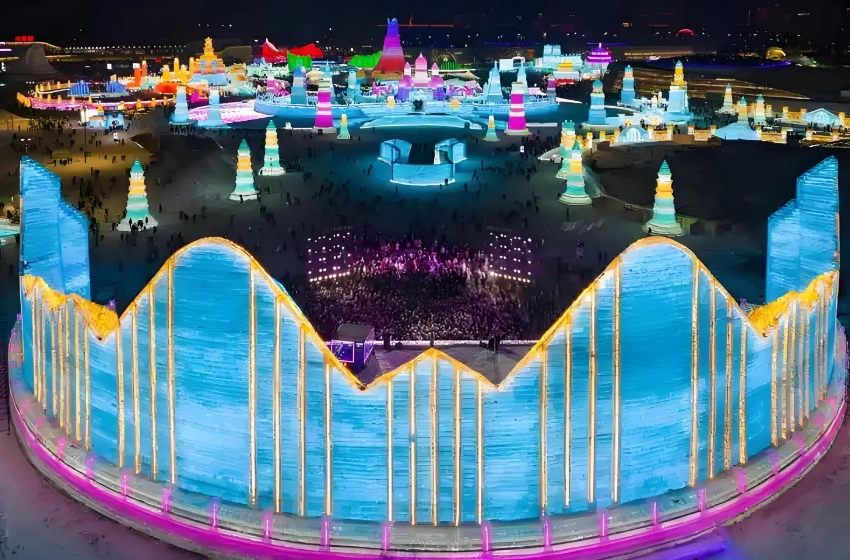
Harbin Ice and Snow World will expand to 1.25 million square meters for its 28th season and build a Frozen-themed zone under a partnership with Walt Disney China, using a record 400,000 cubic meters of ice and snow.
The scale-up marks a shift for the state-owned attraction. After years of competing on size and ice-craft alone, it is now buying global intellectual property and promising theme-park-grade experiences — a bet aimed at lifting spending per visitor before China's ice-and-snow tourism boom cools.
The announcement lands as the northeastern city counts down to the 9th Asian Winter Games, with domestic winter travel entering what the park's operators describe as a tougher, more settled phase of competition.
The site will grow from more than 1 million square meters last season to 1.25 million, the largest in its history. The volume of ice and snow used, 400,000 cubic meters, is also a record.
A state-owned base
Corporate records on Tianyancha, a Chinese business database, show the operator, Harbin Ice and Snow World Co., Ltd., was founded in 2013 with registered capital of about 152 million yuan (about $21 million). Its legal representative is Sun Zemin. The business covers tourism, scenic-area management, ticketing for performances and marketing planning.
Harbin Sun Island Group Co., Ltd. holds 83.6691% of the company and Harbin Venture Capital Group Co., Ltd. holds 16.3309%. The ultimate controller is the Harbin Municipal State-owned Assets Supervision and Administration Commission.
That ownership gives the park advantages private operators cannot match: land allocation, approval to cut ice from the Songhua River, coordination with traffic and security departments, and the ability to organize large-scale construction in extreme cold. It is what allows a 1-million-square-meter complex to be built from real ice and snow within a window of a few dozen days each year.
Why go bigger
Crowding drove the expansion. Last season's surge of visitors to the north bank of the Songhua River generated national headlines, but the queues did too. Reservation systems for the main attractions — the long ice slide and the Ferris wheel — came under heavy public pressure as waits stretched to hours.
The extra space is meant to raise both daily and instantaneous capacity limits, pushing the distance between building clusters and adding more long slides and interactive ice lanes to ease congestion on the busiest routes. Under the gaze of the Asian Winter Games, the size also serves as a showcase of China's ability to deliver large projects in subzero conditions.
Beyond ice blocks
Scale alone no longer satisfies younger visitors and families. For years the park's content leaned on traditional palaces, gates and colored lighting; without a story, visitors tended to tire after two or three hours. Merchandise was thinner still: without its own characters, secondary spending was confined to low-priced items such as candied hawthorn skewers, sausages and cold-weather clothing, well below the per-head spending at Disney or Universal Studios parks.
Frozen, one of the highest-grossing animated franchises in film history, brings Elsa, Anna and Olaf — and recognition across age groups. Disney parks build Arendelle from resin and machine-made snow. Harbin has something no Disney park can replicate: a real subzero environment at 45 degrees north and hundreds of thousands of cubic meters of clear ice cut from the Songhua River.
The commercial logic goes beyond spectacle. Under Disney's licensing system, the park can sell official co-branded merchandise, themed hot drinks and limited-edition figures inside the ice castle — moving from a ticket-only model toward one built on tickets plus high-margin IP sales.
The hard part
Disney polices its characters closely, with global standards for proportions, facial accuracy and material finish. Natural ice carries bubbles and cracks, and it sublimates and softens at the edges as temperatures fluctuate and sunlight hits. Keeping Elsa and Anna recognizable through more than two months of operation will test both the region's ice sculptors and modern temperature-control engineering.
Running a 1.25-million-square-meter site in temperatures around minus 20 degrees Celsius is the second challenge. Walking distances reach several kilometers. Demand for heated indoor restrooms, covered accessible corridors, charging stations and emergency medical response rises sharply. Any cold zone or failed crowd-control point can quickly become a reputational problem on social media.
The registered capital and Sun Island Group's control record the evolution of a northeastern tourism asset from a winter fair into a modern, large-scale operator. Harbin has built an engineering marvel out of a record expanse of ice, and Disney has supplied the story. Whether the combination delivers zero service complaints and strong IP-driven sales before the thaw is the winter's most closely watched test case.