iFlytek launches Spark X2.6 model trained entirely on Chinese chips
iFlytek unveiled its Spark X2.6 model, trained entirely on domestic Chinese computing power, as it pushes all-local AI into education, healthcare and cars.
iFlytek released Spark X2.6, a general-purpose model with 293 billion total and 30 billion active parameters, trained entirely on Chinese-made compute, at its 1024 Developer Festival in Beijing on Oct 22.
The launch puts a full domestic AI chain on show, from chips and training platforms to models and end devices. iFlytek says Spark X2.6 is the first model built wholly on homegrown compute to break through in coding and long-horizon agent tasks, a claim that matters as Chinese firms seek alternatives to Nvidia hardware.
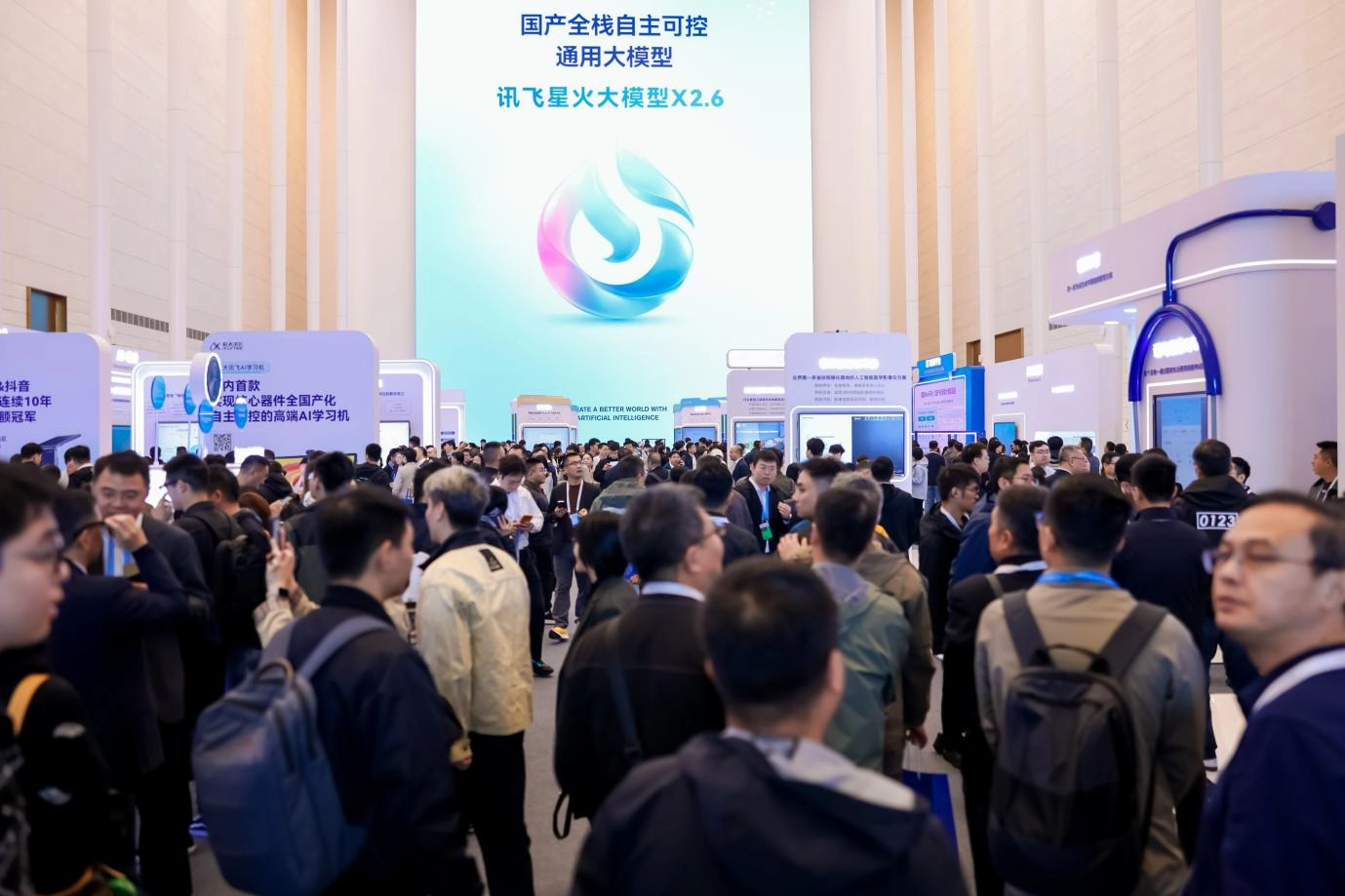
At the 1024 tech expo running alongside the forum, a 7×24 unattended AI supermarket drew crowds: the robot Xiaofei took orders and handed over goods while chatting with shoppers. A demo "AI traditional Chinese medicine clinic" produced a health report and lifestyle advice about 30 seconds after a tongue diagnosis. "This kind of device lets people experience the appeal of AI plus Chinese medicine," said a Beijing resident surnamed Tang.

Rooted in domestic compute
The centrepiece of the exhibition was the Feixing platform, which iFlytek built with Huawei on the Ascend ecosystem. It is China's first domestic compute base at the 10,000-accelerator-card scale and can support training of trillion-parameter models.
"A self-controlled computing base also offers the world a second option," Chairman Liu Qingfeng said.
Spark X2.6 uses a mixture-of-experts architecture and a one-million-token context window. Training ran end to end on domestic chips.
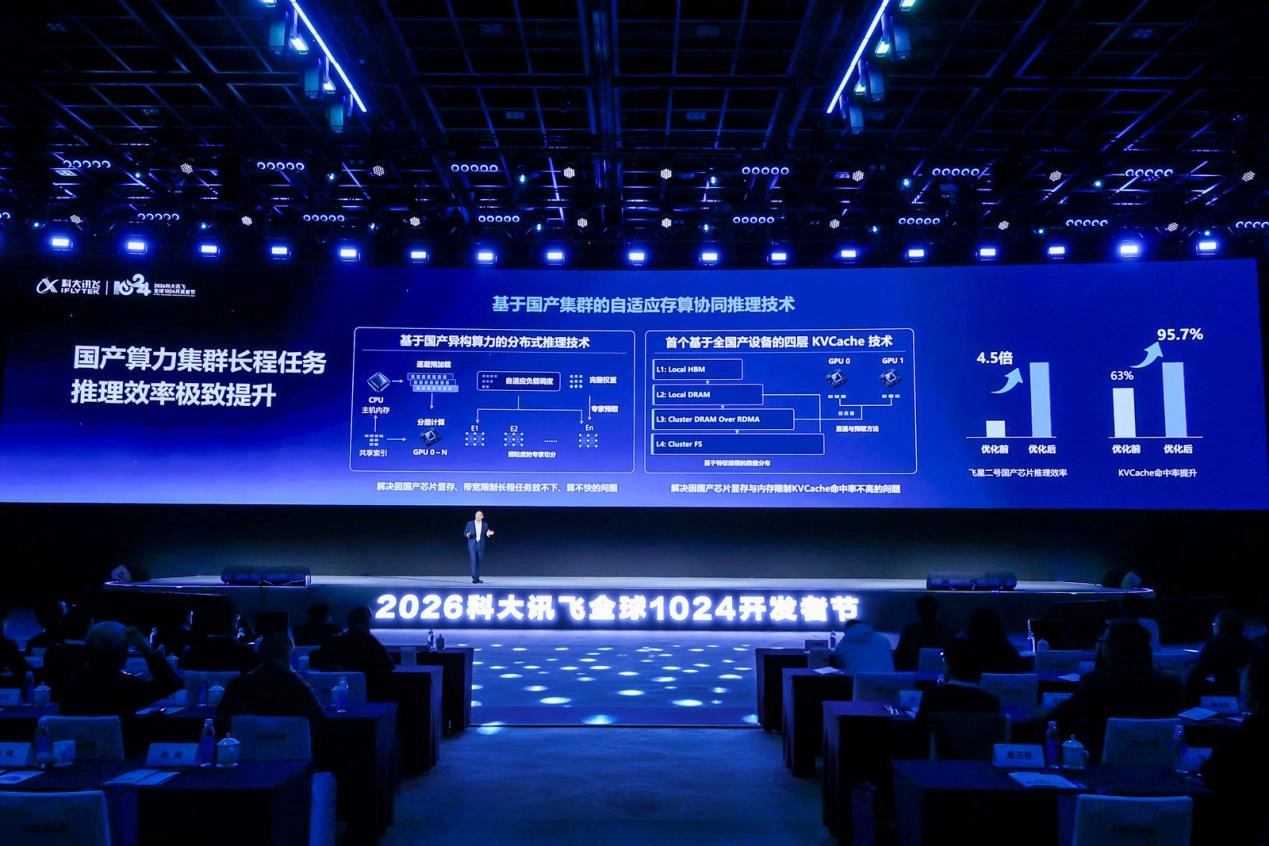
Getting there required hard engineering. Liu acknowledged that domestic chips are constrained by memory bandwidth, which once made very long context windows both slow to train and hard to fit in memory. Dynamic parallel training lifted the efficiency of long-context training fourfold.
"Training a fairly large model version used to take us a year when others needed three months. Now we are four times faster," he said. On the inference side, running on Feixing 2.0 chips, efficiency rose 4.5 times and the KV cache hit rate climbed from 63% to 95.7%.
"Only by actually training your own model on domestic compute are you truly self-reliant and controllable," Liu said. He argued China "will definitely achieve distinctive competitiveness and a distinctive voice" in AI globally.
Splitting work between cloud and device
Data security, token costs and organizational efficiency are the three anxieties holding back AI adoption, according to iFlytek. Its answer is to run the same model in the cloud and on devices: Spark X2.6 strengthens both, and supports pure on-device execution, device-cloud collaboration and pure cloud execution, so tasks can be allocated by difficulty, data sensitivity and model capability.
The on-device side has improved quickly. Spark X2.5-4B, open-sourced a month ago, has been downloaded 2.56 million times and ranks among the world's top four on-device models. Coverage of agent tasks that can be completed on a device rose from an industry level of 12.8% to more than 40%, and device-cloud routing accuracy from 81% to 96.1%.
iFlytek also showed Spark Audio 1.0, Spark Smart Cockpit 3.0 and the Robot Super Brain Platform 3.0. The robot platform is integrated in more than 500 robotics companies and over 100,000 devices. "Ninety percent of China's leading robot companies are our customers," the company said.
In the unmanned supermarket, embodied multimodal interaction models perception, cognition and action together. Combined with noise reduction in complex spaces, multi-target intent recognition and whole-body motion planning, it lets a robot talk and work at the same time.
From classrooms to hospital wards
In education, the Spark M50 smart grading machine can mark a class's homework in as little as five minutes. The series is used in more than 3,000 schools serving over 4.5 million teachers and students, and has saved teachers more than 14 million hours of grading, according to iFlytek. Its iFlytek Starlight tool combines lesson preparation, teaching research, parent communication and administrative assistance in one workspace, saving teachers four to seven hours of paperwork a week. More than 14,000 frontline teachers rated it 4.7 out of 5.
In healthcare, iFlytek Medical Imaging Cloud covers more than 260 million people and is the world's largest medical imaging AI service platform. A single CT scan can support diagnosis of multiple conditions, sparing patients repeat scans and repeat costs. The iFlytek Xiaoyi app has handled more than 220 million AI consultations and is the first and only medical AI system in China to pass the licensed physician examination.
"AI lets quality medical resources break through hospital walls," said Tan Hui, vice president of Qilu Hospital of Shandong University, at the festival's healthcare forum. The hospital is using human-AI collaboration to extend services from in-hospital treatment to pre-admission prevention and full-course management after discharge.
Zhang Hui, nursing director at Jining No.1 People's Hospital, said AI screening plus case management covered all three of its campuses within a year, serving more than 10,000 patients, raising the standard follow-up rate by over 30% and pushing patient satisfaction close to 99%.
Guo Xuemei, outpatient director at the First Affiliated Hospital of USTC, summed up the change in three words: "precise, efficient, high quality."
Cars, homes and developers
Spark Smart Cockpit 3.0 is intended to reset how drivers interact with vehicles. As a Master Agent multimodal hub, it can parse several requests at once, weigh time, budget and parking constraints, reorder tasks, recommend destinations and, once the user confirms, call tools such as navigation. Outside the car it supports long-range voice wake-up and voiceprint recognition, so a user carrying bags or hunting for a car in a parking lot can summon and control the vehicle from tens of metres away.
The cockpit goes into mass production on launch, driven by the SparkAuto model running across cloud and device. The first partner brands are Chery, Great Wall Wey and Dongfeng Nissan. It supports 32 overseas languages across 60 countries and regions; eight of China's top 10 car exporters work with iFlytek.
At home, an AI companion lamp protects children's eyesight, helps plan study and focus time, answers questions about unfamiliar characters and poems, and supports audio and video calls. An AI care camera recognises family members and remembers details from daily conversation, joining in childcare and eldercare.
The products are only half the story. More than 52,000 teams from 351 cities in 15 countries entered this year's developer competition. The iFlytek open platform offers 1,023 AI capabilities to more than 11.85 million developers, with services covering 220 countries and regions.
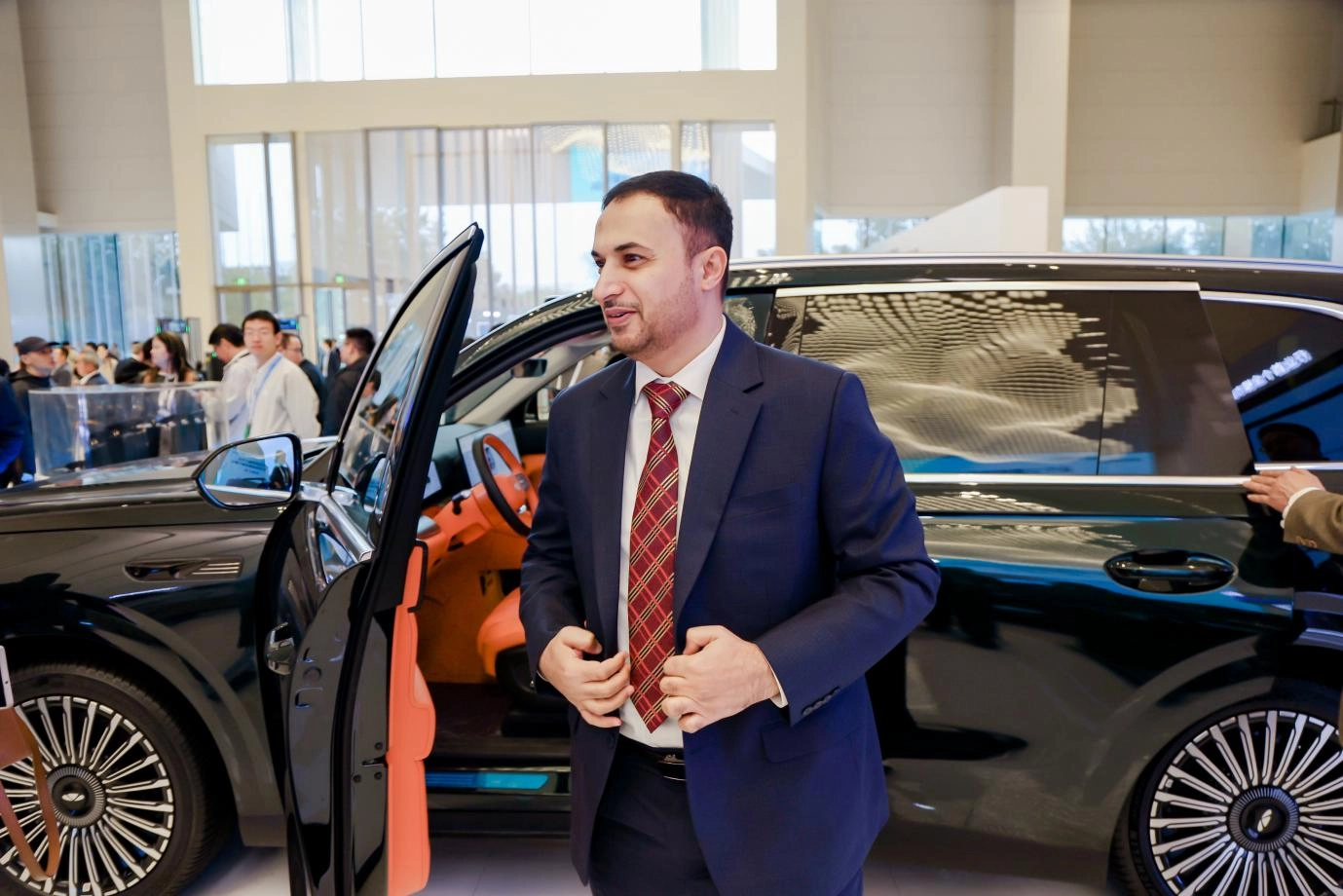
Buyers like Qusai are part of that reach. The visitor from Oman tried on iFlytek's 40-gram AI glasses and said he was amazed. "This is the first time I have seen this type of glasses. It can translate all languages and you hear the translation directly," he said. "I would be very happy to bring this solution to Oman, because it is truly unique."
"Every generation has its own Long March," Liu said in his main forum speech. "AI is a great process in human history, but it is also a long run that requires unity — like the Long March, it needs a mission and it needs belief."
For Liu, the industrial mission of "using AI to build a better world" matters more than any single technology breakthrough. "I believe that with this conviction, our sparks will start a prairie fire."