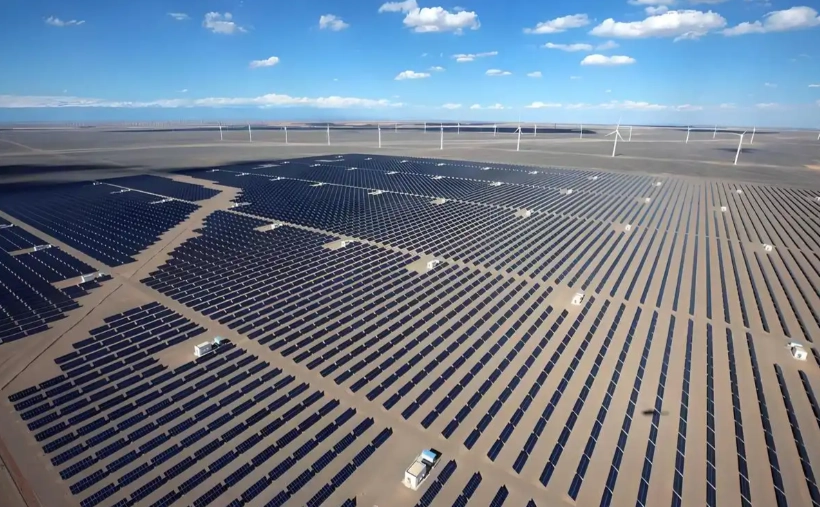
Sheep Mowing and the Westward Tilt: The Manufacturing Flood and O&M Calculus Behind the Taratan Photovoltaic Ocean
Photovoltaic sheep grazing is actually about cutting O&M costs, as eastern manufacturing capacity tilts west, driving PV expansion and a shift toward refined asset management.
Juxtaposing the rolling blue expanse of solar panels with the flocks of sheep wandering among them presents a picture of harmonious coexistence between humanity and nature in a pastoral-solar complementary landscape. This visually striking narrative makes it easy to overlook the cold, hard cost calculus of industrial operations playing out in the northwestern deserts. Putting sheep to graze inside solar farms on the surface looks like a fortunate alignment of green ecology and local welfare, but peel back that warm and fuzzy veneer, and the underlying logic reveals itself as an extremely rigorous, even somewhat resigned, battle to defend operations and maintenance costs.
In the sprawling hundred-megawatt-scale solar farms, weeds are hardly a quaint pastoral scene—they are a hidden bomb threatening the safety of assets worth billions of yuan. The tall grass that grows wildly after summer rains not only shades the panels and creates hot-spot effects that reduce power generation efficiency, but once dried out, it can easily spark fires amid high temperatures and storms, instantly destroying expensive inverters and combiner boxes. If operators relied on manual labor to cut grass out in the desert, the exorbitant labor costs and brutal working conditions would immediately eat away at the already razor-thin per-kilowatt-hour profits of the plant.
The so-called "solar sheep" are essentially the cheapest, self-sustaining, zero-capital-expenditure "biological weed cutters" that plant operators have found.
This spectacle of using biological means to solve industrial operations pain points reflects the immense overcapacity pressure weighing down China's solar manufacturing sector. In recent years, domestic solar module prices have been sliding steadily amid fierce technological iteration and waves of expansion, with polysilicon and module makers facing unprecedented pressure to absorb output. To keep the massive automated production lines in the east running, the solar panels pouring into the western deserts have expanded at a geometric rate.
Following the corporate landscape disclosed by Tianyancha to trace the geographic leap of this capacity, the trajectory of capital and manufacturing flows is especially clear. Tianyancha data shows that the number of surviving solar-related enterprises in China has surpassed 1.327 million, with registration volumes continuing to grow over the past five years and hitting a peak in 2025. In Tianyancha's regional breakdown, Guangdong, Jiangsu, and Shandong together account for nearly 30% of the national total.
This extremely fragmented geographic distribution directly reveals the fractured interests of the sector: the three eastern provinces concentrate the nation's densest capital, module manufacturing plants, and project development shell companies, which control the profits and pricing at the upper end of the supply chain. Meanwhile, the vast northwestern deserts serve as the physical foundation that absorbs these massive volumes of modules, digests the grid-absorption pressure, and withstands the erosion of wind and sand. The rapid discharge of eastern manufacturing capacity into the western deserts forces western plants to squeeze every last cent of expenditure to the limit while caught between ultra-low electricity prices and high operations and maintenance costs.
However, using sheep to mitigate the weed hazard is ultimately just a marginal optimization at the tail end of solar plant operations and maintenance. The real threshold that determines the survival of those 1.32 million related enterprises still lies in the transmission capacity of ultra-high-voltage power lines and the absorption capacity of local green computing power. When the west-to-east power transmission corridors hit physical bottlenecks, simply stacking more solar panels and grazing sheep in the desert cannot resolve the revenue shrinkage caused by curtailment rates and fluctuations in the spot electricity market.
The grand narrative of solar-powered desert control and pastoral-solar complementarity cannot mask the stark reality of the solar sector shifting from extensive scale expansion to refined stock operations. With excess profits at the manufacturing end stripped away entirely, the players that will survive long-term in the western deserts are not the middlemen who merely flip project route permits or buy and sell modules, but rather the heavy-asset integrators who can genuinely connect new energy development, local green computing power absorption, and extreme operations and maintenance control.