Xinyan Group's Ren Yongliang at WAIC: The Key to Home Robots Is Emotion, Not Capability
Xinyan Group CEO Ren Yongliang said in his WAIC speech that the core of home robots is emotion, not capability, and introduced his product philosophy and system architecture.
"What determines whether something has a 'heart' isn't how capable it is—it's whether it has emotions." On July 17, at a themed forum during the 2026 World Artificial Intelligence Conference (WAIC), Ren Yongliang, founder and CEO of Xinyan Group, opened his keynote speech with a question.
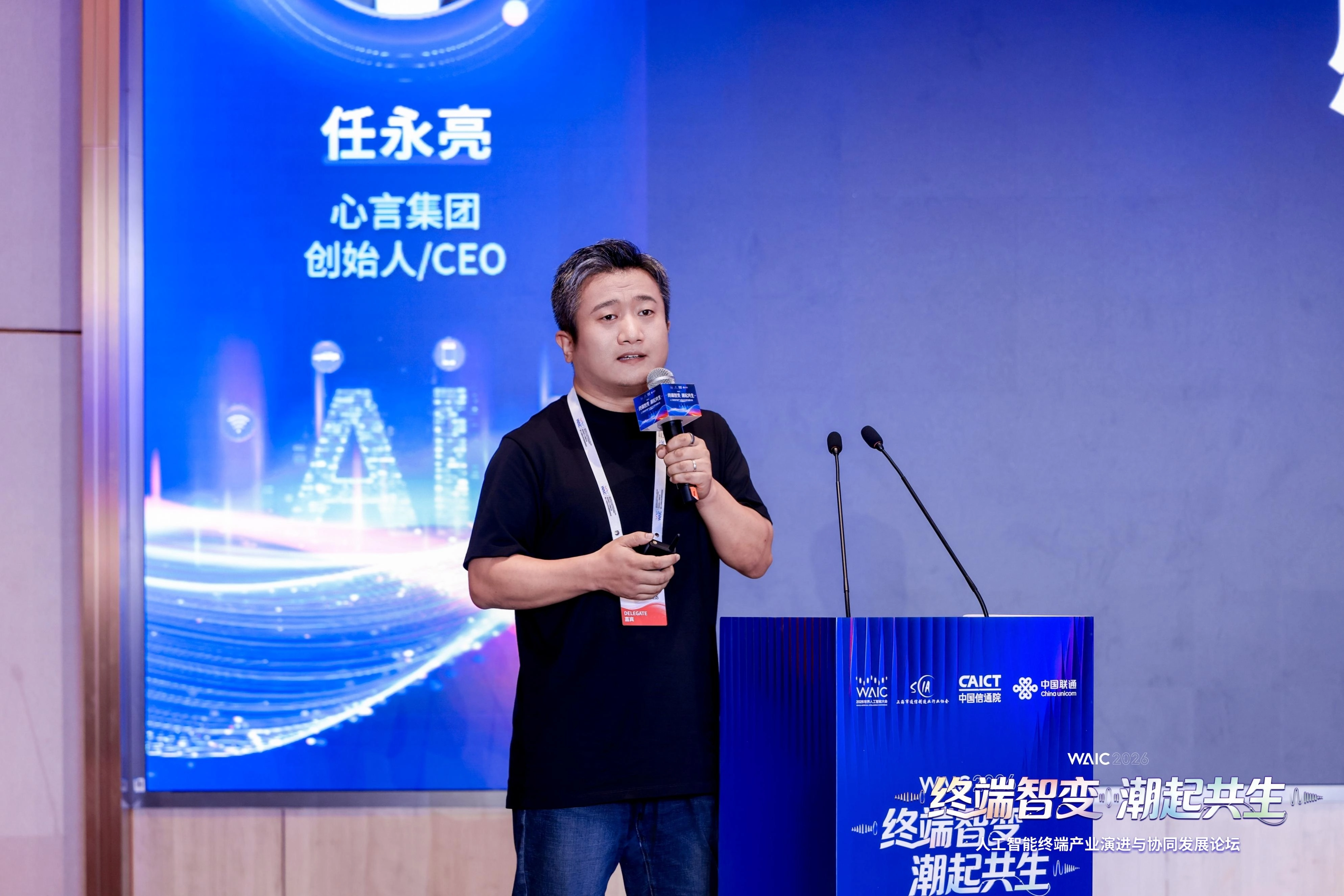
In a keynote focused on AI companion robots, Ren Yongliang did not showcase product specs or announce new features. Instead, over nearly 30 minutes, he systematically laid out a viewpoint that runs counter to mainstream industry narratives: while the entire industry competes on "seeing more clearly and hearing more accurately," the real competition belongs at the other end—"understanding more deeply."
The "Two-Layer World Model" Framework
Ren Yongliang began by unpacking a pair of concepts the industry has long conflated: "seeing" and "perceiving."
"When a camera captures a cup falling, that's seeing—it knows where the cup is and how fast it's dropping. A sensor costing a few dozen yuan can do that. Perceiving, on the other hand, is that 'oh no'—it's 'this thing is falling, what does it mean to me?' It's 'should I reach out to catch it?'" Ren said. Seeing answers "what happened," while perceiving answers "what does this mean to me," and between the two "lies an entire framework for understanding the world."
He distilled this into a single sentence: "Perception is not the starting point—it's the destination." A robot does not begin perceiving the moment it powers on. It must place everything it sees, hears, and remembers into a single architecture, reasoning layer by layer, before it can possibly arrive at being "moved by what's in front of it." And at that destination, perception and emotion are the same thing. "To truly understand the moment before you is already to be moved by it. That 'oh no' is both the peak of perception and emotion itself."
One of the most memorable statements in the keynote was Ren Yongliang's definition of emotion using a mathematical concept: "Emotion is the higher-order derivative of the world model."
He explained that "where the cup is" is the most surface-level information, "the cup is falling" goes one layer deeper, and "that oh no" is what emerges only after understanding reaches its deepest point. "Most robots today stop at the layer of 'seeing the cup fall.' They can't go any further up. Emotion is difficult precisely because it's the last and highest thing to grow out of the system."
Based on this reasoning, Ren Yongliang proposed the "Two-Layer World Model" framework.
The first layer is the physical world model, the industry's current main battlefield, handling space, objects, positions, routes, actions, and tasks. "Without this layer, robots can't even enter real physical space." But Ren argued that in home environments, "what truly determines whether someone will keep using a robot long-term is often not whether it can walk up to you, but why it walks up to you."
Answering "why" requires the second layer—the psychological world model. Ren emphasized that these two layers are not independent systems, but the upper and lower levels of the same world model—the bottom answers "where is the person," and the top answers "what is this person feeling right now."
"While others are competing at the entrance over who sees more clearly, we want to compete at the exit over who understands more deeply," Ren said.
Xinyan Robot's "Logic of Subtraction"
On the product front, Ren Yongliang introduced the design philosophy behind Bubbo, Xinyan Group's first proactive home companion robot. Rather than listing features, he repeatedly emphasized a seemingly paradoxical point: The deciding factor for home companion robots isn't what they can do—it's whether they know when not to act.
"It moves closer because companionship is needed in that moment. It steps back because it shouldn't intrude at that moment. It looks at you because it understands you're engaging with it. It stays quietly in the corner because what this home needs right now is quiet." Ren said that "when to move and when not to" tests not execution, but judgment. "'There's a person on the sofa' and 'this person on the sofa—do they want company, or do they want to be left alone in peace' are two completely different things. That's exactly why restraint is so hard."
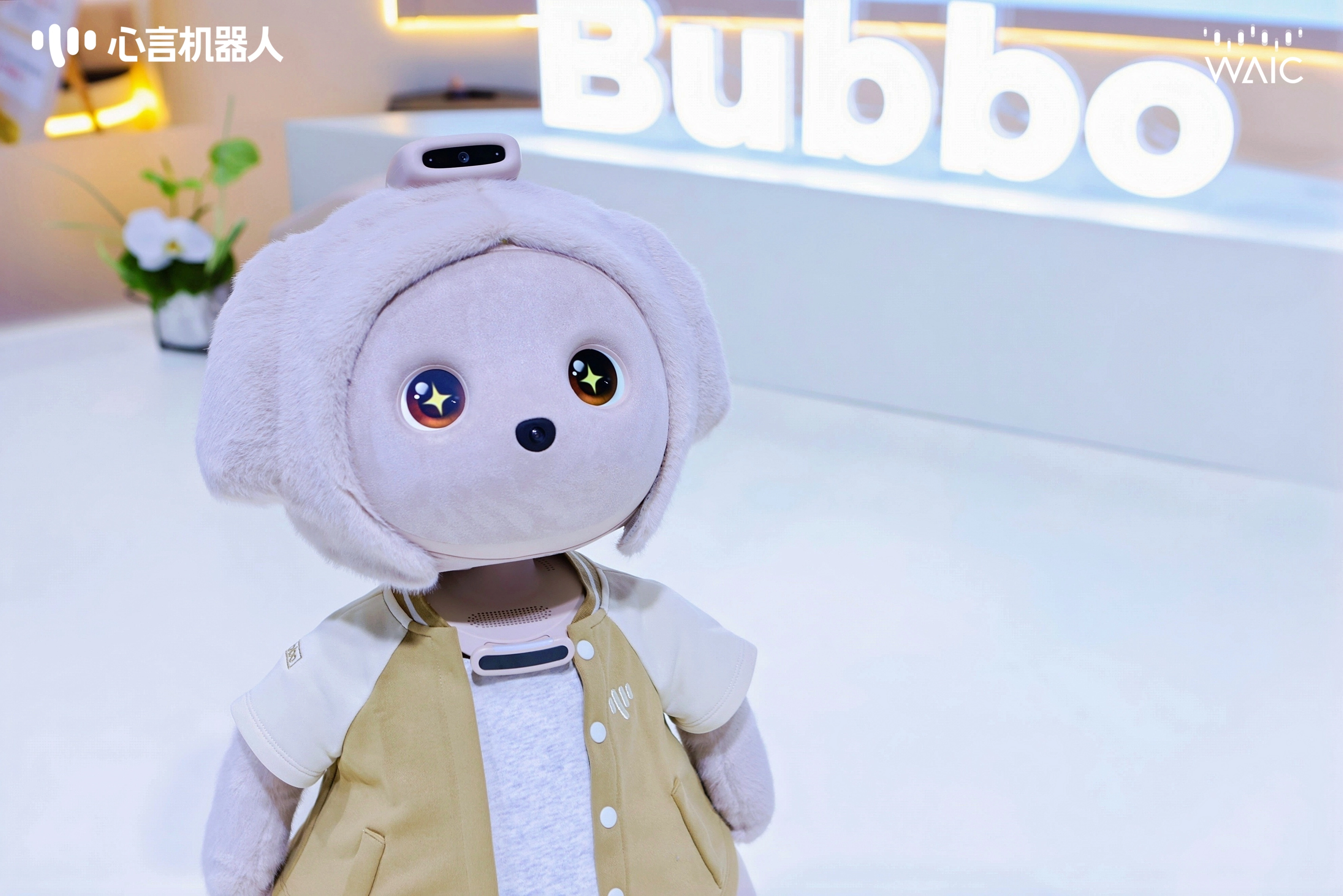
Ren Yongliang summarized Bubbo's value in four areas: real presence (having a body, a position, and movements), long-term companionship (gradually learning who you are and when to appear), proactive engagement (accompanying children, caring for seniors, capturing family moments), and building relationships (bringing AI out of the screen and into the bonds between family members).
Addressing the question "What qualifies an internet company to build a world model?" Ren responded on the spot: "That question should be asked the other way around. Most people building world models today come from robotics or computer vision—it's their home turf, so they naturally stop at the 'physical' layer. Xinyan Group, on the other hand, came from the 'human' side."
Ren disclosed a set of figures on stage: over the past decade-plus, Xinyan Group has served more than 60 million users through products like Cecce, accumulating trillions of tokens of emotional dialogue data—not instruction data, not one-off Q&A data, but large volumes of real-world scenarios centered on emotions, relationships, and companionship. The company's self-developed "Xinyuan" large model is the only vertical model in the emotional companionship space to receive official filing from the Cyberspace Administration of China, and its AI agent "Companion Xiaoxing" attracted nearly one million users within its first month of launch.
"So the foundation of the physical layer was always meant to be built by robotics companies, and the 'understanding people' side was always meant to be built by companies that understand people," Ren said. "We're not latecomer followers. We set out from the right end and made our way all the way to the hardest part of this endeavor."
Bubbo OS: Three Things—Remember, React, Evolve
On the technical implementation side, Ren Yongliang introduced Bubbo OS, the underlying operating system of Bubbo. He distilled the system's capabilities into three keywords.
It remembers. Using vision, hearing, and spatial perception, Bubbo records family members, pets, and objects within a single memory architecture, maintaining identity recognition across time and modalities. "The foundation of companionship is never about being able to answer—it's about remembering who you are."
It reacts quickly. On-device processing handles real-time interactions, while cloud processing handles deep reasoning. The core judgment lies in "when to use a large model and when not to. Anyone can integrate a large model, but not everyone knows when to speak and when to stay silent in a real home."
It understands you better with use. Every real interaction becomes accumulated understanding of the family. "The true long-term moat for a home companion robot doesn't rely on any single parameter being ahead—it's built day by day through real companionship, real relationships, and real feedback."
The Real Opportunity in AI + Hardware
Near the end of his keynote, Ren Yongliang offered an overarching assessment of "AI + hardware": a truly successful company needs to assemble three things at once—the model determines how intelligent it is, real-world scenarios determine whether it can secure a foothold, and engineering and delivery determine whether it can go the distance. "If the model isn't strong enough, the product can't move beyond 'it answers when you ask.' Without entering real scenarios, you can't get real feedback. No matter how advanced the technology, if it can't be delivered to consumers reliably, safely, and at scale, it isn't a product. All three are indispensable."
He further argued that the real opportunity in "AI + hardware" is not about cramming AI into existing devices, but "redefining what a device should be and what its relationship with people should be." Devices of the past were tools, waiting for people to turn them on and operate them. Future products in this space will increasingly become companions that can sense their environment, understand people, and proactively take part in daily life. They will no longer be just an assistant inside a screen, but the one who is truly there with you in real life.
In closing, Ren brought the discussion back to the question he opened with. "What makes something have a 'heart' isn't how smart it is—it's whether it can be truly moved by the world in front of it. And being 'moved' is something that only emerges after understanding has traveled all the way to the deepest level. When AI makes it all the way to that destination, it will finally have a real chance to understand the person beside it. We don't want to build a smarter robot. We want to build a robot that understands people better—one that cares not about where you are, but about how you're doing right now."
It was noted that Bubbo, developed over two years, is Xinyan Group's first proactive home companion robot. Standing approximately 65 cm tall, it targets three core user groups: families with children, seniors living alone, and women living alone. At this year's WAIC, Bubbo opened its first public interactive experience to attendees.