Antelope LLM version 3.5 focuses on compute-power coordination, with mixed public-private capital aiming to crack the challenge of deploying industrial AI, though it still must prove cost reductions in real factory floors.
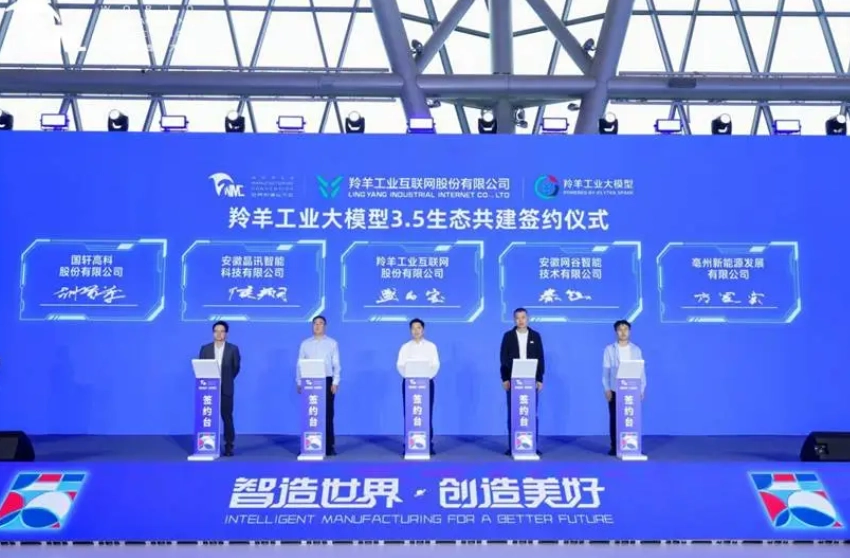
When the spotlight of the World Manufacturing Convention fell on the launch event for Antelope Industrial Large Model Version 3.5, the concentrated rollout of a series of specific application scenarios—including computing-power-electricity coordination, power trading, and zero-carbon parks—announced that general artificial intelligence's land grab in the physical manufacturing sector has entered an extremely pragmatic deep-water zone. Stripping away the technical outer garment of the large model upgrade, this is by no means a routine algorithm show, but rather a forceful offensive launched by industrial AI—after going through early-stage general dialogue and conceptual hype—against the most painful point in factory cost control: energy and electricity settlement.
Without real reductions in book costs as support, any industrial large model can only remain on a display screen for people to visit.
A Capital Foundation of Mixed Government-Enterprise Composition
Tracing the corporate lineage of this large model company through its underlying commercial equity structure, its capital foundation of mixed government-enterprise composition is fully exposed in the Tianyancha records. Tianyancha business registration data shows that Antelope Industrial Internet Co., Ltd. was established in 2022, and its equity structure displays a strong characteristic of resource complementarity: Digital Anhui Co., Ltd., representing the local state-owned data hub, ranks as the largest shareholder with a 35% stake, while iFlytek Co., Ltd., the provider of core artificial intelligence technology, holds 30%.
This top-level design combining local state-owned capital with a leading algorithm giant sharply clarifies the real threshold for industrial internet implementation.
An industrial large model is never general-purpose code that can be forged by piling up computing power alone; its core fuel is the extremely closed mechanism data, energy consumption data, and process parameters deep within factory assembly lines. iFlytek may indeed possess deep underlying algorithms and engineering implementation capabilities, but when facing traditional manufacturing enterprises with their own agendas and mutually disconnected data, it is extremely difficult to pry open the closed factory gates of heavy industry with the identity of a private technology company alone.
As a provincial-level data and state-owned asset coordination platform, Digital Anhui's status as major shareholder directly gives Antelope a natural endorsement of trust and convenience for business coordination when accessing historical data from local power grids and coordinating carbon inventory projects for regional high-energy-consuming enterprises.
Computing-Power-Electricity Coordination: Striking Directly at the Lifeline of Cost Reduction
The computing-power-electricity coordination and power trading intelligent agent highlighted in Version 3.5 precisely hits the most urgent lifeline of cost reduction in manufacturing today. Against the macro backdrop of continuously deepening power system reform and the full rollout of the spot power trading market, electricity bill settlement for high-energy-consuming enterprises is no longer a rigid monthly bill, but a dynamic transaction that requires real-time gaming based on grid peak-valley electricity prices, extreme climate changes, and even carbon emission quotas.
Using large models to accurately predict massive production loads and power market fluctuations, and automatically generating optimal scheduling, electricity use, and power purchasing strategies for factories—this is one of the few rigid-demand scenarios that can let manufacturing enterprises directly see financial returns and be willing to pay real money. The role of the large model here has in fact evolved from a production assistance tool into the factory's energy trading operator.
Implementation Challenges and the Real Test
However, there is still a long and muddy road between the technical blueprint at the launch event and the real factory electricity meter. Despite relying on dual government and enterprise resources, the large model must still confront the harsh reality of old equipment and fragmented data collection protocols in traditional manufacturing enterprises when moving downstream. No matter how perfect the large model's forecasting strategy is, if it cannot shake hands and connect in real time with the factory's outdated underlying sensors and control systems, the so-called zero-carbon parks and computing-power-electricity coordination can only become financial simulations detached from production reality.
What truly determines the success or failure of Antelope Large Model Version 3.5 is not the glossy test parameters at the launch event, but how much real money it can help those benchmark enterprises save after subsequently moving downstream into real workshops with high dust and high noise.