Physical AI Reaches Its 'Eureka Moment': Dashaw Releases Kairos World Model and Three Industry Solutions
Dashaw Robotics unveils Kairos World Model 3.1 and three solutions, propelling physical AI from understanding to execution while reducing trial-and-error costs.
On July 19, the World Model "Six Dragons" Summit Forum, a key agenda of the 2026 World Artificial Intelligence Conference hosted by the conference organizers and undertaken by Daxiao Robotics, opened in Shanghai. Centered on the core proposition of driving physical AI from "understanding" to "execution," the forum brought together Nobel laureates, world-renowned scholars, heads of leading technology companies, and technical leaders in embodied intelligence to confront the core challenges of intelligent deployment in the physical world and explore pathways for the industrial adoption of general world models.
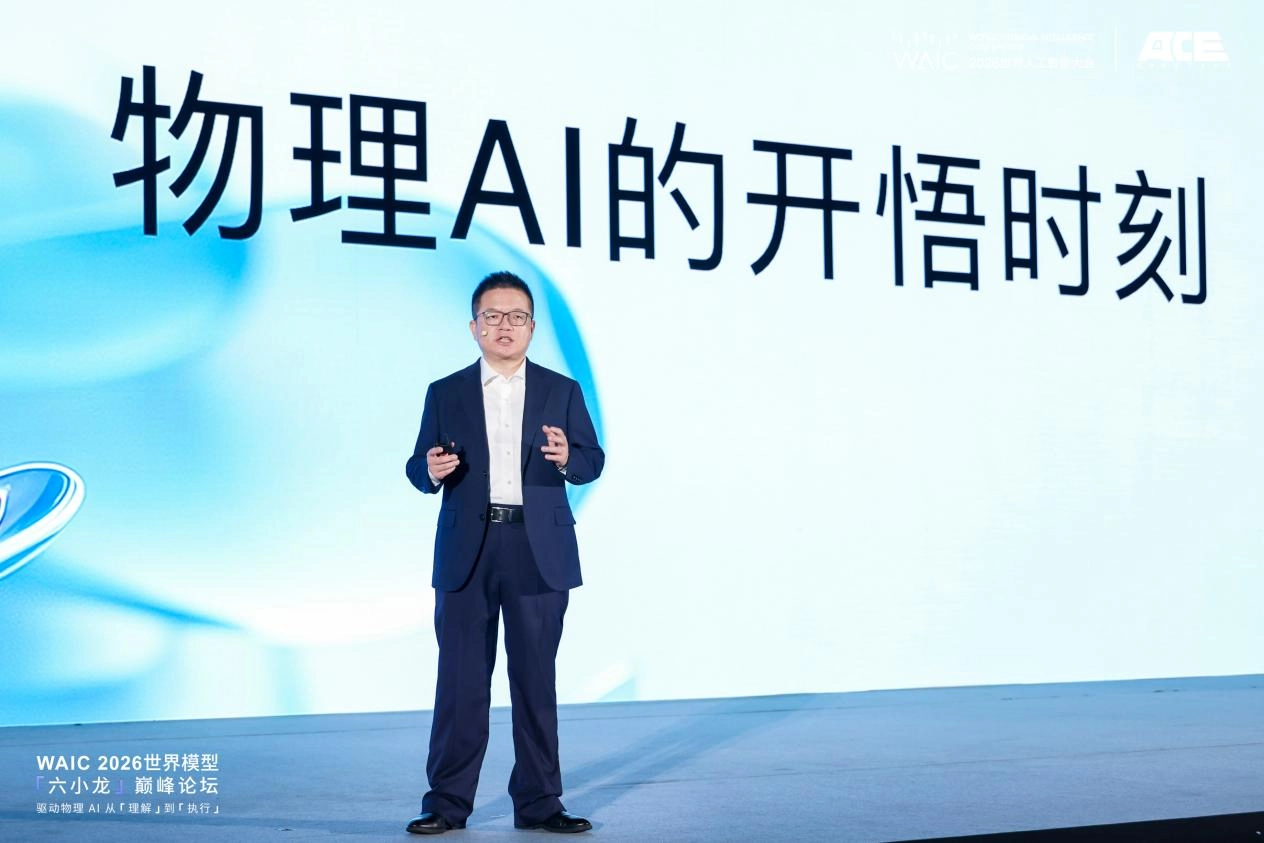
At the forum, Daxiao Robotics unveiled three major outcomes: the Kairos World Model 3.1 (Kairos 3.1), the Environment-Centric Data Collection Solution 2.0, and complete solution suites covering three vertical scenarios, providing a full technology foundation for physical AI deployment.
Wang Xiaogang, Chairman of Daxiao Robotics, directly addressed the pain points of the embodied intelligence industry: "Errors in digital world models only affect image and text generation, but in physical scenarios, predictive deviations by intelligent agents can lead to irreversible real-world losses. This is why we propose the first-principles approach to embodied world models. By leveraging multimodal high-density information extraction and control-sufficient state anchoring, we minimize robot trial-and-error costs in complex, uncertain environments and accelerate the arrival of the 'awakening' moment for physical AI."

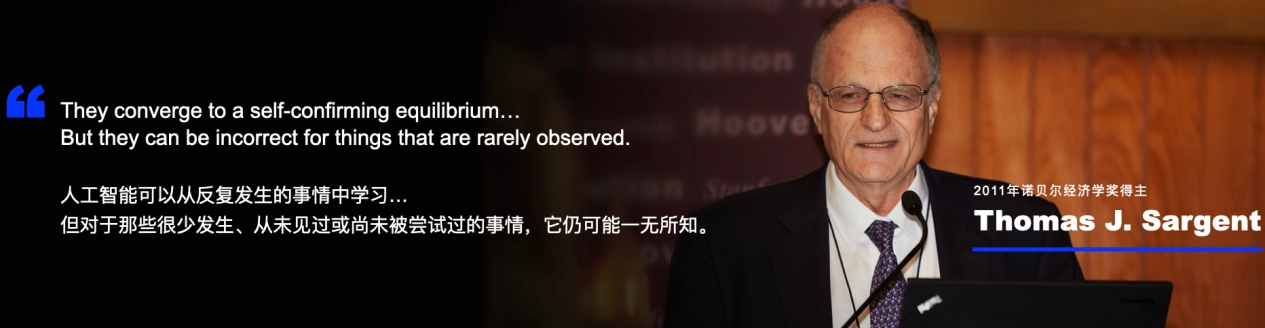
In addition, Nobel Laureate in Economics Thomas J. Sargent shared insights, drawing on decades of research in AI and world models to critically analyze the cognitive limitations of current intelligent systems in rare and unknown scenarios.
Meanwhile, the Physical IQ benchmark platform—a unified evaluation standard for embodied physical intelligence—was officially launched. Jointly initiated by the Shanghai Artificial Intelligence Industry Association, Hetao College, and the East China Branch of the China Academy of Information and Communications Technology (CAICT), and co-built by over 20 universities and industry organizations, the platform fills the gap in standardized evaluation systems for the industry.
Technical leaders from HuiXi Intelligence, Ant Lingbo, Auto0 Robot, Zhiyuan Robotics, Wujie Power, and Jijia Vision took the stage in turn, engaging in in-depth dialogue across computing infrastructure, data systems, simulation platforms, and complete robot platforms to jointly build an open and collaborative ecosystem for the physical world model industry.
Kairos World Model 3.1, the world's first on-device, body-driven world model, leads a new paradigm for embodied world model development.
Daxiao Robotics released Kairos 3.1, an action-integrated world model that merges generative intelligence, physical intelligence, and cognitive intelligence. With a natively unified architecture, Kairos 3.1 breaks down the technical barriers between understanding, generation, and prediction, building a full-loop self-evolving intelligence closed loop of "understanding—reasoning—execution—reflection." This marks the transition of embodied world models from single-capability breakthroughs to a complete closed loop for industrial deployment.
Currently, global embodied world models are evolving along four major schools: representational, generative, interactive, and integrated understanding-generation-prediction approaches. The first three schools generally suffer from fragmented capabilities and fail to meet the integrated demands of industrial deployment for world understanding, state reasoning, and action prediction.
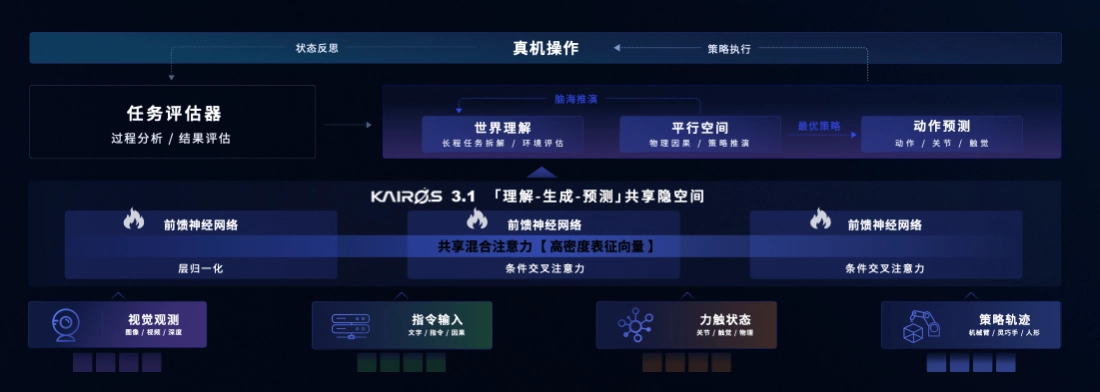
Kairos 3.1 relies on a hybrid Transformer architecture and a shared mixed attention mechanism, compressing multidimensional embodied data—visual observations, language instructions, force-touch states, and policy trajectories—into a unified latent space to form high-density representation vectors, achieving native integration of the three capabilities at the foundational level.
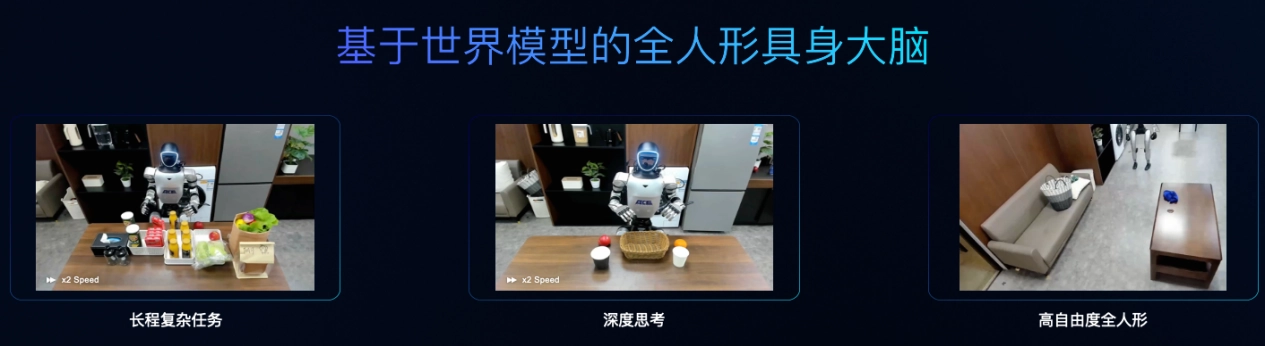
Among these, generative intelligence builds internal representations of the physical world, physical intelligence grasps physical causality and reasons across parallel worlds, and cognitive intelligence supports complex logical reasoning and long-horizon task decomposition. The deep unification of the three enables robots to shift from generating realistic virtual futures to predicting the real impact of actions on the world, truly understanding action consequences, and achieving reliable, controllable closed-loop control.
Based on the unified architecture, the model forms a complete self-evolving closed loop: it first performs long-horizon task decomposition and environment assessment through world understanding, then conducts physical causal reasoning and multi-strategy simulations in parallel space, selects and outputs optimal action predictions, and simultaneously analyzes processes and evaluates results while feeding state back into the model—driving continuous intelligence advancement across the full pipeline.
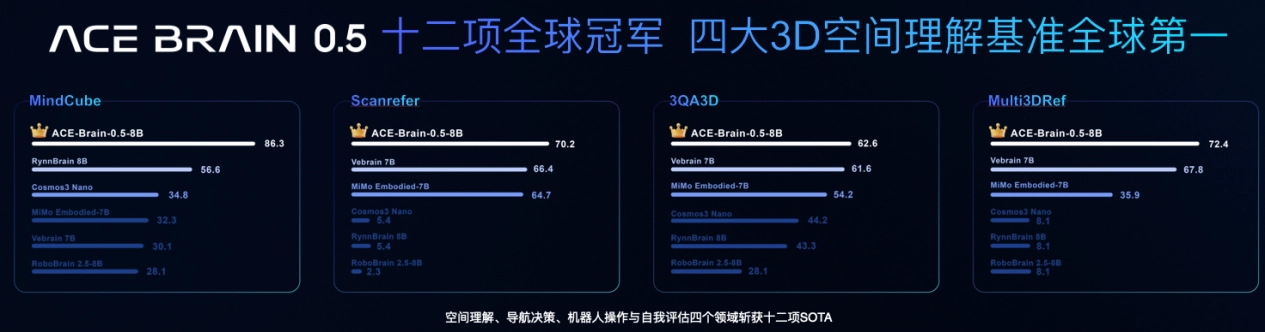
As the core foundation for spatial understanding, ACE-BRAIN-0.5 solidifies the spatial groundwork for the Kairos world model, achieving twelve global SOTA results, with capabilities across spatial understanding, navigation decision-making, operation execution, and progress evaluation ranking in the global first tier.
In real household scenarios such as laundry, the robot can accurately identify spatial relationships between components, decompose over ten operational steps using spatiotemporal memory and chain-of-thought reasoning, and autonomously plan the full pipeline from taking clothes, loading them, starting the machine, to tidying up. It also possesses task-state traceability, verifying the outcome of each step in real time, and can precisely locate failure nodes and restart corresponding steps when anomalies occur, enabling fully autonomous closed-loop operations.
On the physical generation and reasoning front, Kairos-HomeWorld achieves, for the first time, full-home generation and full object interaction, featuring 300,000 Chinese residential floor plans, 5,000 full-home simulation scenes, and 8,700 3D assets covering six physical properties, faithfully reproducing the living characteristics of Chinese households. The model can simultaneously simulate multiple action trajectories in parallel space—for example, when executing an open-refrigerator command, it filters through failure scenarios, high-cost actions, and optimal strategies to output the path with the highest success rate and lowest execution cost to the physical robot.

In terms of performance, on the NVIDIA Jetson Thor platform at BF16 precision, the Kairos 3.1 8B model delivers an inference latency of only 125 milliseconds, enabled by the self-developed KairosRT high-performance computing engine, achieving real-time on-device inference while maintaining the high intelligence ceiling of the world model. With autonomous reflective evolution capabilities, the robot can proactively adjust action strategies upon execution failure—for instance, iterating from a three-finger grip to a four-finger grip during the refrigerator-opening task to ultimately complete it.
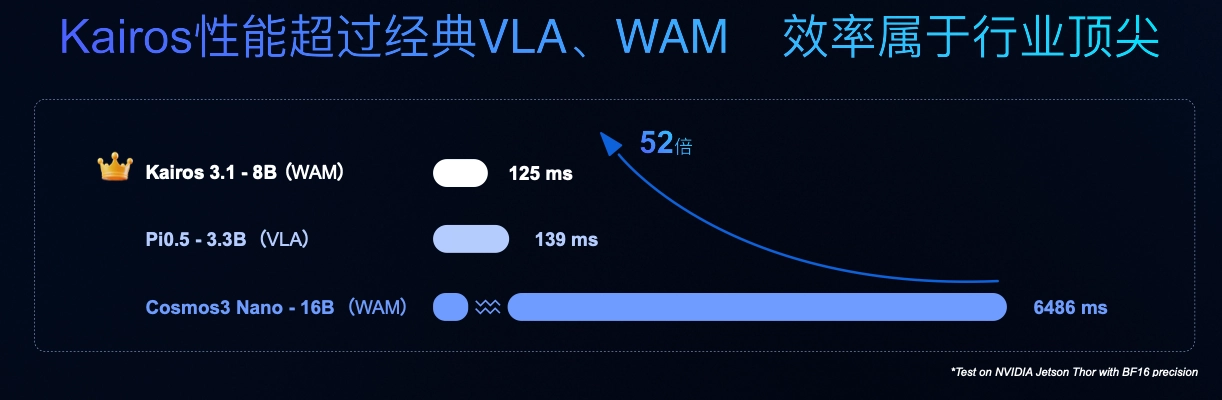
Kairos 3.1 has refreshed SOTA results on leading generation and prediction benchmarks and has built a complete technical stack spanning real-world data, unified models, on-device inference, body control, and autonomous reflection—propelling robots to truly understand the world, reason about the future, act autonomously, and grow continuously, establishing the core technological foundation for large-scale embodied intelligence deployment.
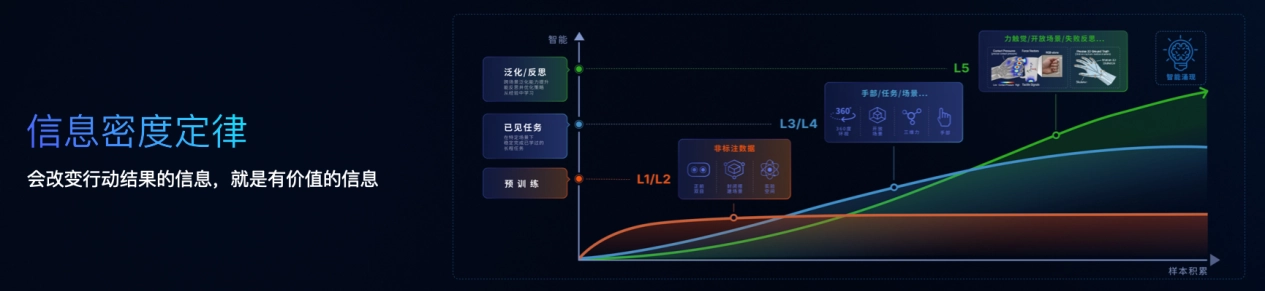
Introducing the first information density law for embodied models: Environment-Centric Data Collection Solution 2.0 defines the underlying data logic for embodied intelligence.
Just as Newton's laws depended on precise astronomical observations, the "awakening" of world models relies on deep capture of physical causality. Daxiao is the first to propose the "information density law": the value of data lies not in volume but in information density—information that changes action outcomes is valuable information.
Under this law, L1–L2 level data only supports basic pretraining, and L3–L4 level data is limited to fitting known tasks; only when data reaches L5, deeply integrating 3D force-touch feedback, failure recovery trajectories, and open-scenario variables, does a world model truly transcend "description" and gain the ability to generalize, reflect, and self-evolve.
Building on this, Daxiao unveiled the human-centric Environment-Centric Data Collection Solution 2.0. With a new paradigm of full-dimension perception (complete capture), deep deconstruction (fine annotation), and unified mapping (effective use), it lays the data foundation for the Kairos world model's reflection and evolution, continuously supplying high-quality digital "nourishment" for robots' cognitive advancement, enabling intelligence to emerge through alignment with the physical world.
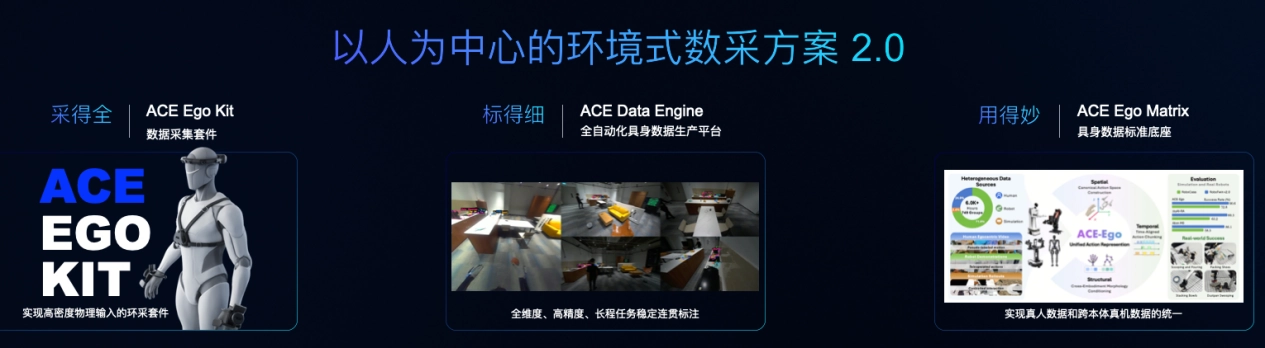
Specifically, on the data collection side, the ACE Ego Kit ensures "complete capture" of high-fidelity, full-dimension data through a modular, lightweight wireless "head-hand-chest" three-in-one suite. The ACE Sense Glove, the industry's first collection glove integrating 3D force-touch and motion capture information, offers 0.01N force-touch sensitivity and joint angle errors below 2°, while synchronizing more than 20 heterogeneous sensors with errors strictly controlled within 1 millisecond, precisely recording real interaction data embedded with physical causality.
In the annotation phase, the fully automated production platform ACE Data Engine delivers "fine annotation." For long-horizon tasks, its built-in ACE-ViDiHand—the world's first generative 4D hand motion capture paradigm—has achieved three world-firsts, overcoming occlusion and fast-motion challenges with a 0.997 frame-level accuracy that improves motion smoothness by 4.8 times.
Finally, to ensure data is "used effectively," ACE Ego Matrix serves as the open-source standard foundation for embodied data, achieving the "four unifications" of spatial coordinates, body structure, action timing, and data quality, breaking hardware barriers to align heterogeneous robots from different collectors and control frequencies so they "speak the same language." With championship results on both the RoboCase and RoboTwin leaderboards, ACE Ego Matrix demonstrates model robustness surpassing industry standards.
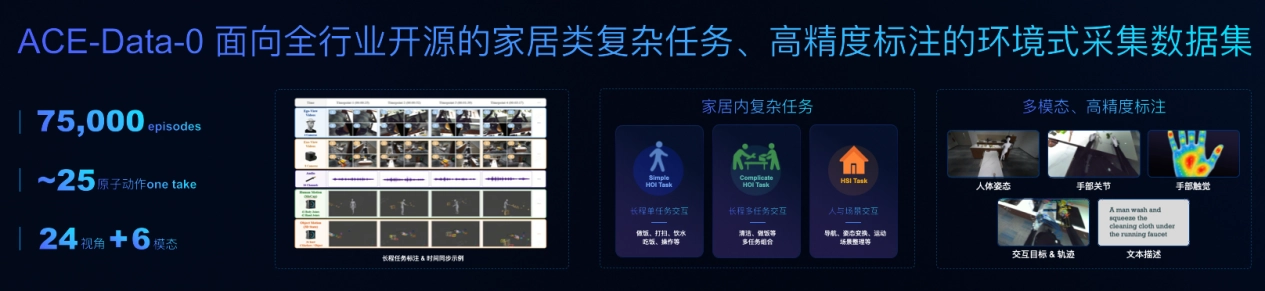
Beyond upgrading the toolchain, Daxiao has also officially open-sourced the L5-level household complex task dataset ACE-Data-0 to the entire industry. Through real physical interactions and high-precision annotation, Daxiao Robotics is providing high-quality "fuel" for global embodied model training, accelerating the pace of industrial deployment.
Anchored on three vertical scenarios, reshaping productivity in physical industries with physical AI.
Leveraging the human-centric environment-based data collection foundation, combined with the powerful generalization capabilities of the Kairos World Model, Daxiao Robotics has developed three standardized industry solutions that are rapidly replicable and deeply tailored to real commercial workflows—"Xiaoman" for instant retail scenarios, "Xiaoxin" for hotel service scenarios, and "Xiaotu" for autonomous operations in open scenarios—ushering in a new era of large-scale commercial embodied intelligence with a standardized, replicable paradigm.
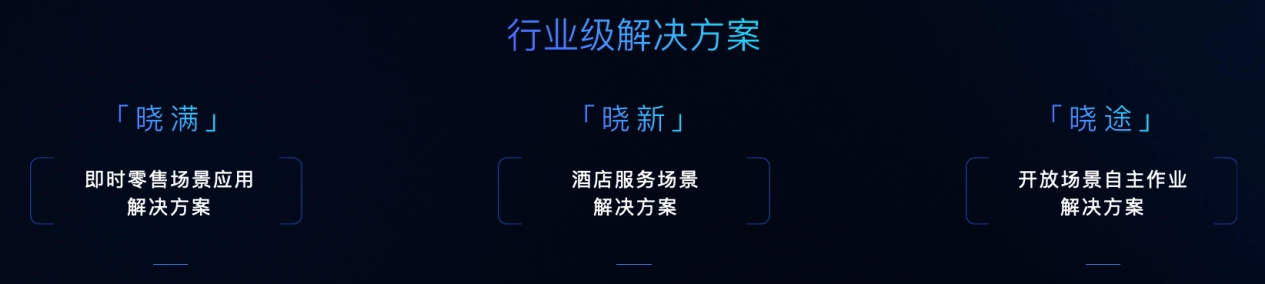
"Xiaoman" Integrated Fulfillment Solution: Redefining instant retail fulfillment efficiency. Targeting the pain points of multi-SKU, high-density narrow warehouses, and 24/7 order peaks in instant retail, Daxiao introduced the "Xiaoman" solution equipped with the new fulfillment robot W1. In aisles as narrow as 75 centimeters, the W1 leverages a self-weight-to-load ratio of less than 2 and ultra-precise force control of ≤1N to stably grip both flexible packaging and rigid products. "Xiaoman" deeply integrates the entire chain of "mechanical control—world model—order and warehousing," achieving a truly integrated closed loop across flash-purchase warehouses, small stores, and warehouse-store hybrids, with deployment support at the day-level.
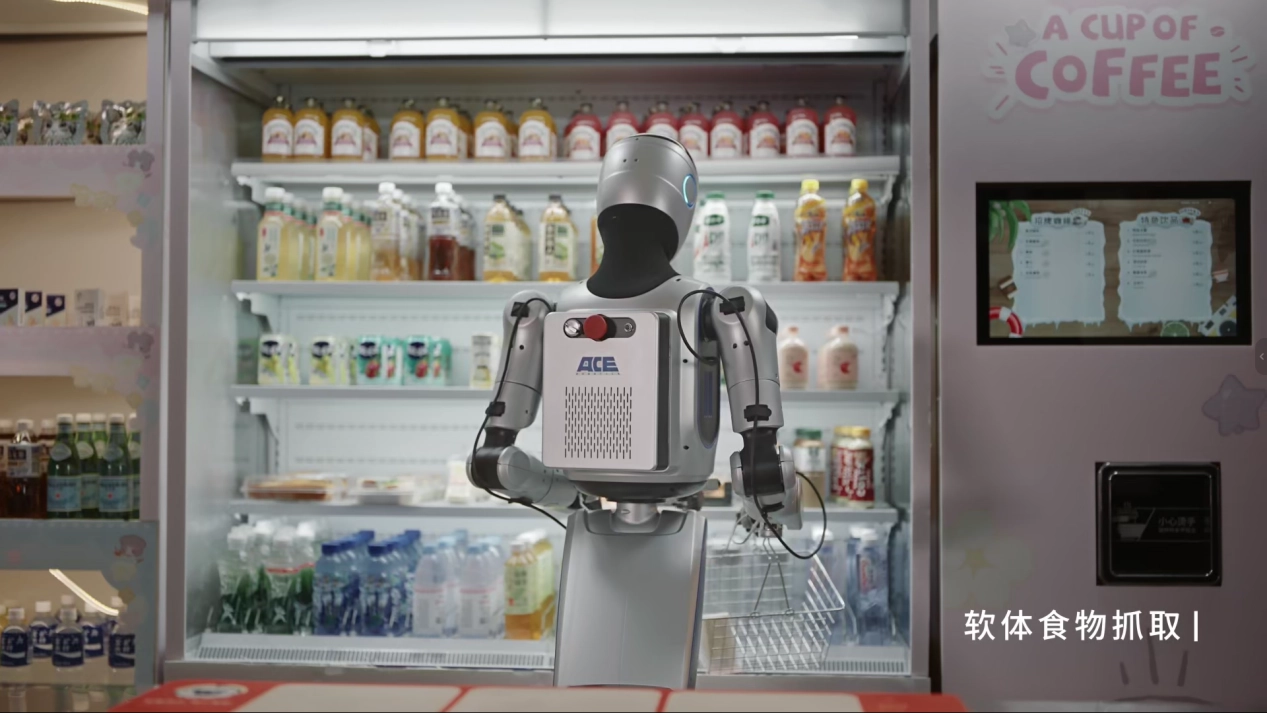
The "Xiaoman" integrated fulfillment solution is already operating in real scenarios such as Shaomai Go, Kuaikeda, and PetroChina convenience stores, continuously "self-evolving" through massive daily order and shelf data to handle late-night, morning, and evening peaks with ease. Within the next year, Daxiao Robotics will complete large-scale deployment across 1,000 retail sites, expanding to 10,000 retail stores within two years.

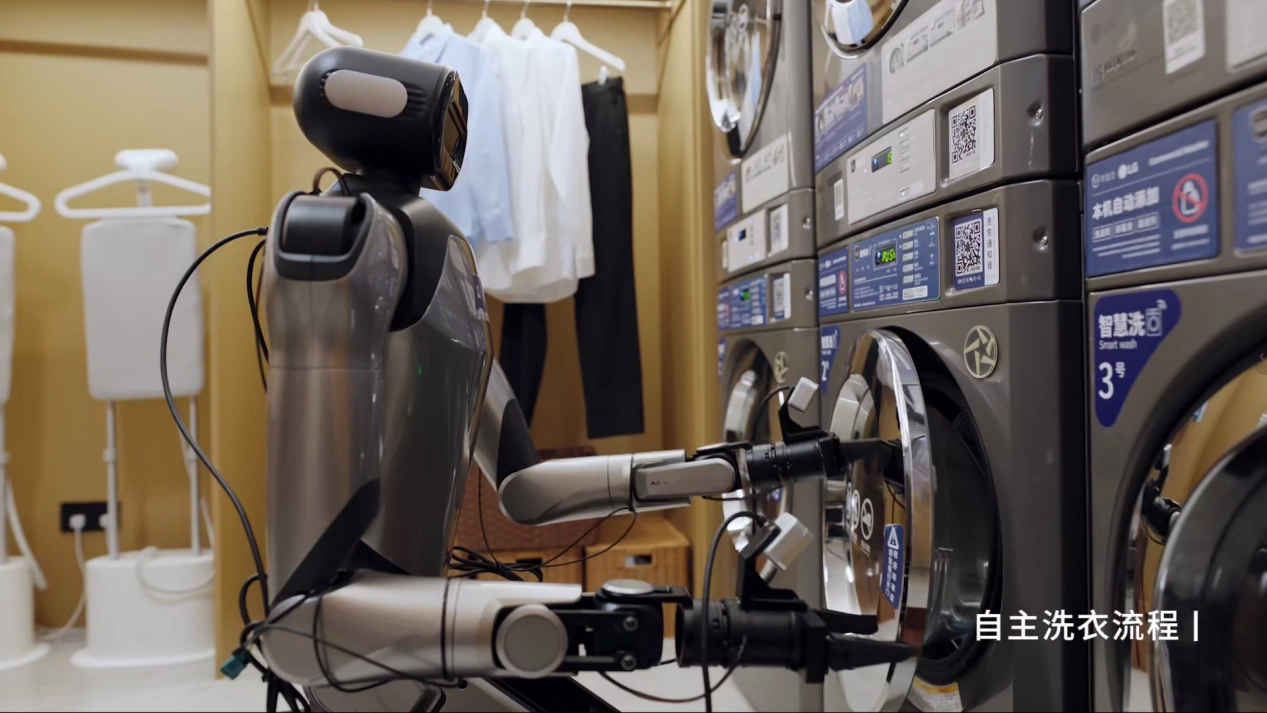
"Xiaoxin" Hotel Unmanned Laundry Solution: Reshaping cost structures for non-standard scenarios. Nighttime laundry demand in hotels accounts for 80% of the full day, and night-shift hiring difficulties and high labor costs are common operational pain points. To address this, Daxiao developed the "Xiaoxin" solution, flexibly adapted to non-standard laundry rooms across hotel star ratings. The robot autonomously connects the entire flow of collecting, loading, washing, and folding clothing, with ironing functionality expanded, transforming highly manual processes into a seamless closed-loop continuous operation. This significantly reduces night-shift labor requirements while smoothly absorbing holiday order backlogs, reliably maintaining the quality of guest room support services.
"Xiaotu" Quadruped Full-Environment Operations Solution: Defining a new "one brain, multiple forms" paradigm for complex environments. Facing complex and variable outdoor environments, "Xiaotu" leverages a general-purpose intelligent brain (Agentic AI) to demonstrate the robust capability of "one brain, multiple forms." It flexibly adapts to various quadruped robot body forms, seamlessly handling indoor-outdoor transitions, dynamic and static obstacle avoidance, and multi-robot collaborative scheduling, completing autonomous operational closed loops without human intervention. Currently, "Xiaotu" is deployed in ongoing scenarios including security patrol at Caohejing Hi-Tech Park, urban governance along the Shanghai riverside, and cultural tourism guidance at the Tianjin Crabapple Blossom Festival, truly opening a new model of 7×24-hour uninterrupted autonomous operation in public spaces.
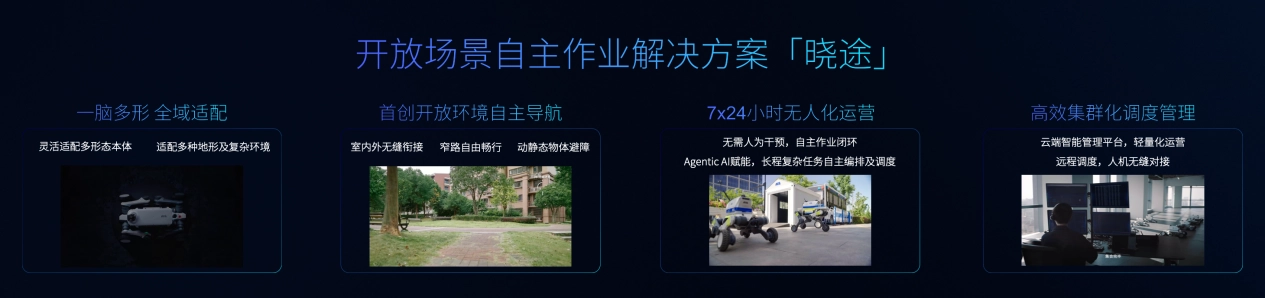
From "Xiaoman's" precise fulfillment, to "Xiaoxin's" hotel services, to "Xiaotu's" autonomous operations in open scenarios, all three solutions share the same reusable capability foundation: unified data collection paradigms, universal world models, and standardized deployment pathways. Daxiao Robotics is building a complete closed loop for routine commercial operations, leveraging market-validated deployment capabilities to accelerate embodied intelligence across a wide range of industries.
PHYSICAL IQ: Building a unified examination platform for embodied physical intelligence.
Addressing the pain points of fragmented industry standards and the absence of evaluation metrics, the first embodied-native, multi-scenario, multi-body, multi-task physical intelligence evaluation benchmark platform—PHYSICAL IQ—has emerged. The platform uses unified protocols that span real scenarios including retail, industrial, and home environments, fairly quantifying the physical intelligence levels of different robot bodies and world models.
To solidify this industry "yardstick," the platform was jointly initiated by the Shanghai Artificial Intelligence Industry Association, Hetao College, and the East China Branch of the China Academy of Information and Communications Technology (CAICT), bringing together leading institutions including Shanghai Jiao Tong University, Nanyang Technological University, The Chinese University of Hong Kong, and The University of Hong Kong, as well as ecosystem partners such as Unitree, Inovance Technology, Fourier, Guodi Center, Tiehu, Lingxin Ingenuity, Daxiao, Auto0, Jijia, Wujie Power, Yingsu, Baidu Cloud, and Huixi. Supported by this powerful industry-academia-research alliance, PHYSICAL IQ will comprehensively propel the embodied intelligence industry into a new era of standardization.
Joining forces with a super "friend circle" to accelerate the leap of the physical AI industry.
Through a series of major strategic partnerships, Daxiao is realizing a closed loop for physical AI from foundational infrastructure to commercial deployment. On the data foundation front, it is co-building an "Embodied Intelligence Industry Innovation Platform" with the Caohejing Development Zone. On the commercial deployment front, it is partnering with PetroChina, Kuaikeda, SenseTime Shanhui, and Enn Group's Zhixin Cognition to deeply deploy unmanned warehouse stores, front warehouses, and intelligent inspection scenarios, reshaping new fulfillment experiences and operational boundaries.
Moreover, Daxiao has launched the "World Model Cloud Ecosystem Co-Building" initiative, bringing together computing power leaders including Baidu Intelligent Cloud, Alibaba Cloud, Huawei Cloud, Tencent Cloud, and SenseTime's large-scale AI infrastructure. From cloud computing power to real-world physical testing grounds, Daxiao is joining forces with its top-tier "friend circle" to accelerate the "leap moment" of physical AI into large-scale productivity.
A vast world, discerned through intelligence: jointly embracing the new future of physical AI.
From the Kairos World Model 3.1 achieving an integrated "understand—generate—predict" self-evolving intelligence closed loop, to the Environment-Centric Data Collection Solution 2.0 unblocking high-density data production chains; from "Xiaoman," "Xiaoxin," and "Xiaotu" penetrating retail, hotel, and open scenarios, to PHYSICAL IQ establishing a unified evaluation benchmark for the industry—Daxiao Robotics is completing a panoramic journey from foundational technological breakthroughs to industrial value realization. With world models as the brain, high-density data as nourishment, robot bodies as carriers, industry scenarios as the landing point, and unified standards as the measure, Daxiao is building an open, collaborative, and ever-evolving new ecosystem for physical AI.
The march of science never stops. Next, Daxiao Robotics will continue to partner with global industry, academic, and research collaborators to enable machines to truly understand world causality, reason about physical futures, and execute complex tasks—continuously unleashing transformative value across industries and jointly opening the door to a new era of large-scale physical AI prosperity.