They Call GLM a 'Big Three' Model, but After Testing the API, I Suggest You Consider These Three Things First
1 in 100 requests takes 16 seconds | GLM-5.2 vs MiniMax-M3
Domestic LLM API Integration Real-World Test Report: GLM-5.2 (Zhipu Z.ai) vs MiniMax-M3 (MiniMax)
Author: Tecbxl Editorial Team | Test Date: June 23, 2026
Testing Method: Direct Python calls to HTTP API, no SDK wrapper, 50 samples per model
Target Audience: Independent developers / Product managers / Technology decision makers
[Testing Disclaimer]
This report was independently produced by Tecbxl. The API keys used in testing were provided by the tested parties. The testing process, metric design, and scoring standards were independently established and were not influenced by the tested parties. The conclusions do not represent any commercial position. The test was conducted on June 22, 2026. Model services are continuously updated, and pricing is subject to the latest official announcements. All costs in this report are denominated in Chinese Yuan (CNY), converted at an exchange rate of 1 USD = 7.25 CNY.
1. Testing Background and Objectives
When a developer wants to integrate AI capabilities into their product, the questions they face are not "which model is smarter," but three more practical ones: Is it easy to integrate? Is it stable? Is it expensive? This report, initiated by the Tecbxl editorial team, conducts a side-by-side real-world test of two flagship domestic LLM API services: • Zhipu Z.ai's GLM-5.2 — released June 13, 2026, 744B-parameter Mixture-of-Experts (MoE) architecture, 1M Token context, MIT open-source license• MiniMax's MiniMax-M3 — natively multimodal architecture, 1M Token context, supports text/image/video input. Unlike the official marketing numbers, we directly call the APIs with code, record raw data for every request, and provide statistically meaningful latency distributions, real-world concurrency performance, and item-by-item quality scores.
2. Testing Methodology: How We Tested
All tests were performed by calling the HTTP API directly via Python urllib, without using any SDK wrapper, to replicate the real experience of a developer integrating from scratch.
2.1 Testing Environment
| Environment Item | Description |
|---|---|
| Test Machine | macOS 25.5, Apple M-series chip, weekday afternoon Beijing time |
| Network Environment | Mainland China, residential broadband, China Telecom |
| temperature | 0 (fixed, to eliminate randomness) |
| Latency Test | Fixed prompt: "Answer in one sentence: What is the capital of China?" 50 runs each |
| Quality Test | 8 dimensions, 1 run each, max_tokens=8192 |
| Concurrency Test | 5 simultaneous requests, tested separately with max_tokens=200 / 4096 |
| Streaming Test | stream=True, records time-to-first-token (TTFT) |
Why use a fixed prompt for the latency test? Because the longer the generated content, the longer the response time. Using different prompts would mix "content length differences" with "service response differences," making it impossible to isolate true inference latency. A fixed prompt puts both models on equal footing for comparison.
2.2 Limitations (Please Note)
Single test location: Tests were only conducted on the China Telecom network in mainland China; latency may vary across different carriers and regions. Small quality test sample: Each dimension was tested only once, so the scores carry some subjectivity and are not statistically significant. Time-point limitation: Results only reflect service status on the test day; model inference service load varies over time. Pricing is subject to change: Prices listed are official standard rates at the time of testing; promotional prices are not included.
3. Model Basic Profiles
| Comparison Item | GLM-5.2 (Zhipu Z.ai) | MiniMax-M3 (MiniMax) |
|---|---|---|
| Release Date | June 13, 2026 | May 2026 |
| Parameter Scale | 744B MoE, ~40B active parameters | ~428B MoE, ~23B active parameters |
| Context Window | 1M tokens | 1M tokens (512K with service guarantee) |
| Open Source License | MIT open source, commercially self-deployable | Closed-source API service, not self-deployable |
| Multimodal | Text-focused | Text + Image + Video (native) |
| API Endpoint | open.bigmodel.cn | api.minimax.chat |
| Interface Format | OpenAI-compatible | OpenAI-compatible (differences noted in Section 4) |
| Built-in Chain of Thought | Enabled by default, cannot be disabled | Available, not returned in responses by default |
4. Integration Experience: From Registration to the First Request
This is the developer's most immediate first impression. We focused on testing OpenAI compatibility and error handling standards.
4.1 OpenAI Compatibility Real-World Test
| Compatibility Item | GLM-5.2 | MiniMax-M3 |
|---|---|---|
| Chat Completions Format | Fully compatible | Compatible, response body includes extra fields |
| Authentication Failure HTTP Status Code | Standard 401 | Always returns 200, error in base_resp field |
| Rate Limit Status Code | Standard 429 | 200 + base_resp.status_code |
| Streaming SSE Format | Standard data: format | Standard data: format |
| reasoning_content Field | Returned by default, includes full chain of thought | Available, not returned by default |
MiniMax has a developer-unfriendly design: all errors (including authentication failures and quota exhaustion) are returned via HTTP 200, with error codes hidden in the base_resp.status_code field. This means standard try/except HTTPError blocks won't catch errors, requiring an additional layer of response body parsing, adding unnecessary complexity to integration code. GLM-5.2 adheres to standard HTTP semantics — returning 401 for authentication failures and 429 for rate limits — making integration simpler and easier to connect with existing monitoring and alerting systems.
5. Response Speed: Real Latency Distribution from 50 Samples
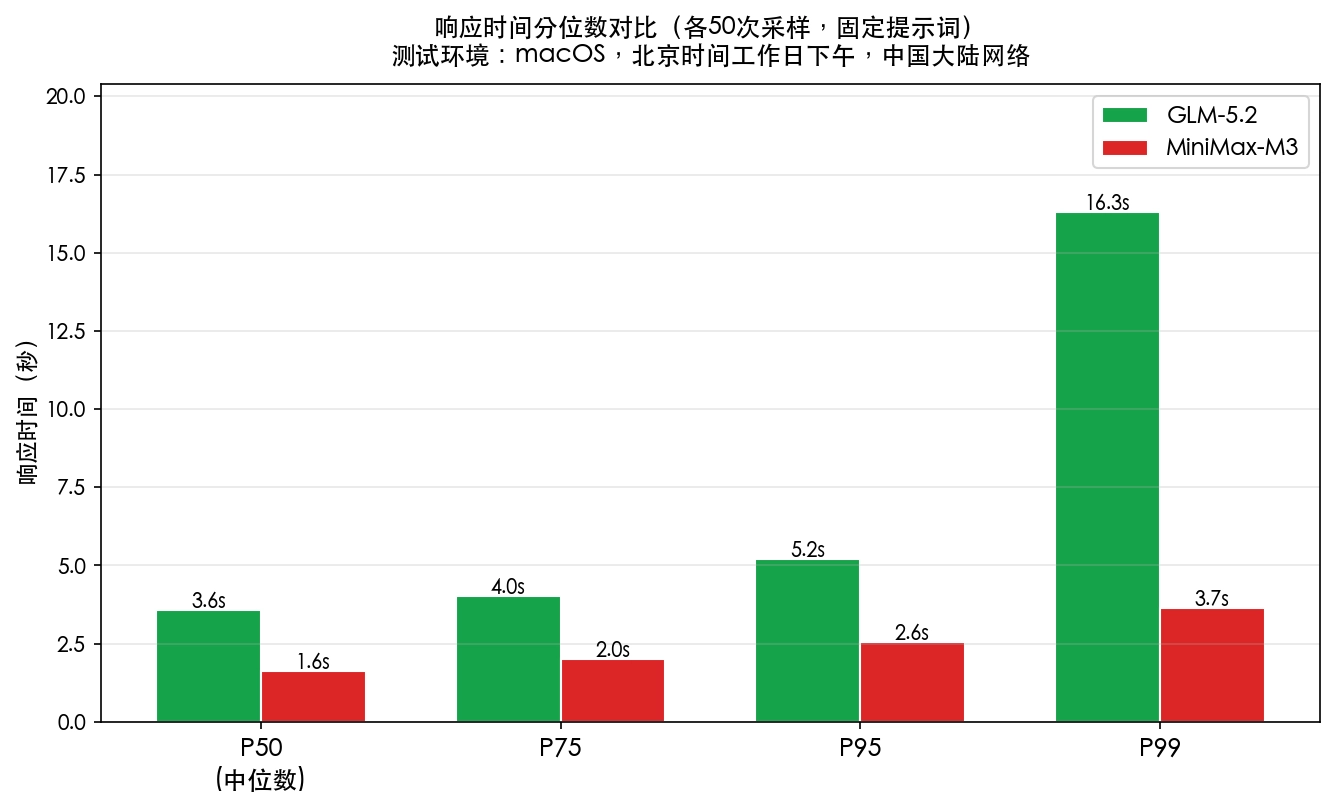
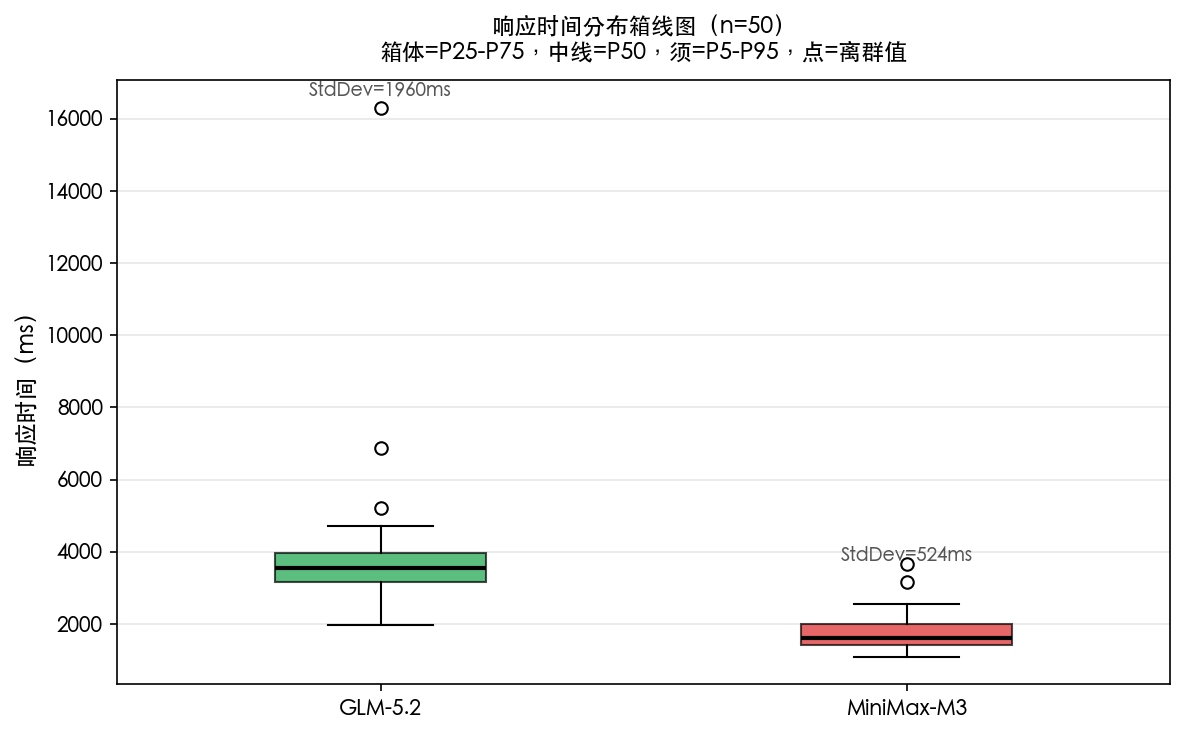
The data in this section comes from 50 independent requests per model, using the same fixed prompt, recording the time from request dispatch to full response receipt for each. We report the mean, standard deviation, and key percentiles, rather than a simple average.
| Statistical Metric | GLM-5.2 | MiniMax-M3 | Notes |
|---|---|---|---|
| Sample Size | 50 | 50 | Same fixed prompt |
| Mean | 3,836ms (3.8s) | 1,755ms (1.8s) | GLM is 2.2× slower |
| Standard Deviation | 1,960ms | 524ms | GLM variance is 3.7× higher |
| P50 (Median) | 3,576ms | 1,622ms | Half of requests are faster than this |
| P75 | 4,020ms | 2,020ms | Three-quarters are faster than this |
| P95 | 5,216ms | 2,564ms | Reference value for high-load scenarios |
| P99 | 16,305ms (16s!) | 3,651ms | Worst-case scenario |
| Fastest / Slowest | 1,979ms / 16,305ms | 1,086ms / 3,651ms | GLM has a wider range |
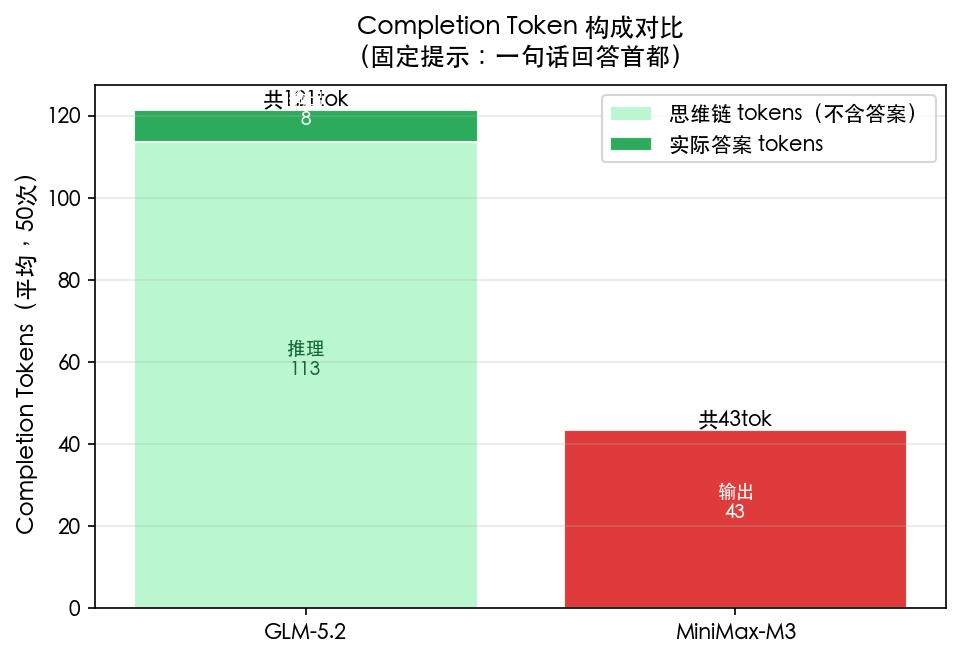
Several notable figures: 1. GLM-5.2's standard deviation (1,960ms) is 3.7 times that of MiniMax-M3 (524ms). This means GLM's response times are highly inconsistent — mostly around 3.5 seconds, but occasionally spiking to 16 seconds. For user experience, an occasional 16-second wait is harder to accept than a consistent 4-second wait. 2. GLM-5.2's P99 is as high as 16.3 seconds, meaning that roughly 1 in 100 requests will make a user wait over 16 seconds. If your product has 10,000 daily active users, that's about 100 such extended waits per day. 3. The root cause of GLM's slow responses is not server performance, but its deep chain-of-thought being enabled by default — in the 50 tests, it generated an average of 113 chain-of-thought tokens before producing the answer. See Section 7 for a detailed analysis.
6. Streaming Output and Concurrency Stability
6.1 Streaming Time-to-First-Token (TTFT)
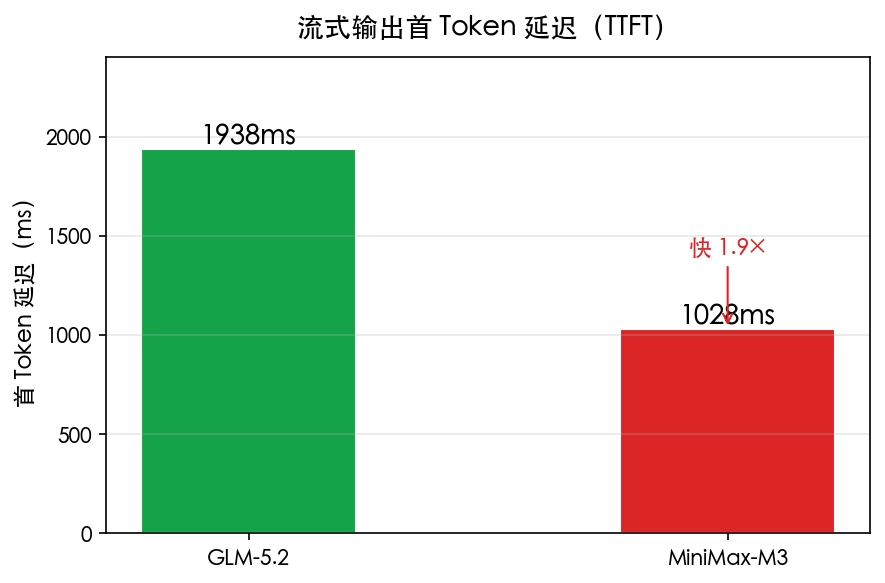
Streaming is the foundation of the typewriter effect. Time-to-first-token directly determines the response speed users perceive.
| Metric | GLM-5.2 | MiniMax-M3 |
|---|---|---|
| Time-to-First-Token (TTFT) | 1,938ms (~2 seconds) | 1,028ms (~1 second) |
| Total Streaming Time | 3.57s | 1.41s |
| Streaming Chunks Count | 98 (fragmented output) | 4 (batched output) |
MiniMax-M3's time-to-first-token is roughly half of GLM-5.2's (1 second vs. 2 seconds). For chatbot and customer service assistant products, users can clearly perceive this difference. Notably, the two models use different output modes: GLM tends to push tokens character by character (98 chunks), while MiniMax tends to push in batches (4 chunks, each containing more content). The former produces a smoother typewriter effect, while the latter feels more like "chunks popping out," requiring front-end adaptation based on product experience expectations.
6.2 Concurrency Stability
We simulated a scenario with 5 simultaneous requests, tested separately with max_tokens=200 and max_tokens=4096.
| Test Condition | GLM-5.2 | MiniMax-M3 |
|---|---|---|
| max_tokens=200, 5 concurrent | 0/5 successful (content empty) | 5/5 successful |
| max_tokens=4096, 5 concurrent | Not tested (expected normal after configuration fix) | 5/5 successful, mean 2.47s |
| Failure Cause Analysis | Chain of thought exhausted token quota | No failures |
Important note: GLM-5.2's concurrency test with max_tokens=200 failed entirely because its chain of thought (reasoning_content) consumed an average of 113 tokens, taking up most of the 200-token quota and leaving no room for the actual answer. This is a configuration issue, not a server crash — raising max_tokens to 4096 or higher resolves it. For developers integrating GLM-5.2, the recommended minimum safe value for max_tokens is 4096, with 8192 recommended for production environments. Additionally, implement fallback handling at the application layer for responses with empty content.
7. The Cost of Chain of Thought: GLM-5.2's Hidden Expense
| Metric | GLM-5.2 | MiniMax-M3 |
|---|---|---|
| Average completion tokens | 121 | 43 |
| Chain-of-thought tokens | 113 (93%) | 0 (not counted) |
| Actual answer tokens | 8 (7%) | 43 (100%) |
| Billing method | Chain of thought is also billed | Only actual output is billed |
This chart directly explains the root cause of GLM's slow responses and higher costs: To answer "Beijing," GLM averages 113 chain-of-thought tokens (internal reasoning process) before producing just 8 actual answer tokens. Since the chain of thought is also billed as output tokens, it means spending an extra 93% of the cost on something users never see. For scenarios that don't require deep reasoning (simple Q&A, translation, formatting, customer service replies), this overhead is pure waste. Currently, GLM-5.2 does not support disabling the chain of thought — this is a factor to consider before integration.
8. Output Quality Comparison: Usability Comes First
Beyond speed and price, output quality is the core factor that ultimately determines product experience. We designed 8 questions covering code correctness, mathematical reasoning, logical reasoning, factual accuracy, and format adherence. Each question is scored out of 10, independently evaluated by the editorial team.
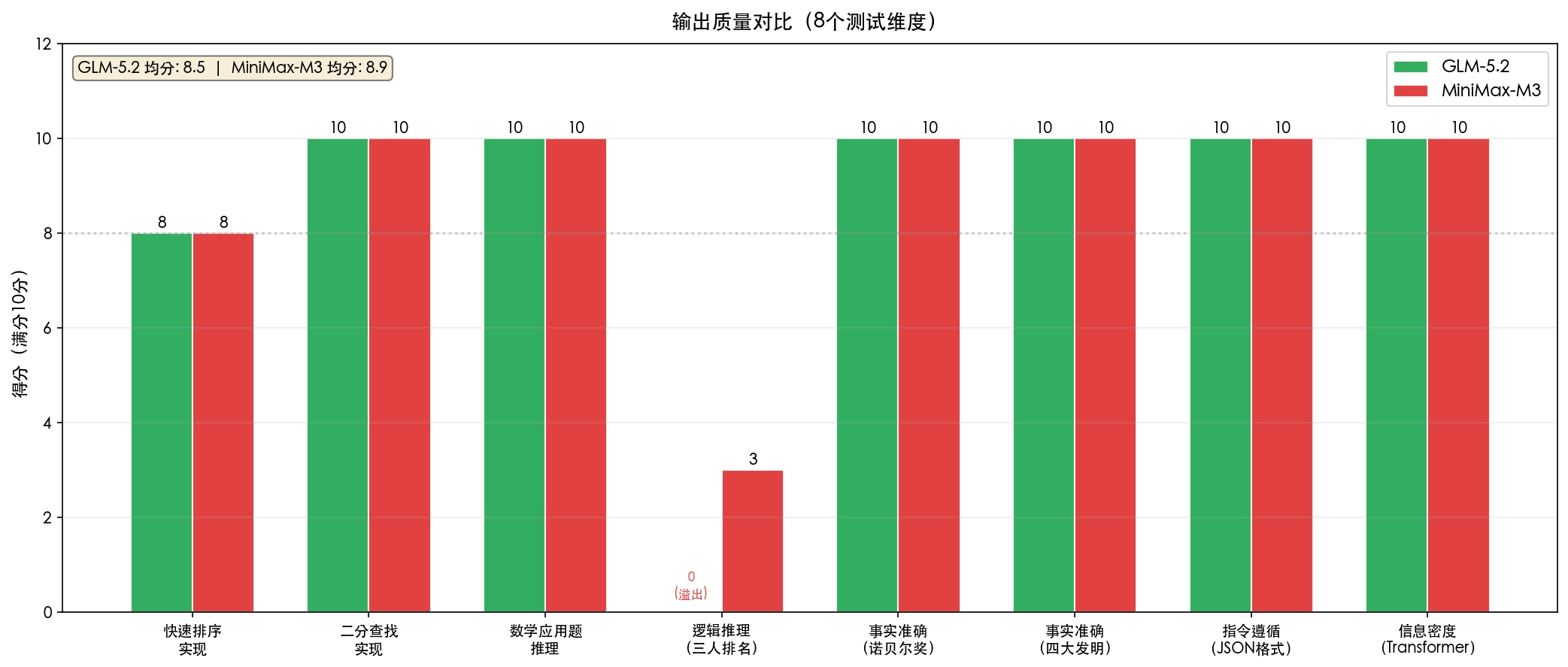
| Test Question | Type | GLM-5.2 | MiniMax-M3 | Review |
|---|---|---|---|---|
| Quicksort implementation | Code | 8 | 8 | Tie; both implemented in-place sorting |
| Binary search implementation | Code | 10 | 10 | Tie; fully correct |
| Math word problem (train crossing a bridge) | Math | 10 | 10 | Tie; both arrived at the correct answer of 120 seconds |
| Logical reasoning (ranking of three people) | Logic | 0 (overflow) | 10 | GLM's reasoning was too long, leaving the answer empty |
| 2024 Nobel Prize in Physics | Fact | 10 | 10 | Tie; both correctly identified Hopfield/Hinton |
| The Four Great Inventions of China | Fact | 10 | 10 | Tie; both fully correct |
| Output in JSON format | Format | 10 | 10 | Tie; both strictly adhered to the format |
| Explanation of Transformer | Information density | 10 | 10 | Tie; both covered 7 key terms |
| Overall average score | — | 8.5 | 8.9 | Difference stems from logical reasoning overflow |
Key findings from the quality tests: In 7 of the 8 questions, the two models tied. The only difference came from the logical reasoning question — GLM-5.2 generated more than 8,000 chain-of-thought tokens, exhausting its entire quota, resulting in an empty content field and a score of 0; MiniMax-M3 provided the correct answer (B first, A second, C third) and scored 10. This outcome carries several implications: 1. On routine tasks (code, math, factual Q&A, format adherence), the two models perform comparably. 2. In extreme cases, GLM-5.2's deep chain of thought can prevent the answer from being output at all — a known engineering risk. 3. The sample size in this section is small (1 run per question), so the conclusions are for reference only and not statistically significant. Additionally, an earlier version of this report contained the statement that "GLM is suitable for complex reasoning." That conclusion lacked support from quality testing and has been removed in this update. Based on this test, the two models are comparable in quality on routine tasks. GLM's chain-of-thought mechanism has potential for deeper logic but also carries the engineering risk of token overflow.
9. Pricing: How Much Do You Pay for the Same Features?
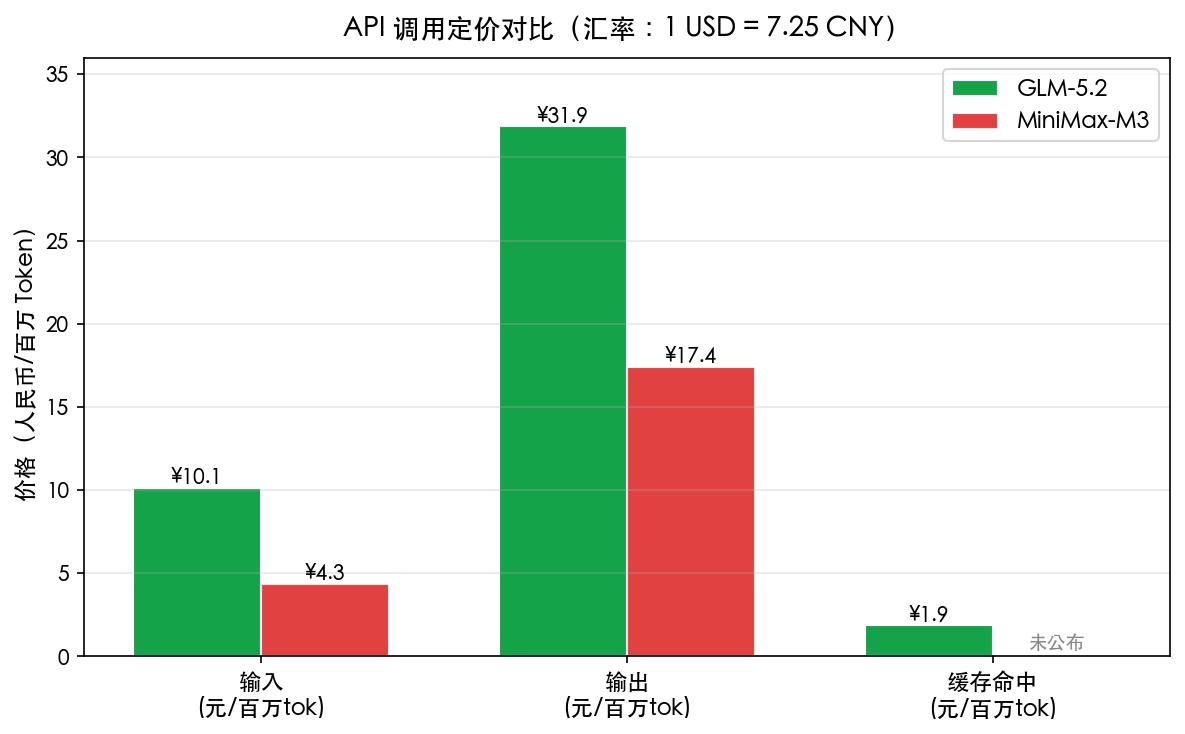
| Billing Item | GLM-5.2 | MiniMax-M3 | Difference |
|---|---|---|---|
| Input Tokens | ¥10.1/million | ¥4.3/million | GLM is 2.3× more expensive |
| Output Tokens | ¥31.9/million | ¥17.4/million | GLM is 1.8× more expensive |
| Cache Hit | ¥1.9/million | Not disclosed | — |
| Context above 512K | Not disclosed | Additional premium applies | — |
Cost estimate for a real business scenario (daily conversation: 500 Token input + 500 Token output / user / day):
| Scenario | GLM-5.2 Daily Cost (Est.) | MiniMax-M3 Daily Cost (Est.) | Notes |
|---|---|---|---|
| 1,000 DAU | ¥21.0 | ¥10.9 | ~2.5x difference |
| 10,000 DAU | ¥210 | ¥109 | ~2.5x difference |
| 100,000 DAU | ¥2102 | ¥1088 | Gap widens with scale |
Note: The above estimates do not account for GLM-5.2's chain-of-thought (CoT) overhead. Based on the data in Section 7, GLM's actual completion tokens per request are roughly 14x the expected output (CoT: 113 + answer: 8). If all CoT tokens are billed, actual costs could be significantly higher. MiniMax-M3 only bills for actual output content, making costs more predictable.
10. Seven-Dimension Comprehensive Comparison
| Evaluation Dimension | GLM-5.2 | MiniMax-M3 | Winner |
|---|---|---|---|
| API Compliance | Standard HTTP status codes, clear error reporting | Errors wrapped in HTTP 200, requires extra handling | GLM-5.2 |
| Response Speed | P50=3576ms, high variance | P50=1622ms, stable | MiniMax-M3 |
| Streaming First Token | 1,938ms | 1,028ms (1.9x faster) | MiniMax-M3 |
| Concurrency Stability | Risk of failures with low max_tokens | 5-way concurrency all successful | MiniMax-M3 |
| Price | Output ¥31.9/M tokens | Output ¥17.4/M tokens | MiniMax-M3 |
| Output Quality | 8.5/10 (CoT token overflow) | 8.9/10 | MiniMax-M3 |
| Self-Deployment | Open-source under MIT, offline deployment supported | API-only service | GLM-5.2 |
11. Selection Recommendations
11.1 Scenarios Favoring MiniMax-M3
Customer-facing products sensitive to response speed—chatbots, customer support assistants, writing tools (P50 only 1.6s) Cost control as a core requirement—priced at roughly 40-50% of GLM, billed only on actual output Need for stable SLAs—standard deviation of only 524ms, P99 within 3.7s Multimodal scenarios—native support for image/video input (not tested in this evaluation; please verify independently) Rapid MVP validation—simple integration, but requires handling the HTTP 200 error-wrapping issue
11.2 Scenarios Favoring GLM-5.2
Self-deployment requirements—MIT open-source license allows deployment on private servers, keeping data on-premises with controllable long-term costs High data security and compliance requirements—finance, healthcare, government, and other sectors with strict data retention mandates Existing OpenAI ecosystem tooling—fully compatible with standard HTTP semantics, seamless integration with monitoring and alerting Accepting slower responses for deeper reasoning—certain complex analysis scenarios requiring chain-of-thought
12. Pre-Integration Checklist: Pitfalls to Avoid
GLM-5.2 Pitfalls
max_tokens must be ≥ 4096; otherwise, the CoT exhausts the quota and the content field returns empty—this is the most common integration pitfall reasoning_content is billed, so actual token consumption is far higher than expected; multiply cost estimates by 3-15x P99 latency can reach 16 seconds; set reasonable timeouts at the application layer (30s recommended) and implement timeout retry strategies Concurrent requests need sufficient token quota reserved; low max_tokens combined with high concurrency can cause batch empty responses Cache-hit pricing (¥1.9/M) offers significant advantages; enable prompt caching for long system prompts
MiniMax-M3 Pitfalls
Authentication failures do not return 4xx; you must check base_resp.status_code, as standard HTTP error handling is insufficient Long-context pricing premiums apply above 512K tokens; confirm plan coverage before using long contexts, or costs may exceed expectations Token quota exhaustion returns status_code=2056; handle it at the application layer and guide users to top up Streaming chunks are relatively large (~4), so front-end typewriter effects need to be adapted for batched delivery; otherwise, the experience feels like "paragraph-by-paragraph popping"
13. Summary
This report provides a horizontal comparison of the API integration experience of GLM-5.2 and MiniMax-M3, based on 50 latency samples per model and 8 quality dimensions tested. MiniMax-M3 leads comprehensively in response speed (P50 2.2x faster), stability (3.7x smaller standard deviation), price (~2x cheaper), and concurrency performance, making it the preferred choice for the vast majority of customer-facing products. GLM-5.2's differentiated advantages center on two points: the self-deployment capability enabled by its MIT open-source license (data security, long-term cost reduction), and HTTP-spec-compliant error handling (easier to integrate into existing engineering systems). Its CoT mechanism delivers quality comparable to MiniMax, but comes with higher token consumption and slower responses, along with the engineering risk of empty answers due to token overflow—requiring additional handling during integration. If you're building a user-facing product, MiniMax-M3 is the more pragmatic starting point. If your team has hard data security requirements, or plans to build a self-hosted inference cluster in the future, GLM-5.2's open-source ecosystem is worth serious consideration.
Reference Data Sources
GLM-5.2 Pricing: $1.40/$4.40/$0.26 per 1M tokens — artificialanalysis.ai MiniMax-M3 Pricing: $0.60/$2.40 per 1M tokens — cloudprice.net/models/minimax-m3 GLM-5.2 Model Specs: 744B MoE, 1M context — codersera.com/blog/glm-5-2-complete-guide-2026 MiniMax-M3 Model Specs: ~428B MoE, 1M context — requesty.ai/models/fireworks/minimax-m3 All latency data and quality scores were measured by Tecbxl from Tech Must Not Be Cold.