Caocao Mobility Partners with Doubao: Top AI Opens the Door to the 3D World
Caocao Mobility partners with Doubao to bring AI intent into the physical world.
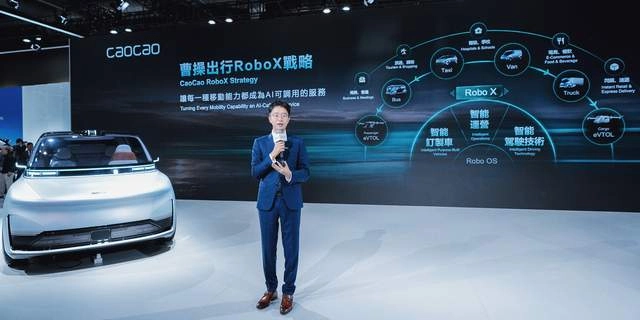
On June 18, 2026, two major pieces of news in the mobility industry landed on the same day: Cao Cao Mobility announced a comprehensive AI transformation at the Hong Kong Auto Expo and officially unveiled its RoboX strategy; simultaneously, Cao Cao Mobility signed a cooperation framework agreement with ByteDance's Doubao, becoming the first mobility-scenario partner for Doubao.
The public spotlight quickly focused on the novel experience of "hailing a ride through conversation," treating it as just another "AI + mobility" feature collaboration.
But seeing only that layer would be a waste of this announcement.
Over the past two years, the AI industry has undergone a wave of aggressive expansion, with Doubao joining the top tier of domestic AI applications thanks to its massive user base. The heat in capital markets at one point made it seem as if AI could do anything.
Yet the industry has always faced a common bottleneck: AI can precisely parse complex user intent, but it struggles to translate commands into stable, reliable execution in the physical world. The gap between digital intelligence and real-world services has kept AI at the level of an "information tool," preventing it from becoming a true gateway for solving real-world problems.
What Cao Cao Mobility is doing is building a physical execution network that can carry out AI commands. The partnership with Doubao marks the first public debut of this network for consumer-facing AI applications.
This is worth a closer look.
Proactive Pivot: Strategic Focus and Organizational Restructuring Completed in the First Half of the Year
This collaboration is not a temporary business tie-up, but rather a planned step in Cao Cao Mobility's comprehensive AI transformation and the RoboX strategic roadmap.
In the first half of 2026, Cao Cao Mobility advanced its strategic focus, continuously optimized its business structure, and proactively scaled back non-core operations. The company reorganized its organizational structure around AI, increased investment in talent and resources in areas such as autonomous driving, AI operations systems, and intelligent mobility networks, and worked to embed AI capabilities deeply into product development, operations management, and business systems, accelerating its transformation into an AI-native company.

To date, Cao Cao Mobility's ride-hailing business has also maintained steady growth, covering 195 cities with 38,000 custom vehicles in stable operation, supported by an energy supply network of 448 battery swap stations within the Geely ecosystem. The total cost of ownership offers a significant advantage, with operational efficiency and profitability continuing to improve, providing a solid foundation for the AI transformation and RoboX strategy.
From business contraction to organizational restructuring, Cao Cao Mobility's transformation path is clear: first, secure the fundamentals of its core business, then leverage organizational upgrades to drive a full transition into an AI-native physical mobility technology company. The RoboX strategy released on June 18 is the formal strategic declaration following all these preparations.
RoboX Strategy: Building the Physical Execution Foundation for the AI Era
As the most important commercialization vehicle for Geely Holding's RoboX, Cao Cao Mobility is building a fully integrated closed-loop ecosystem combining "intelligent custom vehicles + autonomous driving technology + intelligent operations," making its mobility network a physical execution terminal that AI agents can directly call upon.

Three core capabilities together form the moat of the RoboX strategy:
· Intelligent Custom Vehicles: Leveraging Geely Holding's vehicle R&D and manufacturing ecosystem, Cao Cao Mobility can develop industry-leading autonomous mobility products such as Robotaxis, Robovans, Robobuses, and Robottrucks for passenger and cargo scenarios. The first natively developed Robotaxi for mobility scenarios in China, the Eva Cab, has been officially unveiled, featuring no front passenger seat and no steering wheel, with a living-room-class interior space. The vehicle is scheduled for mass production in 2027. The Robovan for urban logistics is also moving toward scaled deployment. These vehicles are designed from the hardware level up to meet autonomous driving and intelligent dispatch requirements, with unified standards and controllable costs, making them the optimal physical carriers for the AI execution network.
· Autonomous Driving Technology: With L4-level autonomous driving as the core, Cao Cao Mobility continues to iterate its technical capabilities for passenger and cargo scenarios. In February 2025, it launched Robotaxi pilots in Hangzhou and Suzhou; in April 2026, it became the first company in Hangzhou to receive qualification for driverless road testing; Hong Kong is also the first international stop for the RoboX strategy, with steady progress in technology deployment.
· Intelligent Operations: Cao Cao Mobility has built an intelligent hybrid dispatch system and a super operations AI brain, combined with 11 years of operational dispatch experience, to achieve efficient coordination of mobility resources across multiple scenarios. The company has also established the RAS remote safety service platform, handling emergency response, remote assistance, and full-trip monitoring, supporting the transition from in-car safety drivers to cloud-based support.
On this foundation, Cao Cao Mobility has also launched CaoCao Robo OS, designed for the era of intelligent mobility. This system covers the entire chain of demand understanding, supply-demand matching, and service fulfillment, with native support for AI agent integration and collaboration—effectively providing a unified mobility dispatch interface and fulfillment system for all upper-layer AI applications.
As quantified targets for strategy implementation, Cao Cao Mobility has proposed the "Dual 100,000 Plan": deploying a cumulative total of 100,000 Robotaxis and 100,000 Robovans by 2030. These 200,000 intelligent mobility units are essentially 200,000 physical execution nodes distributed across cities—when AI issues a command, they can reliably complete real-world tasks such as passenger transport and cargo delivery, translating intent from the digital world into services in the physical world.
Mutual Empowerment: The Deeper Value of the Doubao Partnership
With an understanding of the underlying logic of the RoboX strategy, the partnership between Cao Cao Mobility and Doubao is no longer just a one-way empowerment of "integrating ride-hailing features into a large language model," but rather a complementary capability exchange and mutual validation between two leaders in their respective fields.
From an architectural perspective, Doubao serves as the demand gateway, CaoCao Robo OS handles task parsing and mobility dispatch, and Robotaxis and Robovans handle final execution—together forming a complete chain from demand generation to real-world service delivery.

For Cao Cao Mobility, integrating into the Doubao ecosystem is a significant step in the RoboX strategy. Doubao boasts an extremely large user base and mature natural language interaction capabilities, making it a benchmark among domestic AI applications. By connecting with Doubao, Cao Cao Mobility can validate the full end-to-end experience of "demand understanding, supply-demand matching, and service fulfillment" in real-world scenarios, gaining experience for integrating more AI applications and expanding into more service scenarios in the future. At the same time, conversational interaction provides a new touchpoint for mobility services—users no longer need to switch to a standalone app; they can initiate and confirm travel needs within natural conversation, expanding the boundaries of service scenarios.
For Doubao, Cao Cao Mobility's value lies in providing a complete, stable, and controllable physical fulfillment network. Mobility is one of the most frequent and essential scenarios in local life, and it is a critical gateway for AI to evolve from "chatting about information" to "getting things done." Users only need to express their travel intent in natural conversation, and Doubao can understand the demand and automatically invoke Cao Cao Mobility's service capabilities to complete ride ordering, route and vehicle type matching, intelligent vehicle control, preference memory, and other services. Users confirm with a single tap to place the order, achieving a fully intelligent closed loop from hailing a ride to riding. By integrating with Cao Cao Mobility, Doubao achieves a closed loop from intent understanding to service delivery, and this interaction paradigm can also be replicated across more offline service scenarios.
Among the details released about the partnership, note the keyword "preference memory." This means the service is not a one-off interaction feature, but a continuously evolving system. AI accumulates understanding of each user with every trip—habitual departure times, preferred vehicle types, frequent destinations. As this data is accumulated, AI's ability to dispatch mobility services will grow stronger, and users' reliance on this gateway will deepen. The premise for all of this is a sufficiently stable and standardized mobility network to support it.
Physical AI Offers Greater Long-Term Resilience
The AI industry is transitioning from the technical validation phase to the commercialization phase. User growth in the pure digital AI track is slowing, monetization paths are limited, and investors' patience with AI stories that cannot enter the physical world is waning.
When the bubble recedes, what will remain are the companies that can turn AI capabilities into real services and create tangible value.
By this standard, Cao Cao Mobility's positioning has unique resilience: it is neither a purely algorithm-driven, asset-light AI company nor a traditional mobility operator stuck in legacy models, but rather a physical AI mobility technology company with a fully integrated closed-loop ecosystem.
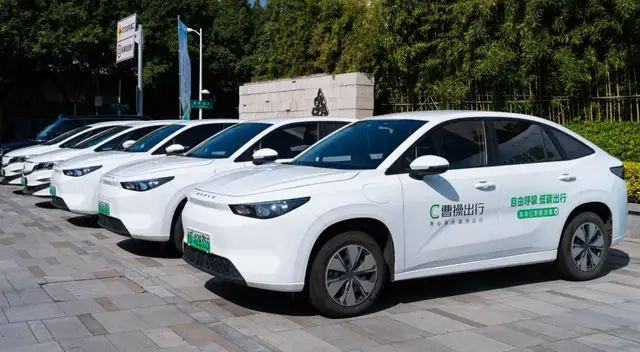
A fleet of 38,000 custom vehicles, a nationwide battery swap network, eleven years of operational dispatch experience, and a future of over 200,000 autonomous mobility units—these heavy assets are precisely the core barrier to AI entering the physical world. Asset-light traffic platforms may be able to quickly launch a ride-hailing entry point, but they cannot rapidly build a standardized, low-cost, highly stable fulfillment network. Cao Cao Mobility's physical assets form a moat that other platforms can hardly match, and they also raise the ceiling on the quality of AI-driven services.
Of course, the challenges are real. User acceptance of AI-hailed rides will take time to cultivate, the accuracy of intent understanding needs continuous refinement, and the large-scale commercialization of Robotaxis and Robovans still faces certain hurdles. But the existence of these challenges means there are few shortcuts on this path, and players who can steadily overcome them will ultimately build deep competitive barriers.
Cao Cao Mobility: The Optimal Mobility Solution in the Physical AI World
AI stepping out of the screen and into the physical world will not be an overnight revolution, but a gradual process in which high-frequency scenarios are proven one by one and execution networks are pieced together piece by piece.
The partnership between Cao Cao Mobility and Doubao is a testable example of this process. It validates not just "whether you can hail a ride through conversation," but more importantly, whether a complete physical execution network can become the universal mobility infrastructure of the AI era—and whether, when AI's intent capabilities meet a standardized fulfillment system, a more efficient and seamless service standard can emerge.
For Cao Cao Mobility, this is just one step in the implementation of the RoboX strategy. When this mobility network covers both passenger transport and urban logistics, and when more AI agents integrate with CaoCao Robo OS, its potential extends far beyond more convenient ride-hailing. What it is truly doing is building a replicable, scalable mobile execution foundation for the coming physical AI era.
And the answer will become increasingly clear with the completion of every order.