80 Million Yuan Partnership in Dexterous Hands: Qianwei Central Kitchen's Hardcore Breakthrough and Defense in Back-of-House Intelligence
Qianwei Central Kitchen invests 80 million yuan to establish Qianqiao Technology, teaming up with a dexterous hand company to advance back-of-house machine substitution and secure its position in the intelligent supply chain.
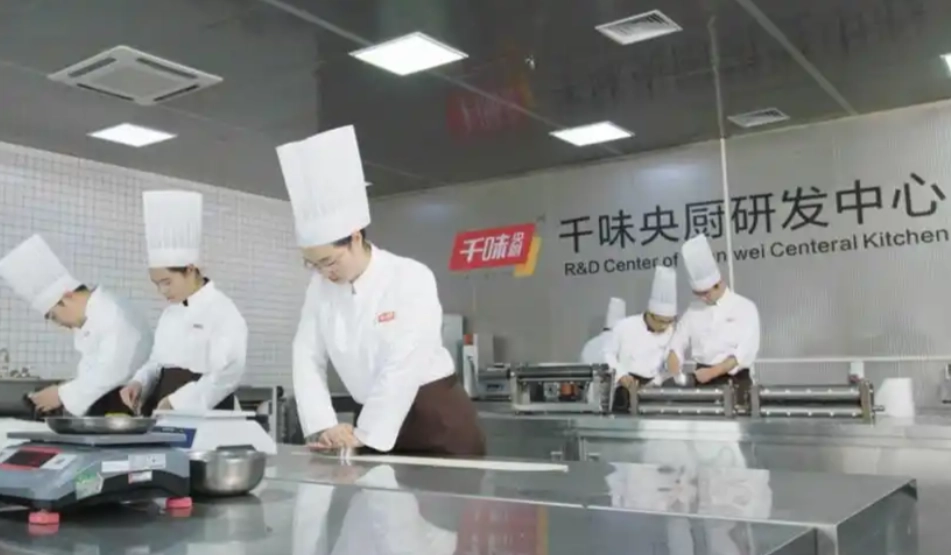
At a time when quick-frozen flour and rice products are mired in a red ocean of homogenization, and B2B foodservice supply chains are being squeezed to the limit by downstream restaurant companies cutting costs and driving down prices, Qianwei Central Kitchen—hailed as the "No. 1 Stock in Prepared Dishes/B2B Supply Chain"—has quietly launched a cross-industry counteroffensive in its home base of Zhengzhou. A registered capital of 80 million yuan is by no means a trivial matter, but when a food supply chain giant, an emerging humanoid robot dexterous hand pioneer, and a private equity fund management institution appear together on the shareholder roster of Zhengzhou Qianqiao Technology Co., Ltd., this cross-industry move is by no means a routine financial investment. Rather, it is a far-sighted, asset-heavy positioning play by a traditional foodservice supply chain—before the critical tipping point of "machines replacing humans" in commercial kitchens arrives—aimed at retaining control over scenarios and processes, and avoiding becoming a mere contract manufacturer in the future.
Equity Penetration: The Rights and Responsibilities Foundation of the New Entity
Tracing the equity penetration through the commercial registration underpinnings to examine the rights and responsibilities foundation of this new entity, the demands of all parties are clearly preserved in the Tianyancha archives. According to the Tianyancha App, Zhengzhou Qianqiao Technology Co., Ltd. was recently established, with a registered capital of 80 million yuan and Sun Jian as its legal representative. Its business scope not only encompasses intelligent robot research and development, industrial robot manufacturing and sales, but also bundles in service consumer robot manufacturing, special operation robot manufacturing, and artificial intelligence industry application system integration services.
Shareholder Lineup: A Deeply Fragmented Cross-Industry Combination with Precise Meshing
In the shareholder lineup, Qianwei Central Kitchen stands alongside Lingxin Qiaoshou (Beijing) Technology and Beijing Bojia Private Equity Fund. This seemingly deeply fragmented cross-industry combination conceals an extremely precise meshing of interests:
Lingxin Qiaoshou, as a domestic hard-tech team focused on mechanical dexterous manipulation, force-controlled end effectors, and high-degree-of-freedom bionic hand research and development, holds the key to the most difficult challenges in robotics—fine grasping and soft-body perception technology;
Qianwei Central Kitchen holds long-term orders from leading national foodservice giants such as Yum China and Haidilao, and possesses the world's most stringent chain restaurant kitchen processing data and real application scenarios;
Meanwhile, the entry of the private equity fund provides risk buffering and capital leverage for the heavy-asset transformation of production lines and technology conversion in the early stages.
The Deeper Driving Force: The Labor Cost Tipping Point and Yield Bottleneck
The deeper driving force behind this 80 million heavy bet is the labor cost tipping point and yield bottleneck that the foodservice supply chain and chain restaurant kitchens are approaching.
For a long time in the past, the automation transformation of quick-frozen foods mainly remained at the front-end rough stages such as automated dough mixing, tunnel quick-freezing, and assembly-line packaging. However, once it comes to processes such as kitchen reheating, skewering, wrapping and pinching, precise sorting, and forming special-shaped dim sum, traditional rigid industrial robotic arms completely fail. Chinese-style dim sum and fresh ingredients have extremely high softness, stickiness, and non-standard forms. Ordinary two-finger grippers either easily pinch through the dough skin and cause filling leakage, or cause detachment due to insufficient gripping force.
Such processes have long had to rely on massive, labor-intensive manual operations, which not only involve extremely high personnel turnover and persistently high management costs but also face uncontrollable food hygiene risks.
Lingxin Qiaoshou's expertise in multi-degree-of-freedom bionic dexterous hands and tactile force-control algorithms is precisely the hardcore missing piece to solve the "grasping of non-standard soft objects" in food processing. By combining the dexterous hand's highly sensitive tactile feedback with an AI vision system, the robot can dynamically adjust gripping force based on the dough's softness and moisture content, achieving pinching motions similar to those of a skilled dim sum chef. By establishing Qianqiao Technology, Qianwei Central Kitchen is in effect converting its decades of exclusive physical and mechanical parameters and temperature processes accumulated on fried dough sticks, sesame balls, and egg tart shells into algorithm models for robot end effectors, thereby fully realizing "machines replacing humans" for highly difficult processes in factory workshops and large restaurant central kitchens.
Strategic Ambition: From Food Manufacturing to a Dual-Driven Model of "Food Consumables + Intelligent Equipment Operations and Maintenance"
A deeper strategic ambition points to a dimensional upgrade of the B2B service model for chain restaurants.
Qianwei Central Kitchen's moat has never been merely selling a few boxes of frozen dough; rather, it is providing one-stop customized kitchen solutions for major clients such as KFC and Pizza Hut. However, the gross margin of simply selling semi-finished dim sum products is highly vulnerable to erosion by fluctuations in bulk raw material prices such as flour and oils. If Qianwei Central Kitchen can leverage Qianqiao Technology to not only provide standardized quick-frozen flour and rice semi-finished products to chain giants like Yum, but also deliver complete sets of "special foodservice robots + automated kitchen workstations + intelligent software integration," its business model will leap directly from traditional low-margin food manufacturing to a high-barrier dual-driven model of "food consumables + intelligent equipment operations and maintenance."
This playbook can not only deeply lock down the kitchen traffic flows of major B2B clients, making it nearly impossible for competitors to replace them through simple price wars, but also, by virtue of special operation robot integration licenses, charge continuous equipment leasing and technology integration service fees from external central kitchens, group meal companies, and even hospital and university cafeterias.
Signal and the Great Engineering Test
This 80 million yuan commercial registration move in early autumn sends a clear signal to the entire food and embodied intelligence industry chain: The commercialization of artificial intelligence and robotics is no longer a one-sided affair of tech companies building in isolation; it must be led by industrial giants with the hardest-core industrial scenarios stepping in as chief architects. Qianwei Central Kitchen is using large-scale scenarios to attract hard tech, installing dexterous hands into kitchen workshops, attempting to smash open a new intelligent space above the ceiling of the traditional food industry.
But in the harsh kitchen environment of grease, high temperatures, high humidity, and frequent washing, whether highly precise bionic robotic hands can maintain an extremely low failure rate and controllable maintenance costs is the great engineering test that Qianqiao Technology must face directly after its commercial registration.