XPeng AeroHT raises registered capital to $340 million
XPeng AeroHT lifted its registered capital to $340 million as it builds a Guangzhou plant for its Land Aircraft Carrier modular flying car ahead of mass production.
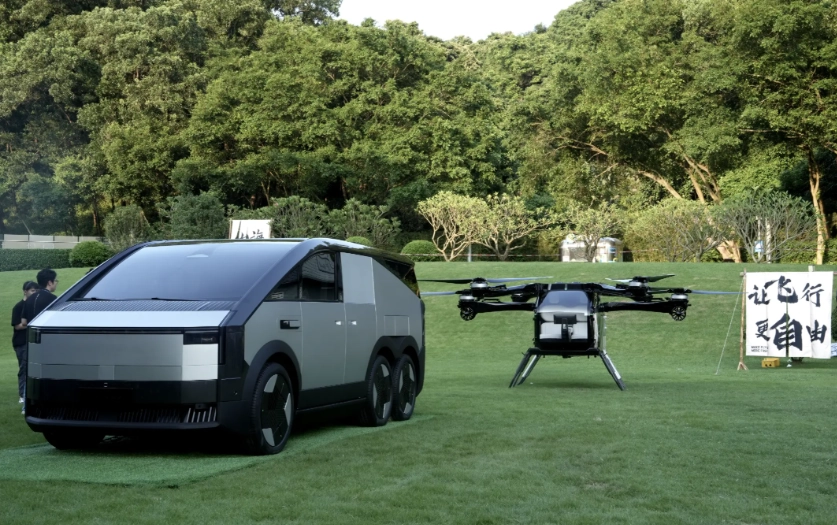
XPeng AeroHT has raised the registered capital of its onshore operating company to $340 million from $330 million, a $10 million increase, as the XPeng-backed flying car maker moves toward certification and mass production.
The sum is modest next to the several billion yuan of outside strategic funding XPeng AeroHT has already raised. But the direction of the money matters: an offshore holding company keeps topping up its Chinese subsidiary in hard currency. That points to peak spending on the Land Aircraft Carrier, its modular flying car, as factory fit-out, flight testing and airworthiness review run in parallel.
A wholly foreign-owned onshore entity
Guangdong Huitian Aerospace Technology Co Ltd completed the business registration change, according to corporate records database Tianyancha. The company was established in December 2020, with founder Zhao Deli as legal representative.
Its business scope covers engineering and technical research and experimental development, vehicle sales, complete new energy vehicle sales, and the manufacture of aviation operations support hardware and components. Offshore-registered HT Flying Car Limited owns 100% of the entity.
After Zhao and He Xiaopeng restructured Huitian, the onshore company has served as the base for engineering work and domestic licensing. HT Flying Car Limited acts as the top-level fundraising vehicle. It carries XPeng's industrial backing as well as dollar investment from financial investors including HongShan and 5Y Capital, and from state-linked strategic backers such as the Guangzhou Development District.
Under this structure, repeated injections of tens of millions of dollars keep flexibility for future offshore capital market moves while adding paid-in capital for domestic research and manufacturing.
Heavy capex before deliveries
The deeper driver is the cost of building manufacturing capacity ahead of mass output. Most eVTOL startups lean on contract manufacturing or small-scale final assembly. XPeng AeroHT is building its own line.
Its flying car plant in the Guangzhou Development District is described as the world's first factory to use modern assembly lines for large-scale flying car production, with planned annual capacity of tens of thousands of units.
Such a plant needs high-cleanliness composite autoclave forming equipment, automotive-grade automated painting and assembly robots, and heavy supporting facilities: high-voltage powertrain testing, an all-weather test track and a dedicated runway. As the site shifts from construction to equipment installation and line commissioning, capital spending reaches its peak.
A larger registered capital gives the onshore entity a firmer credit base. That helps it win syndicated project loans, apply for equipment leasing and secure long-term payment terms with high-end aerospace composites suppliers.
Two sets of standards, one vehicle
The engineering logic runs through the company's split design. The Land Aircraft Carrier separates into a 6x6 all-wheel-drive extended-range smart cabin and a two-seat all-electric vertical take-off and landing aircraft. Splitting the vehicle sidesteps the problem that keeps integrated flying cars off public roads: wings that cannot fold flat and weight that exceeds road limits.
The ground module must clear the Ministry of Industry and Information Technology's passenger car announcement, crash safety tests and automotive durability validation. The air module must face the Civil Aviation Administration of China's type certificate (TC) review, including thousands of flight cycles covering tilt transitions, single-engine failure and full parachute system redundancy.
Matching automotive-style high tempo and low cost against aviation's zero tolerance for failure pushes monthly research spending above that of a typical electric vehicle startup. Every micro-mechanical part in the automatic separation and stowage mechanism needs tooling, wind tunnel testing and airworthiness validation, spending that runs to hundreds of millions of yuan.
Risk one: certification and delivery
Airworthiness certification for a new configuration is slow and hard to predict. Even with the CAAC opening a fast track under its low-altitude economy push, a new VTOL design must accumulate long runs of flight test data before a TC is granted.
If the certificate is delayed, thousands or even tens of thousands of intended orders cannot be legally delivered or invoiced to consumer buyers. Depreciation on a large production line and stocked inventory would then weigh on cash flow.
Risk two: airspace and infrastructure
Even once the vehicle is in mass production and sold into the premium market at around 1 million yuan (about $140,000), whether ordinary buyers can actually fly depends on local airspace approval times, low-altitude radar surveillance coverage, and charging and maintenance support at vertiports.
If use stays confined to a handful of scenic sites and designated remote airspace, the commercial case for flying cars as everyday transport weakens sharply, and the scale needed to keep a line busy becomes hard to reach.
A costly industrial skeleton, an open question
The $340 million registered capital and wholly foreign-owned structure on Tianyancha trace the bet of a Chinese team that began as a lone flying enthusiast and now sits where the electric vehicle and low-altitude economy industries meet.
XPeng AeroHT has spent billions of yuan on the industrial frame for its route to the sky. Whether that frame can deliver on the promise of the world's first mass-produced and delivered flying car, under the laws of physics, aviation's absolute safety line and a long commercialization cycle, is the question the company must now answer.