Qianye Jewelry listed as unreachable at its registered address
Beijing regulators put Qianye Jewelry on the business abnormality list after losing contact at its registered address, underscoring the jeweller's long retreat from department stores.
Beijing's Dongcheng District Market Supervision Administration has added Beijing Qianye Jewelry Co. Ltd. to its list of businesses out of contact, saying the jeweller cannot be reached at its registered address or place of business.
The listing is an administrative warning, but for a chain that once raised its profile with a Hollywood spokeswoman and a nationwide push into high-end department stores, it marks a stark slide. Qianye's retreat shows how traditional jewellers are being squeezed by weak demand for diamond-set pieces and by the shift of spending into plain gold.
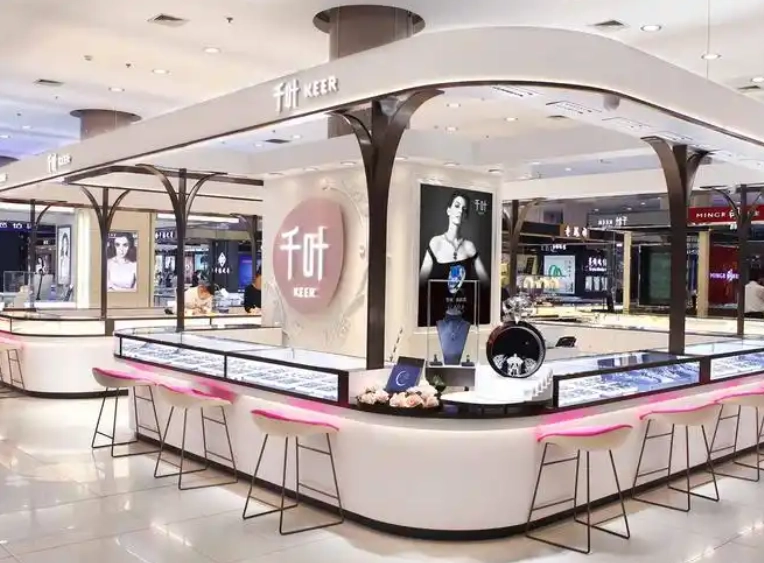
Registered address no longer reachable
Corporate records on Tianyancha, a Chinese business database, show Beijing Qianye Jewelry was founded in March 2001 with registered capital of about 110 million yuan (about $15.5 million). Its legal representative is Lin Mingjie. Its business scope covers corporate management, craft and art design, exhibition services, and the sale of jewellery and handicrafts.
Lin, the founder, is the controlling shareholder and actual controller. Individual shareholders include Gao Xiaosong and Lin Huixian.
The register paints a contrast between past ambition and present absence: more than 100 million yuan of registered capital, a joint-stock structure, and now an address the regulator cannot use to find the company.
From NEEQ listing to a stalled A-share IPO
Qianye grew with a decade-long boom in Chinese gold and jewellery consumption, tying itself closely to core department stores in major cities. It carved out space against chains such as Chow Tai Fook and Lao Feng Xiang with a "light luxury" positioning, a focus on gem-set jewellery, and endorsement by international film stars — Anne Hathaway was among its backers.
After listing on the NEEQ, the country's over-the-counter board for smaller companies, in 2015, Qianye began preparatory work for an A-share listing. The IPO never happened. With performance under pressure, the company delisted from the NEEQ several years ago and withdrew from the capital markets' spotlight, beginning a multi-year decline in its store network and brand presence.
Diamond-set jewellery fades, gold demand concentrates
The first force behind Qianye's retreat is the twin squeeze on diamond-set jewellery and on a market where gold purchases have become highly concentrated.
Qianye's early profit engine was built on K-gold, diamond and coloured-stone set pieces with gross margins of 50% to 60%. That ground shifted. Industrial production of lab-grown diamonds undermined the scarcity story of natural stones, and younger buyers turned away from engagement rings and high-markup set jewellery. The sector has faced a long destocking winter.
Consumer budgets instead flowed almost entirely into pure gold jewellery and bars, which are seen as a store of value.
Plain gold, however, is a thin-margin, capital-heavy business. Gross margins typically run at just 10% to 15%, and the model depends on rapid turnover and large stockpiles of raw material. With gold prices at record highs, shoppers have held back as per-gram prices climbed, weakening volume sales.
For a regional player like Qianye — slow to shift strategy, without a membership seat on the Shanghai Gold Exchange or the backing to fund a large gold supply chain — the outcome was a double bind. It could not sustain old margins on diamond-set pieces, and the interest cost of holding inventory drained cash in the high-risk, asset-heavy gold business.
Channel collapse: department store counters unravel
The more damaging blow was the breakdown of the traditional department store concession model and the shrinkage of offline retail.
Qianye relied heavily on revenue-sharing counters in established department stores in Beijing and northern China. Traffic at those stores was captured by newer shopping malls and by live-streamed e-commerce, eroding the model's advantage. Retailers still faced fixed minimum rents, mall commissions and depreciation on counter fit-outs, plus settlement periods that stretched for months.
As sales per square metre fell, many directly operated and franchised counters slipped into chronic losses, forcing large-scale closures to stop the bleeding. As management teams shrank and stores left prime shopping areas, the old office address used for registration was not updated after its lease expired. The regulator's spot check exposed the operating reality behind it.
An ageing brand caught in the middle
Qianye was also squeezed between old and new rivals, and its ageing brand image hastened its loss of relevance.
CHJ Jewellery and Laopu Gold pushed aggressively into traditional gold craftsmanship and collaborations with Chinese cultural trends. At the same time, the Shuibei wholesale gold model, sold through online daigou agents, undercut the price premium of established brands.
Qianye built no defensible position in heritage gold craft or in gold's cultural storytelling, and it could not compete on price with unbranded gold. With little investment in product development or youth-oriented social marketing, it became effectively invisible to consumers born in the 1990s and 2000s, fading from a light-luxury favourite to a neglected niche player.
Hard questions after the alert
The 110 million yuan of registered capital and the out-of-contact warning on Tianyancha together record the quiet exit of a jewellery veteran that rode two decades of Chinese consumption upgrading. A business abnormality listing is a regulatory status that can be fixed.
What it reflects — a lost retail network and a stalled core business — is an organisational problem that a change of address cannot cure. As the gold and jewellery industry concentrates around state-backed leaders and fast-rising domestic trend brands, the coldest question is whether Qianye can clear its old inventory and debt knots and restructure itself back to health.