Weibo bars new followers for influencer Li Ji after retirement post
Opinion blogger Li Ji lost Weibo's follow feature a day after announcing his exit, while corporate records show most of his six firms shut and one under a spending ban.
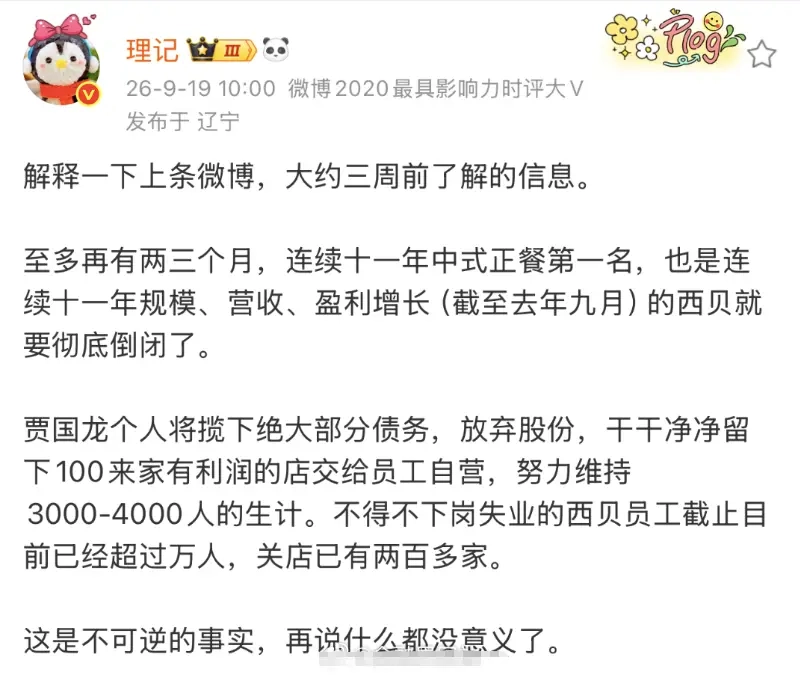
Weibo has blocked new followers from Li Ji, a veteran current-affairs commentator with more than 5 million followers, a day after he announced his retirement from all platforms in a 10,000-character post.
The timing punctured the farewell. Weibo said the account had violated laws or regulations or its community rules — a penalty that landed while the Cyberspace Administration of China is running a campaign against self-media accounts that farm followers without limits and use public issues for paid public-relations fights and malicious hype.
Corporate records point to a second problem. Behind the online persona, much of the business has been wound up, and one surviving company carries a court order restricting how Zhang Yang — Li Ji's real name — can spend.
Six companies, two still standing, one spending ban
Zhang is linked to six businesses, according to Tianyancha, a corporate records database. Only two remain active: Chaoyang Hansen Hengfa Investment Co and Chaoyang Fengyang Commercial Plaza Management Co. The other four have been deregistered or had their business licences revoked.
Fengyang Commercial Plaza, the surviving property management arm, is subject to a consumption restriction order, a court measure that limits spending on non-essential goods and travel. The person named in the order is Zhang himself.
The company had already faced court enforcement over the same case for just over 40,000 yuan (about $5,600).
An unpaid bill of that size, followed by a spending ban, sits oddly with the image of a commentator who shapes national debate and drives public issues to millions of readers.
The filings show how hollow the offline operation has become: affiliates deregistered en masse, and the remaining property and investment vehicles stuck in small claims and enforcement proceedings.
From 'investigative reporter' to polarising traffic
Zhang made his name in 2015 with a first-person account of taking on China Southern Airlines over an in-flight medical emergency. The episode built an early reputation for rigour, professionalism and a search for the truth.
The strategy shifted as self-media economics turned algorithm-driven and controversy became a revenue stream. He weighed in on the Hangzhou nanny arson case and a medical dispute at Aier Eye Hospital, and spent years attacking Jiang Ge's mother.
His positions grew increasingly contrarian, courting notoriety by taking the angle most likely to inflame. On business topics, he has repeatedly been accused of using his reach to intervene in corporate PR battles, dropping selective disclosures and steering sentiment to split public opinion.
When verification gives way to taking sides, and public reach becomes leverage for private influence or commercial gain, the model leaves the realm of legitimate scrutiny — and runs into the legal limits set for online speech.
A retirement announced hours before the penalty
In the essay, Zhang framed the exit as voluntary: weariness with conflict, an idealist's clean break.
The platform's penalty the next day suggested his output was already under regulatory and compliance review. The "voluntary" retirement reads as a defensive move by someone who sensed a ban, the loss of a platform, or scrutiny at a higher level.
The essay sought one last wave of sympathy and online grievance, obscuring an exit that was not his to choose.
Influence versus a court order
The consumption restriction and the corporate wreckage logged on Tianyancha are a cold footnote to the decline of one of China's best-known self-media figures.
The internet is not outside the law, and it is not a shelter where clever wording buys unlimited immunity. Once the platform strips away the privilege of passing judgment online, and the enforcement records stay on file, influence built on information manipulation erodes quickly against real-world legal obligations.