Xinyan Robotics launches Bubbo 1 companion robot for families
Xinyan Robotics launched Bubbo 1, a family companion robot running on its own Bubbo OS with 26 sensors, priced from 7,999 yuan (about $1,130).
Xinyan Robotics launched Bubbo 1, a companion robot for families, in Beijing on Oct 29, pricing it at 9,499 yuan (about $1,340) and betting that emotional interaction, not screens, is what brings AI into the home.
The company, founded in 2025 and focused on emotional-intelligence robots for households, says a machine that moves, senses and recognizes each family member can do what screen-based assistants have not. Bubbo 1 is on sale now through JD.com and other official channels.
The robot hosted its own launch event, calling industry and academic guests to the stage.
Huang Yuan, a deputy division chief at the Zhongguancun Science City Administrative Committee, said the product marks a test of "human-machine symbiosis" in real homes. "Bubbo shows us that embodied robots can have both hard capability and warmth," he said.
Cao Yi, chairman of the Zhongguancun High-Tech Association, asked Xinyan to stay with "technology that has temperature," keep pushing on emotion computing, large models and embodied intelligence, and build a benchmark company rooted in Zhongguancun.
Interaction, not screens
Founder and chief designer Ren Yongliang argued that "technology sets the floor on experience, interaction sets the ceiling." Screen-based interfaces have held back consumer adoption of AI, he said, and Xinyan spent two years developing a product built around companion-style interaction.
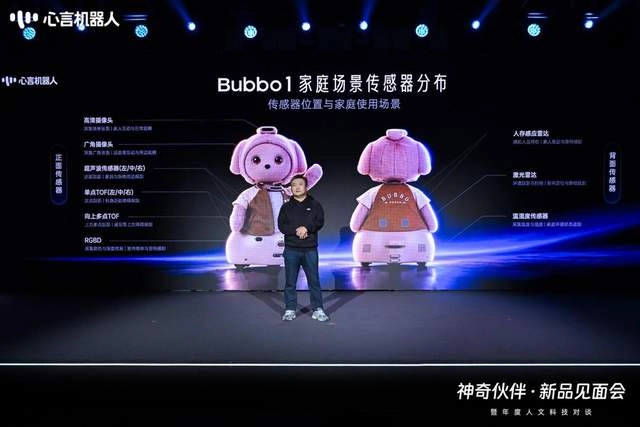
Bubbo carries 13 types of sensor, 26 in total — the most of any embodied family robot, according to the company. Output comes through six degrees of freedom and two expression screens meant to convey complex emotion.
A camera-based heart-rate monitor offers non-medical alerts, and a partnership with the Cece smart ring lets devices share data so the robot can track shifts in a user's mood.
Its replies are designed with "delay, breathing and boundaries" — enough realism to feel present without encouraging over-dependence. Bubbo 1 ships bilingual, with a tiered dialogue system that adjusts the depth of its answers to what the user can absorb.
"We want Bubbo to be a bridge, giving autonomy back to children and space back to families, using AI to spark human initiative," Ren said. He described the robot as a household photographer that records family moments. "With Bubbo, we hope every family ends up with a few more group photos."
A partner or an appliance?
At the event's annual human-technology dialogue, Geek Park founder and CEO Zhang Peng asked what a robot should be when it enters a home of people who feel joy, loneliness, ageing and temper — a more capable appliance, or a partner that understands people.
Ren said past AI was a tool summoned by voice: silent until called. Companion interaction, by contrast, means the robot approaches and responds on its own. It rests on four traits — an independent subject, autonomous movement, real-time multimodal sensing and semantic events. Recognizing that someone is present is not enough, he said; the robot must know who they are, what they said before and how they feel now.
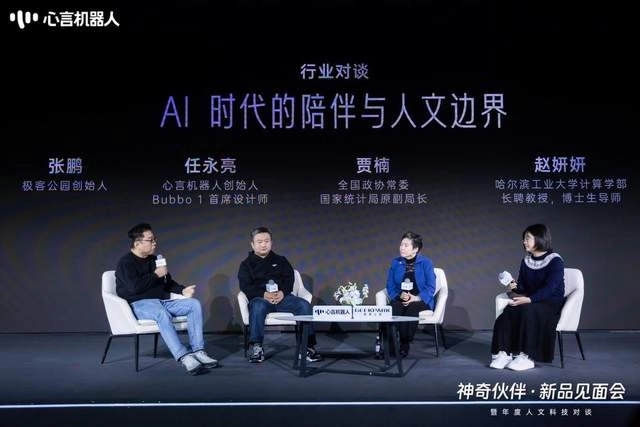
Jia Nan, a standing committee member of the Chinese People's Political Consultative Conference and former deputy head of the National Bureau of Statistics, focused on ageing. She argued for companion robots in home and community care, and said Bubbo should refine flexible emotional exchange that fits different users, especially older people living alone.
Zhao Yanyan, a professor at the Harbin Institute of Technology, said understanding emotion splits into three technical layers: sensing, cognition and interaction. Each relies on rich multimodal signals and context, plus the ability to follow and sense while moving. She said the core task is remembering the user well enough to respond with accurate empathy.
Partners and pricing
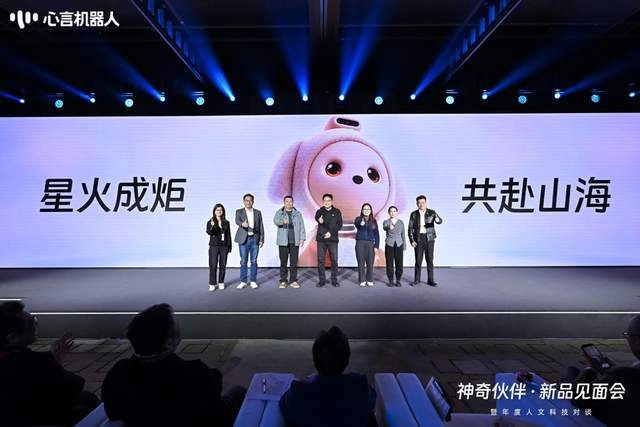
Xinyan co-founder Zhang Xinhua took the stage with representatives of Shaanxi Ruixun Electronics, JD Retail's smart robot division, Ingram Micro China, Beijing Shoucheng Robotics, Beijing Yingchao Technology and Boshi Investment-Boshi Mercedes-Benz to launch strategic cooperation.
"Every step from today's stage to tomorrow's lit windows needs fellow travellers," Zhang said, thanking ecosystem partners for making the robot reachable. "Let reliability be the foundation of companionship, and let users feel at ease."
The first mass-produced Bubbo rolled off the line in mid-August. Buyers ordering from Oct 29 pay 9,499 yuan, with the first 1,000 orders at a promotional 7,999 yuan (about $1,130).