Wujie Dynamics Inks JD.com Retail Robotics Deal
Wujie Dynamics will deploy embodied AI robots in JD retail settings under a 1 billion yuan partnership, testing commercial viability beyond demos.
Chinese robotics startup Wujie Dynamics has signed a strategic partnership with JD.com targeting 1 billion yuan ($141 million) in product collaboration, testing embodied AI in real retail settings.
The deal gives the 18-month-old company access to JD.com’s stores, warehouses and distribution network at a time when robot developers are being judged on real-world returns rather than demonstrations. Wujie’s K15 robots are already operating at two 7Fresh Cafe stores in Beijing, and the first hardware units have been delivered to third-party customers through JD.com.
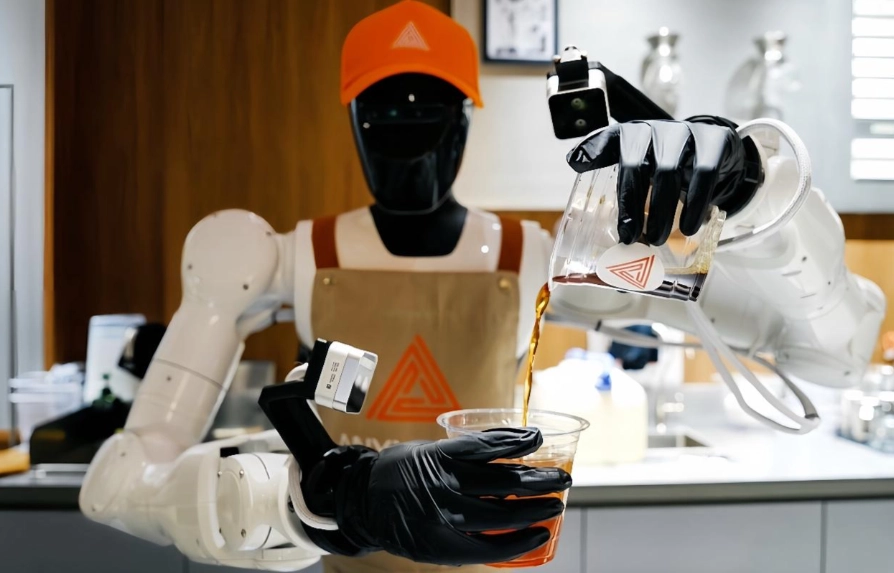
Under the Oct. 31 agreement, reported by China Securities Journal, the companies will work on retail applications for embodied AI products, commercialization platforms and ecosystem channels.
For JD.com, the partnership links its offline retail, warehousing and delivery operations with a new robot maker. The goal is to use fragmented retail scenarios as a commercial testing ground before large-scale embodied robot production begins globally.
Four funding rounds, JD-linked backing
Corporate records provider Tianyancha shows Wujie Dynamics (Beijing) Technology R&D Co., Ltd. was established in March 2025. Its legal representative is Zhang Yufeng, and its registered capital is about 1.1781 million yuan.
Its approved business scope includes AI basic software development, AI application software development, AI hardware sales and computer system services.
Tianyancha records show four financing rounds in a short period. In June alone, its Angel+++ round reached 400 million yuan, with investors including a JD.com-linked fund, C Capital, Hony Capital and HongShan.
Patent records also point to its engineering focus. Published patents include methods and devices for controlling multiple execution units, and fault diagnosis based on domain controllers.
Autonomous-driving team
Zhang is a former vice president at Horizon Robotics. His background in autonomous-driving chips and algorithms aligns with the startup’s patents on domain controllers and execution-unit fault diagnosis.
The team brings an auto-industry focus on reliability, functional safety and low-cost mass production of heterogeneous computing power.
JD.com’s linked fund first invested in the 400-million-yuan angel round. The group then followed with the 1-billion-yuan business partnership, opening 7Fresh stores, forward warehouses and logistics routes as real-world training sites.
Hunt for real-world data
A major driver of the partnership is the embodied AI industry’s need for data from complex physical environments, rather than simulations or laboratory teleoperation.
- 7Fresh Cafe stores involve moving customers, changing lighting, non-standard cup placement and frequent vibration.
- The K15 can collect data on rare errors and fine force-control feedback while working in an actual service workflow.
- JD.com’s retail network gives Wujie immediate commercial users, helping it avoid relying only on lab demonstrations.
JD.com’s instant-retail pressure
JD.com also faces rising labor costs in instant retail and omnichannel operations. Stores such as 7Fresh need staff for warehouse sorting, freshly made drinks and shelf restocking amid intense competition.
- Traditional industrial arms lack mobility and general interaction skills.
- Two-legged humanoids can be energy-hungry, expensive and prone to falls in commercial venues.
- The K15 uses a wheeled base and two arms, combining stable movement with dexterous operation as a near-term engineering solution.
JD.com also plans to distribute robots through its own platform to third-party customers. That could turn it from a retailer into an integrator of embodied AI commercialization standards and hardware-software distribution.
Unit economics and reliability
Wujie still faces major tests on hardware yields and commercial return on investment.
In a high-turnover 7Fresh Cafe, the key question is whether robot purchase, maintenance and depreciation costs are materially below the hourly wage of a skilled worker.
If the K15’s mean time between failures does not meet industrial standards, or a mechanical stoppage requires costly remote technical support, the robot could become an operational burden rather than a cost saver.
Can the 1-billion-yuan target be met?
It is comparatively manageable for JD.com to buy or use the first trial units in its own operations. Selling thousands or even tens of thousands of robots to supermarkets and tea-drink chains will be harder.
External customers will require complex cross-brand system integration and are closely watching capital spending. If the offline consumption recovery remains weak, demand for long-cycle automation investment could cool, leaving Wujie exposed to inventory and production-line costs.
The partnership opens a route from prototype to industrial-scale production. Whether Wujie crosses that gap will depend on real order turnover, hardware reliability and willingness among third-party businesses to pay.