Small-Town Youth, Global Harvest
Chinese AI short dramas are reshaping the global audiovisual industry with low cost and high efficiency, dominating overseas markets and achieving cultural export.
The core resources of the global audiovisual industry, over the past century, have been concentrated primarily in the large studios of Hollywood, Los Angeles.
The barriers formed by high capital requirements, top-tier movie stars, heavy equipment, and massive post-production teams have made the Western-dominated content industry standards difficult to challenge for a long time. For years, non-Western content creators have largely played a follow-on role in this system.
However, the walls of this established order are being quietly shattered by a set of codes from China.
In the third quarter of 2025, among the top 30 short drama apps in overseas markets, Chinese apps captured a staggering 93.52% share of revenue, with an almost aggressive dominance.
On this visually striking commercial landscape, just two giants—ReelShort and DramaBox—together swallowed up nearly 60% of the massive overseas short drama market.
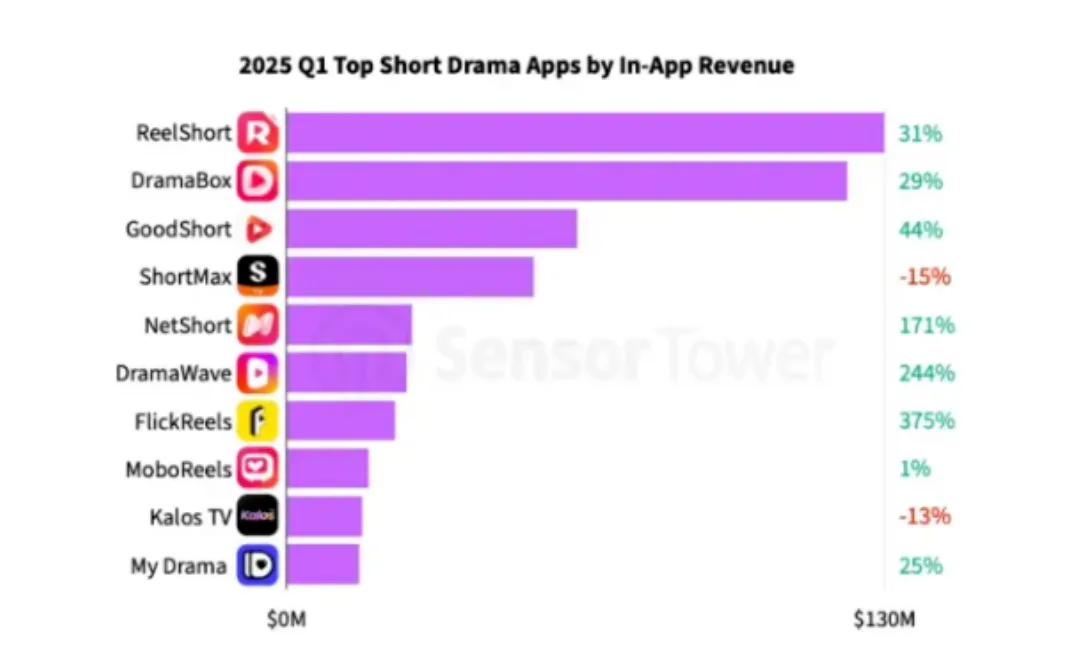
In 2025, overseas revenue from Chinese short dramas surpassed $2.3 billion, up nearly 30% from $1.8 billion in 2024. In the first half of the year alone, revenue reached $1.088 billion, a year-on-year surge of 249%.
In this emerging track now exceeding the $10 billion scale, Chinese content producers have carved out an unprecedented fast lane.
Leveraging leaps in foundational AI technology and an extremely sharp sense of local content trends, we have skipped the long and heavy accumulation phase of the traditional film industry, using algorithms to directly reconstruct the factors of production.
This is an audiovisual revolution led by Chinese forces—from once hesitantly "following behind" to now forcefully defining a brand-new digital consumption track. Chinese standards are being exported globally at an unprecedented pace, reshaping the competitive landscape of the industry.
The Death of Hollywood's Heavy Industry
The essence of the traditional audiovisual industry lies in using extremely large amounts of capital to hedge against the uncertainty of box office returns.
For a top-tier live-action short drama, production costs can easily climb to as high as 3 million RMB. From location scouting and set building to filming and lengthy post-production editing, the cycle lasts 30 to 45 days.
This asset-heavy, slow-turnover model is inherently a game for a few capital giants—it is extremely fragile and leaves very little room for error.
But the arrival of AI technology has reshaped this cost curve with remarkable force.
Today's AI-powered live-action short dramas have squeezed production costs down to around 1,000 RMB per minute. A complete 80-minute short drama can have its total cost precisely controlled within the range of 80,000 to 100,000 RMB—just one-tenth of the expenditure of a traditional live-action production.
The underlying logic behind this dramatic cost reduction lies in the extremely high reuse rate of digital assets. Once character templates and scene models are established in the cloud, their reuse rate can easily exceed 90%.
This means that as output increases, marginal costs approach absolute zero.
Along with the capital barrier, the extremely heavy production cycle is also being dismantled.
Relying on the full-process industrialized pipeline of "script—storyboard—generation—editing" developed by Chinese companies, a piece that previously took over a month to refine can now be mass-produced in just 7 to 10 days.
This ultimate "Chinese efficiency" is by no means shoddy work achieved at the expense of quality.
On the contrary, technology is crossing the "uncanny valley" at astonishing speed. Early AI-generated content often appeared stiff and disjointed in micro-expression control, but today's technology has achieved precise command over complex human emotions such as "three parts mockery, three parts aloofness, and four parts nonchalance."
Subtle twitches of the orbicularis oculi muscle, the rise and fall of the chest during a character's breathing—the generation of these micro-movements gives virtual characters a refined "acting ability" that conveys deep subtext.
When the cost of trial and error is spread infinitely thin, and when productivity is massively unleashed, content creators can flood the market with high-quality tests in a "small steps, fast iterations" manner.
Chinese companies are using highly penetrating algorithms to compress Hollywood's massive heavy-industry assembly line into cloud servers.
Chinese Code Goes Global
This efficiency revolution is now proving its impact on the overseas battlefield.
For a long time, the biggest pain point for Chinese cultural exports has been the barrier of context and limited distribution channels.
But this time, short dramas have crossed that divide, completing a highly impressive cultural breakthrough.
The overseas short drama market is in an explosive growth trajectory. Overseas short drama apps reached 1.855 billion downloads in 2025, with a market size of $4 billion, and are expected to surpass the $5 billion mark in 2026.
In this enormous incremental market, Chinese apps hold absolute dominance with over 90% share.
Why can Chinese companies win? Because what we export is no longer just a single cultural product, but a complete, unassailable commercial ecosystem infrastructure.
Chinese short drama players going overseas have demonstrated astonishing localization insight. To precisely match the aesthetics and consumption habits of European and American users, these companies have set up local writing teams abroad, delving deeply into highly localized genres such as vampires, werewolves, and campus romance tropes.

In the North American market, the AI live-action short dramas launched on ReelShort have performed exceptionally well, generating approximately $600 million in revenue for the full year 2025.
Meanwhile, FlareFlow, the international micro-drama platform newly launched by Chinese Online in April 2025, saw initial monthly recharge revenue growth exceeding 500%, with an average of around 600,000 daily active users at the time, and its user base continuing to expand.
The platform has launched over 3,000 short dramas, covering 177 countries and regions worldwide, with estimated cumulative in-app purchase revenue exceeding $20 million.
This is an extremely advanced form of going global.
We use China's years-accumulated web novel IP as the storytelling core, China's most advanced AI video foundation models as the production engine, and layer on the precise traffic distribution and micro-transaction payment mechanisms that Chinese companies excel at.
This combination of "short, fast, and light" tactics precisely hits the fragmented entertainment needs of the global younger generation.
In this brand-new track, Chinese players are writing the new rules of global content consumption with an unprecedented and assertive posture.
The Grassroots Dream-Making Assembly Line
If the macro market data showcases commercial sharpness, then the turning points of individual destinies give this technological revolution its most authentic human warmth.
But more moving than the data are the human stories.
In the past, making animation or shooting films and TV series was the exclusive domain of a few trained elites and capital players. Expensive rendering equipment, complex camera choreography, and massive crew budgets kept the vast majority of talented ordinary people firmly outside the door.
But today, the barriers to the means of production have been completely broken through.
The democratization of technology is giving rise to a magnificent movement of creative empowerment in lower-tier markets.
In Deqing, Huzhou, Zhejiang, a post-95s founder set up his company there, organizing several AI comic drama production teams of just 3 to 4 people each. On average, they can complete the entire production process of a single work and recoup costs every month.
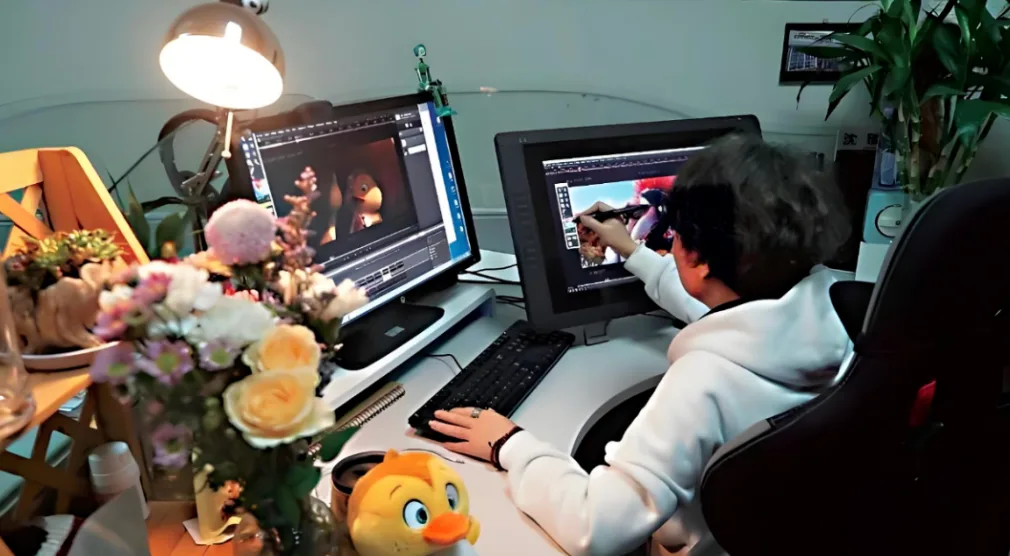
Previously, training an animator capable of working independently took anywhere from six months to a year. Now, simply by typing in text, AI can generate images in seconds and string them together into complete storylines.
This is a dream-making assembly line built for young people from small towns.
Furthermore, the widespread adoption of technology has genuinely shifted the production of film and television content from "capital-intensive" to "creativity-intensive."
When everyone can obtain extremely high-quality visuals at very low cost, "understanding narrative and being able to tell a story" becomes the most solid moat.
AI has improved the efficiency of "drawing," but "what story to tell" and "how to tell it well" remain exclusively the domain of the human mind.
This democratization has greatly enriched the diversity of supply in the content market. Genres such as fantasy, post-apocalyptic, xianxia, and suspense—previously difficult to produce due to high live-action costs—are now experiencing a full-scale boom with the support of AI.
Even in niche verticals like ice and snow sports, Hongguo has successfully launched several passionate comic dramas, including "Blade and Star Trail: A Dance of Heaven and Earth" and "Twins on Ice."
Technology has given grassroots creators the right to express themselves, allowing every good story the possibility of being seen by the world. This is also the deepest confidence of China's content ecosystem.
However, when everyone can produce at low cost, what is the real barrier?
Content Faith in the Algorithm Age
Once AI solves the efficiency and cost problems on the industrial assembly line, what truly determines whether this industry can transcend its life cycle and escape the fate of meteoric rise and fall is the leading studios that hold fast to content depth.
On this fast-charging track, top-tier production houses represented by Tinghuadao (Listening to the Flower Island) show us the human warmth and artistic pursuit that operate within the machinery of commerce.
Audience aesthetic evolution is happening far faster than imagined.
By 2025, short drama audiences had undergone a cognitive awakening—from "I'll just turn off my brain and watch" at the start of the year to "Is there nothing more to short dramas than just excitement?" in the second half. They began to reject insulting logic and demand greater emotional depth and aesthetic quality.
At this critical juncture, Tinghuadao delivered a response of overwhelming dominance.
In 2025, out of the top 10 works on Hongguo Short Drama's annual heat rankings, Tinghuadao occupied an astonishing 9 spots, including "Great-Grandmother at Eighteen Takes Charge, Restoring Family Glory 3" with a heat value of 202 million, and hits like "Madam Only Treats Non-Compliance 3: Finding a Son-in-Law in the General's Mansion."
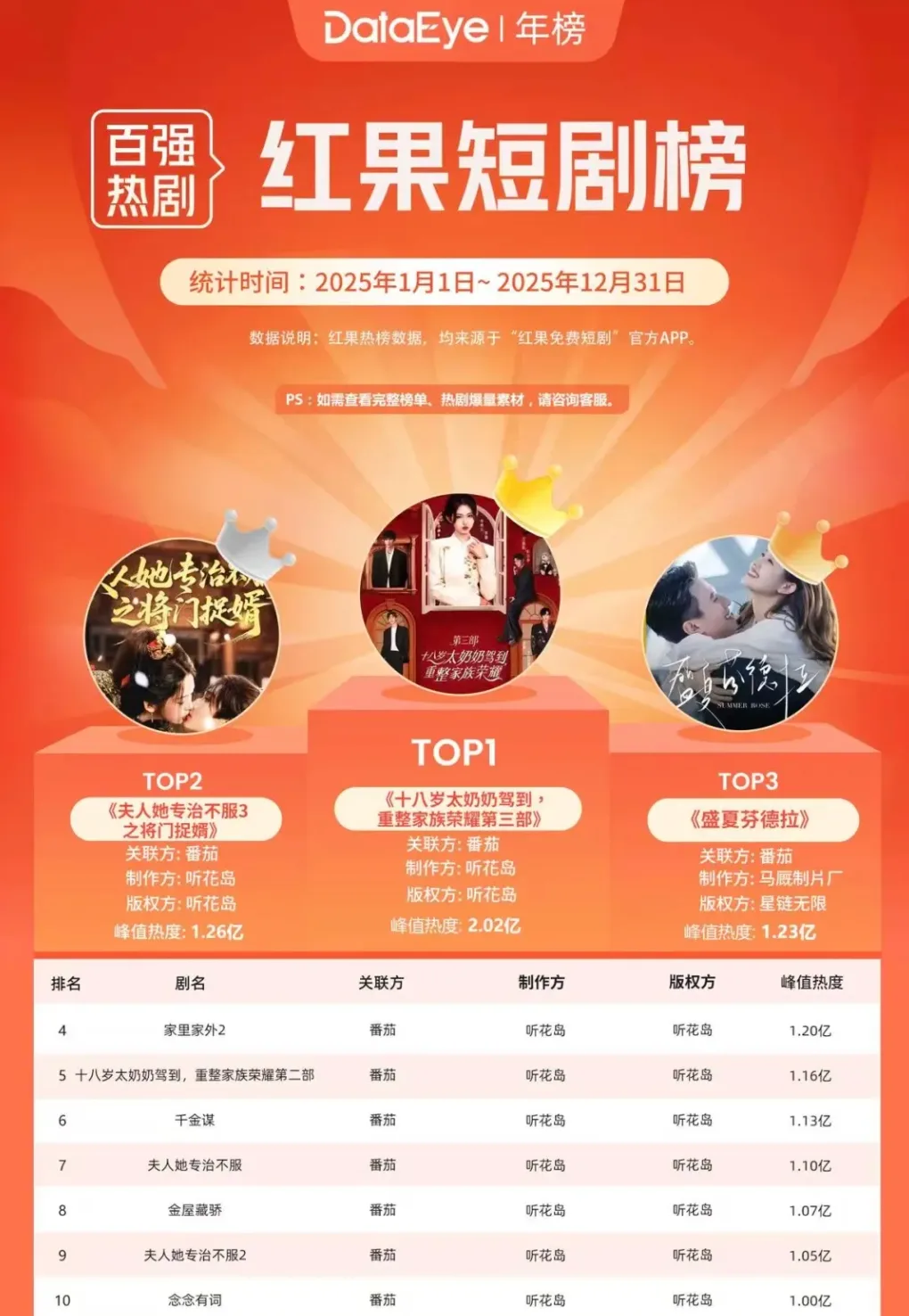
Behind those 100 billion views is by no means simple traffic stacking, but a fierce expansion and elevation of content boundaries.
To combat the industry-wide homogenization caused by producing the same script multiple times, Tinghuadao developed 17 original scripts from scratch, including "Home and Away" and "Echoes of the Heart."
They have even dared to plant seeds of rare genres in the wasteland of short dramas:
Suspense titles like "Daybreak" and "Blade of Justice" have been praised by audiences for having "cinematic quality, strong logic, and being thought-provoking."
The fantasy monster-hunting series "It's Okay, We're Family" abandons cliché romance, instead using four short stories filled with family and friendship, earning it the label of a "tearjerker" from viewers.
The rural legal drama "The Honor of the Judge" pays heartfelt tribute to judges working in the countryside.
Even more striking, Tinghuadao pioneered professional OST production for short dramas, inviting renowned singer Zhou Shen to perform the theme song "Time" for "Home and Away 2," using top-tier mainstream entertainment resources to amplify the emotional resonance of the characters.
This is the most captivating undertone of China's content industry.
When underlying algorithms provide the capability for massive generation, and when AI clears away the barriers of technical thresholds, houses like Tinghuadao continue to iterate at a pace measured in days, respecting the intelligence, emotions, and aesthetics of their audiences.
They have proven that no matter how rapidly technology advances, what can permanently lock in user loyalty and build an insurmountable moat are always the good stories that respect humanity and possess a unique expressive aesthetic.
Final Thoughts
When the spark of digital technology meets China's vast and resilient creative ecosystem, a global industrial evolution is all but certain.
We hold not only the world's most acute algorithmic distribution mechanisms and the largest reservoir of web novel IP resources, but we have also cultivated the infrastructure capability to rapidly turn technology into practical applications.
Within this fast-turning industrial gear, there are both countless grassroots creators who have gained a voice through the democratization of technology, and top-tier studios like Tinghuadao that are committed to original content and pushing the boundaries of art.
Together, they form a complete, healthy content ecosystem with a remarkable capacity for self-renewal.
But whether this system can continue to operate depends on the key shifts of 2026: from regulatory compliance to deep content cultivation, from traffic expansion to competition based on premium quality. A first-mover advantage is not the finish line, but rather the starting point of a new round of competition.