JAC-built Maextro V800 brake bracket fractures in braking test
Three Maextro V800s suffered brake pedal bracket fractures in hard-braking tests, hitting JAC Motors shares and raising safety concerns over Huawei-backed luxury EVs.
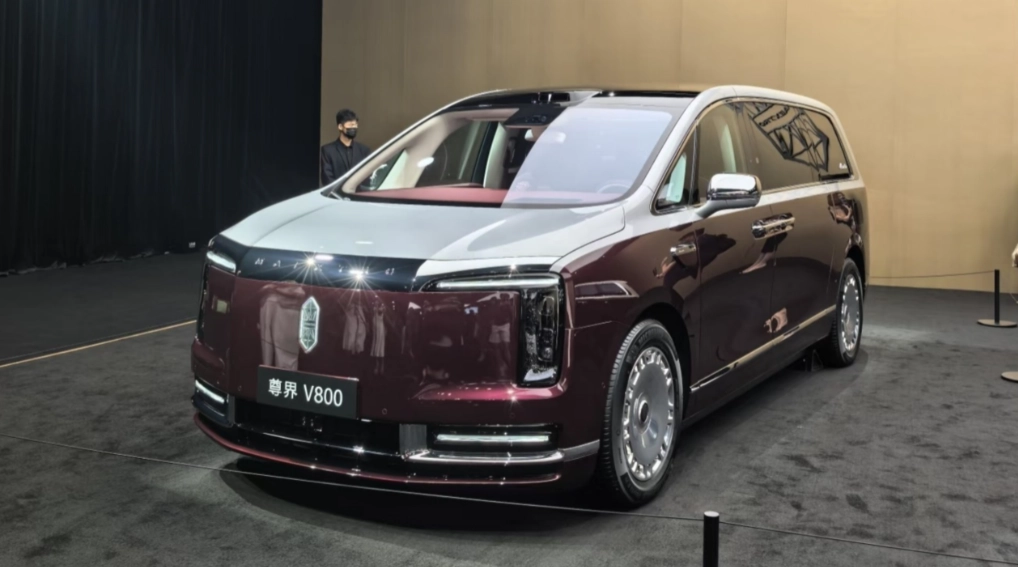
Three Maextro V800s from separate production batches suffered brake pedal bracket fractures during repeated emergency stops from 100 km/h, a Dongchedi test has found, sending shares in manufacturer JAC Motors into consecutive limit-down sessions.
The failure strikes at the heart of China's push into million-yuan ultra-luxury cars. The V800 is the most expensive model in Huawei's HIMA lineup and is being pitched against Maybach and Rolls-Royce — yet it broke at the most basic mechanical level, in a part no driver can do without.
What the test showed
Dongchedi, a car-reviewing outlet, ran consecutive 100 km/h-to-zero emergency braking tests on the three vehicles. On the second to fourth full-force stops, the brake pedal bracket snapped, with the break occurring at the same height in every case.
The V800 is in the middle of a production and delivery ramp-up. It is the flagship of HIMA, the Huawei-backed marque system that also includes AITO, Luxeed and Stelato.
Dongchedi's teardown pointed to brittle overload failure: under instantaneous extreme braking loads, the bracket material lacked robustness. Modern passenger cars widely use glass-fibre reinforced engineering plastics such as PA66+GF for pedal arms and bracket bases, to cut weight and to stop the pedal from intruding into the cabin and crushing the driver's ankles in a frontal crash.
A question of tolerances
But the strength of non-metallic composites is highly sensitive to the injection-moulding temperature curve, glass-fibre orientation, the position of weld lines and ambient humidity, according to the analysis.
Under repeated hard braking, the peak impact force on the pedal can exceed a kilonewton. If a supplier leaves too little mechanical safety margin in mould design, rib layout or material choice, microscopic defects inside the material can tear open under severe bending loads.
Single-brake tests under national standards are usually easy to pass. Repeated high-load impacts in extreme conditions are where the fatigue limit of the material and structure gives way.
The positioning problem
What turned a test result into a public-relations storm is the tension between Maextro's ultra-luxury billing and JAC's manufacturing reputation. For decades JAC's core business has been light trucks, commercial vehicles, small battery-electric runabouts and early contract manufacturing for Nio. Its own brand has thin credentials in premium passenger cars.
Now a flagship priced from several hundred thousand yuan to more than 1 million yuan is being built at a dedicated JAC plant, and buyers are judging every detail.
Huawei's strength lies in software-defined vehicles, electrical and electronic architecture, and user interfaces. Brake pedals, steering knuckles and control arms still depend on a conventional automaker's management of second- and third-tier suppliers and on automotive-grade fatigue bench testing.
Tianyancha, a corporate records database, shows Anhui Jianghuai Automobile Group was incorporated in September 1999 with registered capital of about 2.18 billion yuan (about $308 million). The state-controlled, A-share-listed automaker holds more than 21,000 patents, including several on braking systems and brake pedals. One, a brake control method and system for electric vehicles, works by detecting pedal travel in real time and controlling deceleration against a target master-cylinder pressure.
That the company holds 20,000-plus patents while a plastic bracket snaps cleanly on a test track is the uncomfortable contrast. The weak point was not code or algorithms but a drifting injection parameter or a missing reinforcing rib on a drawing.
Response and cost
JAC Motors and Maextro moved quickly, announcing a systematic review, design changes and free upgrades for cars already delivered.
The visible cost is modest. The invisible cost is not. Ultra-luxury cars rest as much on a century of mechanical reliability as on smart features, and a broken pedal bracket cuts through the safety expectations of exactly the buyers Maextro wants.
If the label of a fragile brake pedal sticks to a million-yuan car, it will hurt Maextro's sales conversions and damage JAC's reputation in high-end manufacturing.
The 20,000-plus patents trace JAC's march from a local truck plant in Hefei to a national vehicle group. The snapped bracket is a warning to China's fast-moving electric-vehicle industry: intelligence can reshape how a car feels, but it cannot repeal material mechanics. JAC has paid for that lesson in limit-down shares; whether management can weld the basics shut in its design review and production overhaul is now the question it must answer to Huawei and to luxury buyers.