BYD patents water-immersion detection for mass-market cars
BYD has patented a low-cost sensor system that detects a vehicle entering water, judges its posture and unlocks doors to help occupants escape, with plans to extend it beyond premium models.
BYD has filed a patent for a low-cost system that detects when a vehicle plunges into water and automatically opens doors and windows to help occupants escape. The technology shifts water-immersion safety from a premium feature to a standard function for mass-market models.
The application, filed with China's intellectual property office, points to how the automaker is using its in-house electronics architecture to spread extreme-condition safety across cheaper cars. The company's Yangwang U8 luxury SUV already offers an emergency floating capability, but a feature priced at around 1 million yuan cannot reach everyday drivers.
Patent filing details
Corporate records on Tianyancha, a business database, show the application number CN202511220152.7, filed on August 28, 2025 and published on October 2. Its legal status is listed as under examination.
BYD Company Limited was founded in February 1995, is chaired by Wang Chuanfu and has registered capital of about 9.1 billion yuan (about $1.28 billion). It holds more than 45,000 patent records.
What the system does
The patent covers a detection system, its software and the vehicle itself. Rather than a single water sensor, it combines data to judge whether a car has entered the water, assess its submerged position and control components to aid escape.
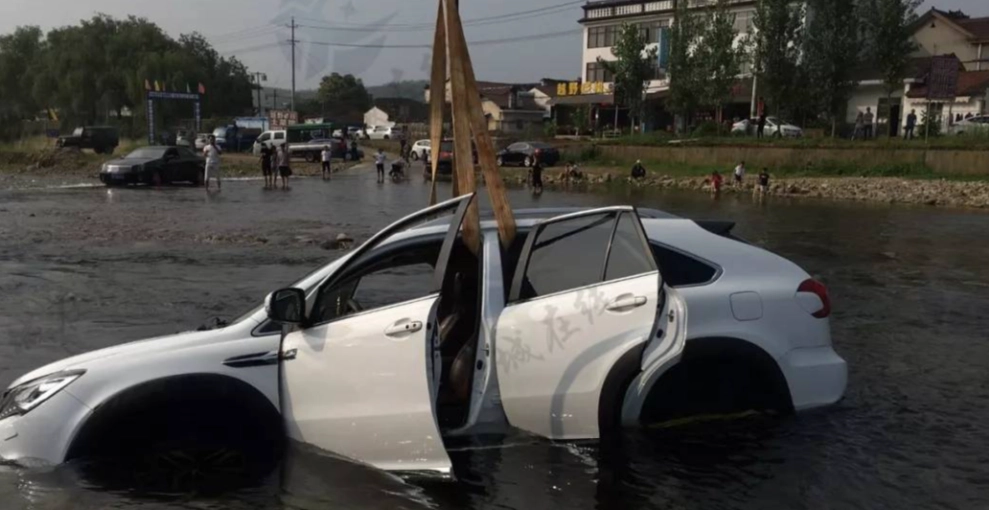
That targets a shared weakness of petrol and electric cars alike. After a vehicle rolls or noses into deep water, hundreds of kilograms of pressure can pin the doors shut. Within tens of seconds, a short-circuited low-voltage battery and door modules can disable power windows, flush handles and central locking.
BYD's proposal turns panic-stricken self-rescue into automatic system control:
- Reconcile data from existing airbag crash sensors, an inertia measurement unit, suspension-travel sensors and low-cost liquid contacts to rule out false alarms from rain or car washing and confirm an actual plunge.
- Calculate the car's roll and pitch in the water to determine whether it is floating level, nose-down or on its side.
- In the few seconds before water shorts the low-voltage and high-voltage circuits, have the gateway controller issue a top-priority command to unlock all doors, lower the windows or sunroof on the less-pressured side and activate interior lights and hazard flashers.
An industry shift to extreme-case safety
The filing reflects a broader move by electric-vehicle makers from touting driver-assist computing power and fast charging toward redundancy in extreme conditions.
Years of piling on lidar, chips and acceleration figures have drawn public doubts about whether extra intelligence comes at the cost of mechanical reliability, since complex electronics are often the first to fail in flooding, fire or battery thermal runaway. Having claimed safety ground with its Blade Battery and e⁴ platform, BYD now extends that boundary to flooding and escape from water.
The cost advantage
BYD's in-house electronic and electrical architecture is central to making the feature cheap. Under a conventional distributed ECU setup, linking body-position sensing, the powertrain, chassis and door locks would require coordinating several foreign Tier 1 suppliers such as Bosch and Continental, raising development costs and delaying response times.
With a highly integrated central domain architecture and its own base software, BYD can write the water-detection logic into the vehicle controller at little marginal cost.
That means the function could reach not only the million-yuan Yangwang but also mass-market Yuan, Song and Qin models priced at 100,000–200,000 yuan (about $14,000–28,000), through over-the-air updates or annual facelifts.
Outlook
The 45,000-plus patents on Tianyancha trace BYD's path from battery supplier to the world's top seller of new energy vehicles. The pending application shows vehicle safety moving from passive crash structures toward systems that sense a disaster and actively open an escape route.
Still, the real test is whether the multi-sensor algorithm can achieve zero false alarms and remain reliable in violent rollovers and sudden flooding — before it moves from the patent office to the production lines of millions of cars.