Hongdou sets up 6 million yuan chip sales unit in Hangzhou
Hongdou, the Chinese menswear maker, has set up a Hangzhou chip sales subsidiary with 6 million yuan (about $845,000) as it seeks growth beyond its slowing apparel business.
Hongdou, the A-share apparel maker known for its shirts and suits, has set up a chip sales subsidiary in Hangzhou with registered capital of 6 million yuan (about $845,000), a small, low-risk step into hardware distribution as its core clothing business stalls.
Hangzhou Hongxinyue Intelligent Technology Co was recently established with Xu Hui as legal representative, according to corporate records database Tianyancha. Its registered address is Raffles City Hangzhou in Shangcheng district, and its business scope covers integrated circuit sales, IC chip and related product sales, discrete semiconductor devices and cloud computing equipment.
A holding platform plus an operating front
Hongxinyue is wholly owned by Jiangsu Hongxin Zhilian Technology Co, which was set up on September 16 with registered capital of 10 million yuan. Listed Jiangsu Hongdou Industrial Co holds 51% of Hongxin Zhilian.
That structure gives the listed company control and consolidated accounts, while leaving 49% for outside partners or industry investors. Hongdou built the two-tier setup within weeks.
Sales only, asset-light
The business scope points to sales rather than manufacturing. Chip fabrication is a capital-intensive, long-payback business that a traditional light manufacturer would not enter lightly. Hongdou has kept its new unit to chip, device and cloud equipment distribution.
By basing the unit in Hangzhou, a hub for chip design and computing demand, Hongdou can take on distribution, procurement agency or server trading with limited sunk cost. The model caps risk at the registered capital and adds new revenue to the listed company's books without exposing it to R&D losses.
Why apparel is looking elsewhere
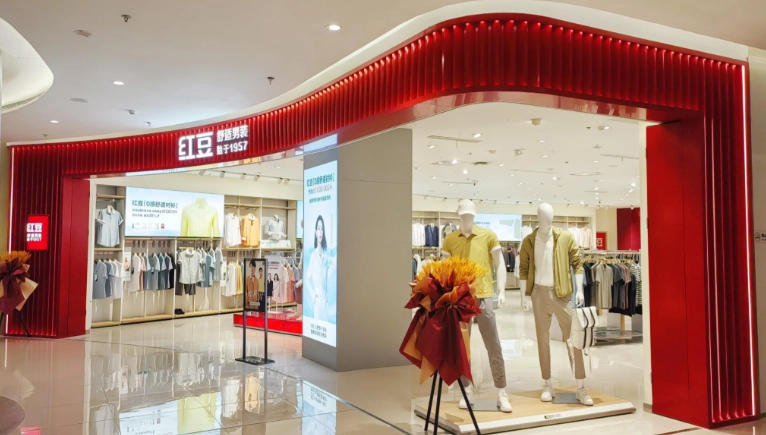
Hongdou menswear built its position over decades on a large network of bricks-and-mortar stores and deep distribution. Fast fashion, domestic sportswear brands and low-cost sellers on Douyin and Kuaishou have since taken share from mass menswear, slowing sales of formal and business clothing.
High inventory write-downs and fixed store rents keep squeezing margins. Valuation for pure textile and apparel names on the A-share market has long stayed low, pushing companies to build higher-value or technology-related growth businesses.
Hongdou Group, the parent, also spans clothing, tire and rubber, and industrial park development. Those manufacturing units buy industrial IoT sensors, automotive control chips and edge computing equipment in large volumes. Funneled through the new sales platform, that demand could give the startup stable internal orders while it builds an external distribution network.
Supply chain barriers and investor scrutiny
The unit still faces high technical barriers and strict authorization rules in chip distribution. Established distributors need strong field application engineering support and top-tier agency rights from international chipmakers. With the industry working through an inventory correction and smaller distributors' margins under heavy pressure, a newcomer backed by a menswear company will find mainstream supply chains hard to crack.
Investors are also wary of unrelated diversification and concept-driven hype. A-share history is full of traditional companies that moved into semiconductors and ended up as shell firms or failed stories. Hongdou's outlay of a few million to 10 million yuan limits the financial downside, but without a scaled technology R&D barrier, it is unclear how much sustainable profit the asset-light sales business can add.
The move signals that older manufacturing groups are using capital to look beyond their core businesses as growth in traditional consumer sectors slows. Hongdou has built a place in the hardware distribution chain through a tidy ownership structure and limited funding. Whether the new unit can generate real trading cash flow in a crowded, highly specialized semiconductor supply chain is a question management will have to answer for the market.