Shantou seafood firm fined 10,000 yuan over mislabeled antibiotic-tainted bullfrogs
A Shantou distributor was fined just 10,000 yuan for selling bullfrogs with antibiotic residues and using fake factory labels, exposing gaps in China's food safety chain.
A Shantou seafood distributor has been fined just 10,000 yuan (about $1,400) over mislabeled bullfrogs at the centre of a nationwide antibiotic-residue scare, a penalty that has left consumers and restaurateurs questioning how serious the offence really was.
The case has focused attention on the weakest link in China's aquatic supply chain: small middlemen who buy from scattered farms, skip testing and relabel product to get it into restaurant kitchens.
Shantou Shunlian Aquatic Products Co., Ltd. was penalised by the Chenghai District Market Supervision Administration in Shantou, according to corporate records database Tianyancha. The decision lists two violations.
The company was given a warning for selling edible agricultural products without carrying out its legal duty to check goods on purchase. It was also ordered to surrender the products and fined 10,000 yuan for producing and selling counterfeit goods bearing another factory's name and address.
A small company, a small fine
Shunlian was set up in June 2019 with registered capital of 500,000 yuan (about $70,000). Its legal representative is Chen Chulin, and its business covers aquaculture, purchasing, primary processing and wholesale and retail of aquatic products.
The gap between the company's tiny scale and the 10,000 yuan penalty exposes the weakest and most stubborn corner of China's seafood trade.
Why the penalty looks light
Public anger has centred on why a case with such health implications drew a fine of only 10,000 yuan. The answer lies in how the law treats primary agricultural products differently from manufactured food.
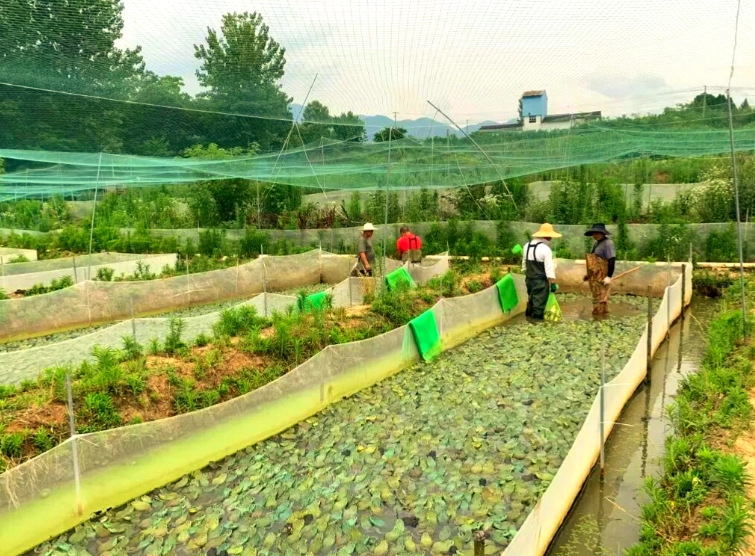
Bullfrog is classified as a primary edible agricultural product. The antibiotics found in the animals almost always originate at the pond, where farmers dose crowded tanks to ward off skin disease and enteritis and rush fish to market without observing the required withdrawal period.
Once the bullfrogs leave the pond, buyers such as Shunlian are legally treated as middlemen. Rules on the sale of edible agricultural products require them to obtain proof of origin, purchase receipts and certificates of conformity. In practice, most small farms cannot produce a testing certificate at all.
Regulators therefore charged Shunlian with failing to check its suppliers rather than with producing toxic food, which would carry far heavier penalties. Middlemen chasing quick margins have long bought stock without screening it.
The fake labels
The violation that actually triggered the 10,000 yuan fine was the use of another factory's name and address — a common workaround in the trade.
To move untested bullfrogs of unknown origin into large hotpot and bullfrog restaurant chains, or into wholesale markets in other provinces, middlemen often use packaging, certificates and inspection labels from licensed processors. The fake label serves as a pass through loose quality checks downstream while masking the source of the residue upstream.
An industry outgrowing its farms
The deeper problem is the mismatch between booming demand for bullfrog and backward farming and environmental standards.
As bullfrog restaurant chains spread through shopping malls nationwide, the industry's annual output value has swelled to tens of billions of yuan. But the species, an invasive alien, pollutes water badly, and provinces including Guangdong, Fujian and Jiangxi have imposed strict bans and limits on farming it.
As large-scale crackdowns closed illegal pond sheds, much production moved to more remote, unlicensed sites. Farmers evading environmental inspections often lack guidance on drug use and adopt a short-term outlook, dosing heavily with antibiotics to cut mortality.
Restaurant chains fighting price wars squeeze procurement costs, pushing down prices through the supply chain. That drives out licensed processors with proper rapid testing and cold-chain traceability, leaving room for small workshops with registered capital in the hundreds of thousands of yuan and little to lose.
What comes next
The 10,000 yuan fine is a precise ruling against a downstream distribution violation on the available evidence, but it is not the end of the antibiotic crisis.
While the penalty is too small to threaten the grey supply chain, what is being drained is consumer confidence in the bullfrog restaurant market that the industry worked hard to build. Unless farms are brought into environmental compliance and cross-regional distribution hubs are required to run rapid tests, the next shipment of mislabeled bullfrogs carrying antibiotics beyond the withdrawal period will still reach Chinese dinner tables.