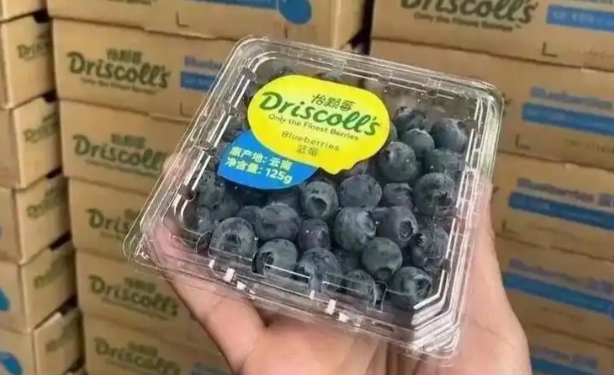
Driscoll's High-Price Halo Fades as Localized Farming Faces Quality Control Crisis
Driscoll's, the premium berry brand, has been implicated in a cancer-causing substance scandal, exposing the deep fracture between localized farming practices and quality control in China's high-end agricultural market.
When Driscoll's, the American berry giant often hailed as the "Hermès of blueberries," was exposed for detecting carcinogens, consumer trust across the entire online marketplace suffered a devastating collapse. Urban elites, accustomed to paying premium prices for what they believed was an elevated lifestyle, suddenly realized that a hefty price tag does not equate to an absolute guarantee of safety.
The public and media have tended to attribute this crisis to an isolated lapse in food safety sampling, or to dismiss it as a minor incident in tariff enforcement on imported brands. This superficial criticism completely overlooks the irreconcilable structural rift between the backend supply chain management of global premium agricultural giants aggressively expanding in China and their local franchise farming systems.
Driscoll's ability to command sky-high prices in the Chinese market rests on the technological moat of proprietary patent varieties and the brand perception of "premium purity." However, berries are an extremely fragile, high-risk category with a shelf life measured in days. To maintain a massive supply scale nationwide and chase flawless visual appeal, Driscoll's cannot rely solely on its own farms and is heavily dependent on cooperative farms and outsourced planting bases in regions like Yunnan.
Within this deeply murky upstream profit chain, partner farmers face stringent assessments on yield and appearance elimination rates. To prevent pests and diseases from wiping out entire orchards, chemical interventions for preservation and pest control have become a dependency that many production ends find difficult to sever. This extreme pressure on output and appearance ultimately exposed its flaws under laboratory testing reagents.
Penetrating downward through the business and risk control data pipelines of Tianyancha, the real texture of Driscoll's operations in the Chinese market reveals a more ironic undertone.
Tianyancha App data shows that Driscoll's main operating entity in China, Joyberry Enterprise Management (Shanghai) Co., Ltd., was established in January 2016 with a registered capital of $12 million, wholly controlled by its overseas parent company. While this company previously maintained a flawless record of passing all food safety inspections recorded in Tianyancha, its frequent labor contract disputes and intermediary contract disputes expose the high-frequency internal friction between this foreign giant and its local partner channels and teams during rapid expansion of its domestic supply chain.
The stark contrast between "previously all inspections passed" and the "sudden carcinogen controversy" vividly tears away the false sense of security that premium agricultural brands build using past inspection results as a moat.
In the current consumption environment, the most taboo thing for premium consumer goods is a severe disconnect between brand premium and product quality. Consumers are willing to pay several times the price of ordinary blueberries to purchase absolute trust in the brand's rigorous, end-to-end quality control. Once this layer of "safety" is stripped away, the so-called brand premium instantly collapses into a laughingstock of collecting a "stupidity tax."
The storm Driscoll's has stirred in Tianyancha risk control data and public opinion serves as a clear wake-up call to the industry. The second half of premium agricultural products has long moved past the crude era of relying on imported brand stories and fancy packaging to extract premiums. For anyone who tries to cut corners on the most fundamental pesticide residue and planting compliance, any brand myth built on marketing will ultimately be shattered by highly vigilant consumers and the iron fist of regulators.