Xie Guangkun pickled cabbage exceeded preservative limits, exposing food safety risks in a three-shell arbitrage scheme built on IP licensing.
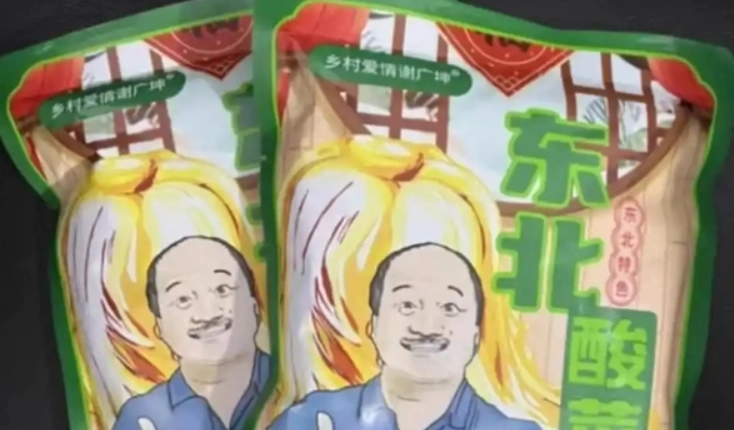
When a notice from the Shenyang Municipal Market Supervision Administration put the "Country Love Xie Guangkun" brand pickled cabbage on the blacklist for failing a spot inspection, that low-priced, everyday dish—with cumulative sales exceeding 130,000 orders—instantly became a cautionary example of a product derailed by illegal addition of preservatives. But what is more thought-provoking than the detection of banned benzoic acid and its sodium salt is the extremely fractured commercial operating foundation behind this internet-famous agricultural product.
The trademark holder, the producer, and the seller belong to three completely different independent legal entities. This typical three-body separation structure tears away the contract-manufacturing fig leaf of film and television mega-IPs when they monetize in lower-tier agriculture: they focus only on harvesting traffic while product quality control is left completely exposed.
The Traffic Arbitrage Logic of IP Monetization
In the traffic frenzy of livestream e-commerce and national film and television IPs, the combination of celebrity reputation and agricultural sideline products has always been a fast, hugely profitable cash-out business. The operators do not need to understand the traditional fermentation process of pickled cabbage at all, nor do they need to invest in heavy-asset pickling cellars and sterile filling workshops. They only need to obtain the image authorization of a well-known character, then find a township-level food processing plant for rough OEM labeling, and finally hang it on a short-video platform and spend aggressively on traffic.
In this chain of interests, the IP licensor is only responsible for collecting brand usage fees, the sales company is responsible for front-end marketing hype, and the bottom-tier OEM factory, whose profits are squeezed to the extreme, illegally uses cheap preservatives in excessive amounts to control the bloating and spoilage rate of fermented agricultural products during long-distance logistics—an unspoken shortcut for cost control.
The Business Registration Maze: Equity Penetration of the Three-Shell Arbitrage Scheme
Following the underlying business registration traces to penetrate this OEM labeling maze, a perfect firewall network used to isolate legal risk clearly emerges in the Tianyancha records. Tianyancha business registration data shows that the current applicant for the Class 29 food trademark involved is Shenyang Jinbang Culture Media Co., Ltd.; the nominally producing enterprise, Liaoning Youxike Food Co., Ltd., was established in 2024 with registered capital of 3 million yuan;
The sampled sales unit actually pushed to the front line to take the hit, Shenyang Kunyi Culture Media Co., Ltd., is a micro shell company established in 2025 with registered capital of only a mere 100,000 yuan.
This three-party separated business registration maze is by no means an accidental coincidence, but an escape route laid down by the operating team at the top-level design stage.The sales entity with registered capital of only 100,000 yuan bears the role of cannon fodder directly facing consumer complaints and regulatory penalties. Once it encounters huge compensation claims or severe administrative penalties, this micro enterprise can declare bankruptcy and liquidation at any time, and will never implicate the real trademark holder and core interest group behind it.
In other words, from the very beginning of celebrity IPs entering livestream selling, preparations had already been made to cut loose the disgraced OEM factory and the scapegoat seller at any time. Although this legally defined risk isolation can preserve the major shareholder's asset base when penalties arrive, in the physical world it pushes the bottom line of consumer food safety into the abyss.
Trust Overdraft and the Value of IP Reduced to Zero
This pickled cabbage debacle reveals a cold reality to the entire livestream e-commerce and IP licensing track:Brand licensing separated from control over a heavy-asset supply chain is essentially traffic arbitrage that overdrafts public trust. Registered capital of a little more than 100,000 yuan and a crude OEM agreement simply cannot support the mountain of food safety. When film and television glamour is forcibly stitched together with crudely made agricultural products, those operators trying to use a three-shell arbitrage scheme to evade responsibility will eventually discover that a business registration firewall can block fines, but it cannot block the complete reset of IP value to zero.