Qi Xiangdong Takes the Helm as Registered Capital Tops 100 Million Yuan: Qi An Xin Builds an AI Cybersecurity Firewall
Qi An Xin's AI subsidiary has increased its registered capital to 100 million yuan, with Qi Xiangdong personally taking the helm to capture the government and enterprise AI security market.
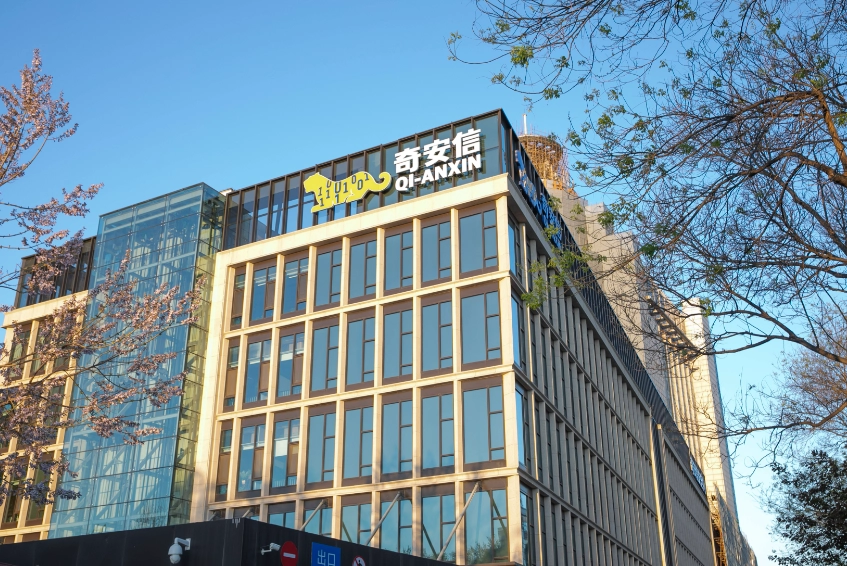
While the domestic cybersecurity sector is still struggling through a long winter of tightening government and enterprise budgets and soaring accounts receivable, Qi An Xin, the cybersecurity leader, has quietly played a highly strategically aggressive heavy-asset card in the AI arena.
Tianyancha App shows that recently, Qi An Xin Artificial Intelligence Technology (Beijing) Co., Ltd. underwent a business registration change, with its registered capital increasing significantly from approximately 57.4404 million yuan to 100 million yuan, an increase of about 74%. This veteran technology entity, established as early as 2010, is not only wholly owned by the listed company Qi An Xin Technology Group Co., Ltd., but its legal representative is also personally led by Qi Xiangdong, the head of Qi An Xin.
Under the industry convention that traditional software outsourcing and technical service companies usually present themselves with a light-asset structure of several million yuan, pushing the registered capital of a purely technology R&D entity to the 100 million yuan mark is by no means a paper financial maneuver, but a heavy-asset pledge of commitment made by the cybersecurity giant in the tough battle for major government and enterprise clients to seize the discourse power in generative artificial intelligence and large model security.
The Invisible Qualification Red Line in Government and Enterprise Procurement
To understand the underlying demand of this capital expansion, one must face squarely the extremely stringent commercial rules of China's government and enterprise cybersecurity procurement.
As governments at all levels, central state-owned enterprises, and financial institutions intensively launch AI private large models and intelligent computing center construction, model anti-poisoning, data anti-leakage, and Agent automated attack-defense defense for AI infrastructure have rapidly become the highest single-budget incremental cake in government and enterprise bidding. However, when selecting technology suppliers, large institutional clients have always had an indestructible invisible qualification red line: the bidding entity not only needs top-level military and confidentiality qualifications, but also faces extremely stringent requirements for the bidding legal person's registered capital, net asset scale, and the industry weight of the legal representative.
The previous capital scale of more than 50 million yuan often triggers the anxiety of the cybersecurity big brother in the AI era when competing for tens of millions or even hundreds of millions of yuan in large central state-owned enterprise national-level AI security base tenders, and this anxiety is often hidden in seemingly ordinary business registration changes.
According to the latest business registration changes from Tianyancha, the registered capital of Qi An Xin Artificial Intelligence Technology (Beijing) Co., Ltd. was directly raised from 57.44 million yuan to exactly 100 million yuan, an increase of more than 70%. Chairman Qi Xiangdong personally serves as the legal representative, and the parent company Qi An Xin wholly owns it. On paper, this amount of money is not an astronomical figure, but at a time when the entire industry is contracting its battle lines and tightening its belt, the parent company injecting tens of millions of yuan into a second-tier AI subsidiary in one go is by no means routine financial housekeeping, but a naked defensive bet.
Survival Pressure Under the Stall of the Main Business
The market easily interprets this move as another routine operation of a major security vendor embracing general large models. But if one strips away the hot-air bubble of large models, one will find that the fundamental trigger for Qi An Xin's move is the survival pressure brought by the stall in growth of its main business.
Over the past few years, the profit logic of traditional cybersecurity has almost reached its ceiling. The model relying on project-based procurement from governments and large central state-owned enterprises is suffering a substantial blow from lengthening payment collection cycles and shrinking hardware gross margins. Traditional infrastructure such as firewalls and endpoint detection has become a stock game in a red ocean, and the cybersecurity industry urgently needs a new story that can once again pry open government and enterprise customer budgets.
AI has恰好 become the life-saving straw of this story.
But there is a huge contrast in the core logic here: Qi An Xin is by no means going to enter the fray of competing on the parameter scale of foundation models; what it wants to solve is the security fatal weakness that, after the birth of large models, enterprise customers dare not use and do not know how to use.
The most direct hidden dangers of large models landing in government and enterprise institutions are data poisoning, cross-border leakage of sensitive information, and uncontrollable logical reasoning. If an enterprise buys a general AI set without a security net wrapped around it, it is equivalent to installing an unreviewed information transmitter in a confidential stronghold. What Qi An Xin does in AI is essentially not to be the car maker, but to sell crash beams and brake pads at high prices around all systems running AI engines.
Qi Xiangdong increasing the capital of this AI company to 100 million yuan is to build it into a dedicated firepower point for government and enterprise private network security, and to seize the security escort budget for the landing of large models across industries one step ahead.
An Anxious Bet Under the Dual Reshuffle of Capital and Technology
A deeper driving force also lies in the dual reshuffle at the capital end and the technology end. When the open-source large model ecosystem has already driven the inference threshold down to a cabbage price, simply providing a few sets of model algorithms is long since worthless. Under the four-sided siege of Sangfor, NSFOCUS, and cloud vendors, traditional cybersecurity vendors without entity-based independent combat power to carry AI assets can easily become also-rans in the next round of government and enterprise procurement standard reconstruction.
Pushing the subsidiary's registered capital to the 100 million yuan threshold, on the one hand, is to cross the hard qualification threshold for high-standard bidding by large central state-owned enterprises and classified institutions; on the other hand, it is to isolate and reorganize at the capital level the AI R&D forces previously scattered across various group departments, reserving space for future computing power procurement, industry vertical model R&D, and even independent external financing.
This is not a leisurely strategic expansion, but an anxiety that, before the old continent collapses, one must first use real gold and silver to pour a new base area. Cybersecurity does not need the next model that can only chat, and Qi An Xin does not need it either. What it needs is to use this 100 million yuan chip to prove to a market trapped in stagnant growth: when everyone is fanatical about AI, the person selling locks still holds irreplaceable discourse power.