China Aims to Provide TCM Services to All by 2030, with Over 2.07 Million TCM-Related Enterprises
China aims to provide TCM services to all by 2030, with over 2.07 million TCM-related enterprises and 10 core targets set.
The "15th Five-Year Plan for the Revitalization and Development of Traditional Chinese Medicine" has been officially released, specifying that by 2030 a TCM service system covering the entire population and the full life cycle will be established, ensuring accessible and affordable TCM services for everyone and advancing the revitalization and development of TCM to a new level.
During the "14th Five-Year Plan" period, China's TCM development achieved phased results, with full coverage of county-level TCM medical institutions, over 96% of public general hospitals at or above the second tier having TCM clinical departments, and citizens' TCM health literacy rate rising to 28.1%, laying a solid foundation for the next stage of development.
This plan sets 10 core indicators across dimensions such as resources, services, and culture, focusing on ten key tasks including improving the service system, integrating TCM and Western medicine, and industrial innovation. It also includes supporting mechanisms optimized for TCM characteristics in medical insurance and review and approval processes, aiming to deeply integrate TCM into the Healthy China initiative.
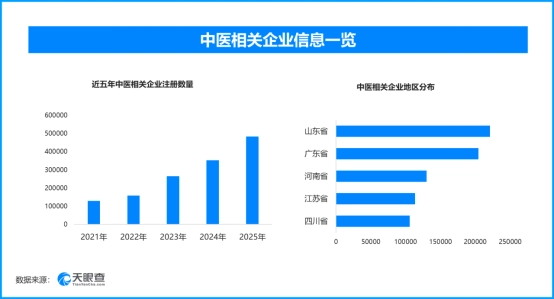
Tianyancha Professional Edition data shows that as of now, there are over 2.071 million TCM-related enterprises in China that are active or operating. Among them, approximately 188,000 new related enterprises have been registered so far in 2026. Looking at registration trends, over the past five years, the number of newly registered TCM-related enterprises has shown year-on-year growth, peaking in 2025.
In terms of regional distribution, Shandong Province, Guangdong Province, and Henan Province lead in the number of TCM-related enterprises, with over 220,000, 204,000, and 130,000 enterprises respectively. They are followed by Jiangsu Province and Sichuan Province.