Chagee buy-one-get-one promotion crashes mini-program, strains stores
Chagee's buy-one-get-one celebration for Zheng Qinwen's win crashed its ordering mini-program and led stores to turn customers away, exposing fulfillment limits at 6,000 outlets.
Chagee's nationwide buy-one-get-one giveaway, launched to celebrate Zheng Qinwen's title run, overwhelmed its ordering app and left stores unable to keep up, turning a marketing win into a service test.
The offer drew more than 550,000 new followers in a month, but the crash exposed a gap between Chagee's online reach and the capacity of its technology and its 6,000-plus franchised stores — a gap that matters as the chain expands overseas and prepares for a listing.
Tianyancha: 5.2 million yuan behind 6,000 stores
Corporate records on Tianyancha, a business database, show the core operating entity, Kunming Chagee Catering Management Co., Ltd., was set up in December 2017. Its legal representative is founder Zhang Junjie and its registered capital is 5.2 million yuan (about $730,000).
The registered business scope covers food sales, online food sales, catering services, brand management and marketing planning. Yunnan Weizhijue Catering Management Co., Ltd. owns 100% of the entity, and its annual report lists 213 insured employees.
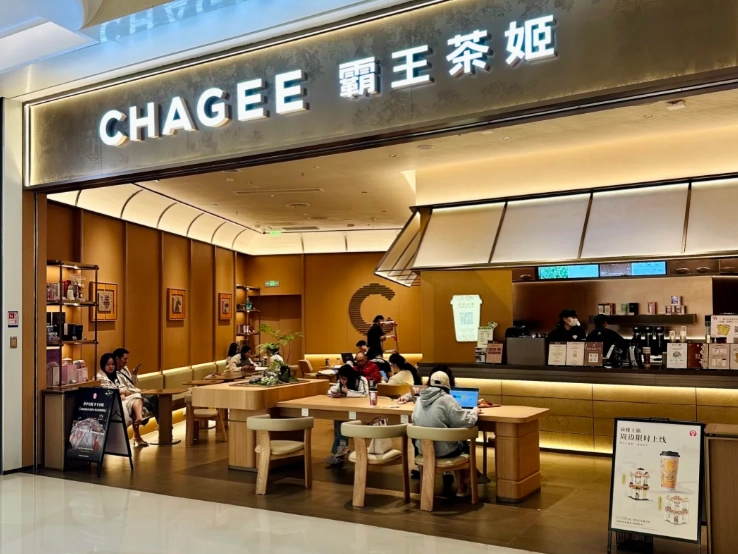
The contrast is stark. A parent with a few million yuan in registered capital and a few hundred staff directly on the books sits atop a global network of more than 6,000 franchised outlets and a short-video account with over 14 million followers.
That light-headquarters, heavy-franchise model is what let Chagee expand at an exponential pace across China and into Southeast Asia over the past two years.
An early bet on Zheng Qinwen
Chagee signed Zheng as its "health ambassador" and core endorser before she won the sport's biggest honors. Sports marketing usually means a long, patient bet on athletes from niche events.
When she went on to take a major title and set off nationwide celebration, the earlier endorsement spend multiplied in value many times over.
For a tea brand chasing volume, that was a rare window. Management went straight to an aggressive buy-one-get-one subsidy across the whole menu, a low-barrier offer built to spread fast on social platforms. Net follower growth of more than 550,000 in a month showed the pull of a sports star.
Traffic flood, fulfillment breakdown
The mini-program is more than a payment screen in a new-style tea chain. It links point-of-sale orders, automated brewing and labeling machines, inventory deductions and rider dispatch.
At peak, millions of concurrent order requests hit the server cluster at once. Without e-commerce-scale stress testing and fallback plans, the database connection pool can be saturated within seconds, causing a nationwide outage.
Physical limits are just as firm. Even with automation, unpacking ingredients, adding fresh milk, hand-shaking, sealing and bagging each take fixed time. A single store typically tops out at 150 to 250 cups an hour.
With the buy-one-get-one offer multiplying demand several times over, franchise stores ran out of ice, fresh milk and branded packaging within hours. Counters filled with backed-up tickets and waits stretched to several hours. Facing angry queues, staff had little option but to turn customers away.
That swing from celebration to rejection turned a campaign meant to build goodwill into questions about how reliably the brand can deliver.
The double-edged sword for franchisees
The deeper risk is what heavy discounting does to the margins of those 6,000 franchisees, and to the brand itself.
Unlike company-owned chains, franchised tea brands usually ask store owners to absorb ingredient costs or heavy labor losses on promotions. The whole sector is stuck in a price war, with average ticket prices sliding toward 10 to 15 yuan.
Chagee had built a 15 to 20 yuan moat on its whole-leaf fresh milk tea concept and premium Chinese-style packaging. Buy-one-get-one effectively halves the per-cup price to below 10 yuan.
Relying on half-price offers to capture public traffic can produce strong daily sales and user acquisition in the short run. It can also teach customers to wait for discounts. If franchisees cannot earn a real net profit during a full-capacity surge — or if late orders and missing ingredients draw complaints — the rift between headquarters and its franchise network widens quietly.
Beyond the trending topic
The 5.2 million yuan of registered capital and the 6,000-store map together show where this new-style tea unicorn actually stands. Signing Zheng demonstrated sharp marketing judgment.
As Chagee pushes toward bigger capital markets, investors will look past any single trending topic or follower spike. They will ask whether the mid-office systems hold under concurrent surges, whether the supply chain can allocate stock precisely, and whether thousands of franchise outlets can deliver.