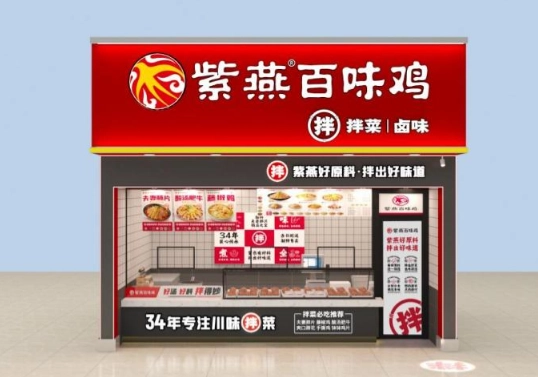
Ziyan Food Invests Heavily in Supply Chain, Bolstering Cost Centralization for Table-Side Braised Delicacies
Ziyan Food injects an additional 200 million yuan into its Chengdu supply chain, strengthening cost centralization for table-side braised delicacies amid intensifying industry competition and raw material volatility.
With the casual braised food market struggling in the mire of declining average order value and sliding table turnover rates, the braised food giants that once carved out their niche through the differentiated "side-dish" track are now accelerating their heavy-asset bets toward the southwest supply chain hub, shifting both defensive and offensive capital.
Recently, the capital restructuring of the core production entity under Zi Yan Foods has revealed the most genuine supply chain hedging and regional centralization strategy of this Shanghai-listed company amid the industry's existing-market grind.
Tianyancha App business registration data shows that Chengdu Zi Yan Foods Co., Ltd. has undergone business registration changes, with its registered capital increasing from RMB 1 billion to RMB 1.2 billion, a 20% rise. The company was established in December 2007, with its legal representative being Yang Yunli. Its business scope covers food production, aquatic product processing, and software development, and it is wholly owned by Zi Yan Foods Group Co., Ltd.
To most industry observers accustomed to evaluating the braised food track through single-store sales efficiency and franchise store growth rates, this RMB 200 million capital infusion may appear to be just a routine regional plant equipment upgrade. Such a surface-level interpretation completely underestimates the deep cost anxiety experienced by Zi Yan's management in the face of sharp fluctuations in upstream raw material prices such as duck and beef, as well as declining profitability at downstream franchise stores.
The Cost Anxiety of Side-Dish Braised Food
Unlike casual braised foods with social and leisure attributes, such as Juewei and Zhou Hei Ya, Zi Yan Bai Wei Ji focuses on side-dish braised food with higher consumption frequency. The side-dish positioning imposes extremely stringent requirements on product freshness, daily delivery fulfillment timelines, and extremely low single-store spoilage rates. Within the optimal cold chain radiation radius of 300 kilometers, whoever can complete daily fresh delivery to franchise outlets at lower marginal cost will lock in gross margin floors in the terminal price war.
As a key hub for Sichuan-style seasonings and poultry processing resources, Chengdu serves both as the raw material source base for Zi Yan's national supply chain and as the core production capacity hub radiating to the southwest and even central China markets.
Algorithm-Driven Supply Chain and Category Expansion
The software development and aquatic product processing registered with Tianyancha clearly signal Zi Yan's ambition to pursue algorithm-driven supply chain management and category expansion at its southwest base. This injection of RMB 200 million is essentially Zi Yan welding an additional high-density central factory fortress outside its existing operations. By expanding capacity and undergoing digital transformation at the Chengdu production base, Zi Yan aims to use algorithms to restructure the automated replenishment system across its thousands of front-end franchise stores, compressing fulfillment losses for fresh, short-shelf-life products to the extreme.
At the same time, the concentration of large-scale production capacity effectively absorbs the impact of upstream raw and auxiliary material price fluctuations. When small workshops and mid-to-small braised food brands are weeded out in the squeeze between high costs and an inability to raise terminal prices, major players with massive registered capital and standardized central factories can leverage cost advantages to forcibly capture the vacated community wet market and proximate retail space.
An Industry Shift Signal
The second half of the braised food track has long moved past the crude phase of relying on franchise expansion and concept hype to buy capital confidence. As franchisees' investment willingness turns more rational, the ultimate test of a braised food giant's survival capability is no longer the flashy store count touted at press conferences, but whether its core factories can squeeze every cent of cost premium from the deeply muddied supply chain capillaries.
Zi Yan Foods' RMB 200 million capital increase in Chengdu is a clear industry shift signal: In the latter half of the side-dish braised food war, whoever can first transform their heavy production operations into a supply chain weapon characterized by high turnover and low spoilage will be the one to truly secure long-term premium across the entire balance sheet in the coming industry-wide shakeout.