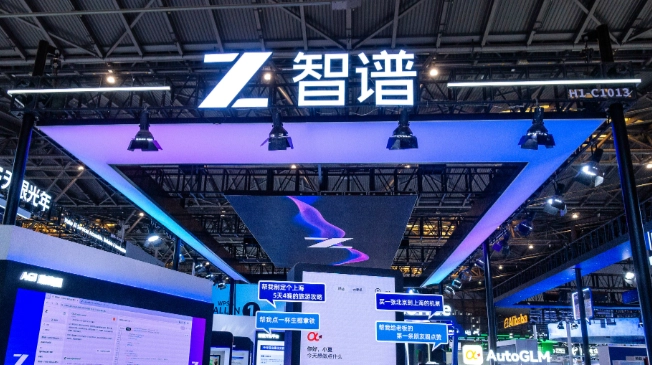
Zhipu Aims for STAR Market: Large Models From Lab Lottery to Industrial Meat Grinder
Zhipu's STAR Market push reveals the shift of large models from asset-light to capital-heavy compute battles, with surging capital and staffing, behind which lies fierce competition among tech giants' proxies and the harsh reality of industrialization.
The capital markets in June have never lacked for drama, but when Zhipu, a leading player in China's domestic general-purpose large model space, formally laid its cards on the table for a STAR Market IPO, the industry still felt a powerful jolt of pressure. The cross-market financing signal released via a Hong Kong Stock Exchange announcement is far more than a routine financial capital maneuver. Penetrating the technological fantasy woven from cutting-edge algorithms, silicon-based futures, and artificial general intelligence, what emerges for business observers is an extremely brutal, asset-heavy computing power war that rejects any trace of romanticism. Zhipu's move to knock on the STAR Market's door effectively sounds the ultimate bugle call for China's large model startups to transition wholesale from the "lab blind box era" to the "industrial assembly line hand-to-hand combat era."
For a long time, there has been an extremely stubborn cognitive disconnect in how outsiders view AI startups. In the eyes of the public and some trend-chasing investors, this appears to be a remarkably elegant business: a few algorithm geniuses from top university computer science departments, a few academic papers that shake international core journals, plus a few lines of highly disruptive low-level code, and within a short time they can lever hundreds of millions of dollars in valuations and execute a dimensionality reduction harvest on traditional industries. This asset-light narrative, born from the early mobile internet era, has been crushed to pieces by reality in the current war of a hundred models. The truly large model track is, at its core, driven by the merciless logic of manufacturing and heavy industry. It demands bottomless capital to hoard computing hardware and requires an enormous workforce to handle the gritty, thankless work.
This transformation from light to heavy is etched with striking clarity into the company's underlying business and industrial evolution records. In the shareholder and change filings visible through Tianyancha, the foundational data of Beijing Zhipu Huazhang Technology Co., Ltd. presents a cold bill for the industrialization transformation of large models. Systematic records show that this technology entity, founded in June 2019 with Liu Debing as its legal representative, has seen its registered capital forcibly pushed from over 17.1 million RMB to the current 44.58 million RMB over the past three years of extreme survival testing, an increase exceeding 160 percent. Even more dramatic fission has occurred within the organizational structure: social insurance participation numbers have surged from a founding elite research team of just 43 people to a formidable army of 647 by 2024, a fourteen-fold physical expansion in five years.
This frenzied surge in registered capital and headcount is by no means simple cosmetic data dressing to satisfy IPO coaching requirements, but rather defensive muscle the company has been forced to grow under the extreme gravity of survival.
In the computing-power-is-power cycle of intelligent computation, capital depth directly determines whether a company can stay at the table. The global supply chain for high-end computing cards is currently in an extremely distorted state, and the unit procurement price for computing clusters has long since departed from conventional Moore's Law, evolving into a zero-sum arms race of cold, hard cash. Every training and iteration of a hundred-billion-parameter model leaves behind the round-the-clock roar of tens of thousands of high-performance GPUs consuming electricity, along with extremely high hardware depreciation and amortization. Zhipu's geometric leap in registered capital is essentially a move to build a financial breakwater under extreme supply chain pressure, capable of locking in long-term computing lease agreements in advance and bulk-procuring core computing hardware. Without a massive paid-in capital base serving as the underlying ballast, any grand narrative about technology changing the world would be reduced to dust the moment computing supply is cut off.
And those 647 employees with real social security contribution records tear wide open the brutal truth about commercializing large models. Outsiders naively assume these hundreds of people are uniformly top-tier scientists earning millions in annual salary, but the real industrial cross-section is covered in mud. When the underlying inference capability of a base large model reaches a certain industrial threshold, the marginal returns from pure algorithmic breakthroughs decline sharply. What truly determines whether Zhipu can generate free cash flow in the market is the massive engineering delivery team, the meticulous data-cleaning workforce enduring tedium and repetition, and the business development army that must penetrate diverse industries to crack hard nuts for government and enterprise clients.
This is the inevitable pain of a technology company transforming into a complex commercial service provider. Beneath the iceberg of this personnel structure, Zhipu must staff a large number of senior product managers to repeatedly refine the subtle interaction friction on the application side; it must build professional compliance and risk-control teams to meet increasingly stringent information content security review deadlines; and it needs a formidable delivery force to prove to conservative enterprise clients in traditional industries that adopting large models genuinely delivers cost reduction and efficiency gains on the financial statements, rather than merely adding an expensive chat tool inside the organization. This explosive growth in organizational scale carries an extremely heavy fixed payroll burden and places demanding modern corporate governance and profit-distribution requirements on a founding team accustomed to the pure research environment of Tsinghua's laboratories. The war of large models is no longer about whose code is more elegant, but whose organizational machine can convert technology into client revenue at the lowest internal friction and fastest speed.
Shifting the lens from internal capital and personnel fission to the external shareholder camp, the interest-chain game behind this STAR Market push is equally unfathomable. In this company's shareholder registry, alongside founders such as Tang Jie with deep Tsinghua academic roots, the precise positioning of giants such as Tianjin SanKuai Technology Co., Ltd. and Guangxi Tencent Venture Investment Co., Ltd. stands out sharply. Meituan and Tencent's participation is by no means simple financial follow-on investing, but rather a highly seasoned proxy-war strategy adopted by China's internet giants in the face of underlying technological shifts.
Under the shockwave of generative AI, traditional traffic giants are equally gripped by strategic anxiety. They well understand that the underlying large model is the absolute infrastructure of the future digital ecosystem, but within their own financial statements, directly pouring tens of billions into independent model development with an uncertain outcome could easily cripple current profit performance, and could mean missing the entire era due to wrong technical choices. Thus, injecting capital through equity penetration into a neutral third-party foundational model provider like Zhipu with strong research DNA has become the giants' shrewdest asset-hedging tool. For Meituan and Tencent, Zhipu is the arms dealer they support on the computing power frontier. This deeply intertwined equity relationship not only allows the giants to access top-tier domestic foundational algorithm capabilities at minimal trial-and-error cost, but also lets them lock in their own exclusive interest zones within Zhipu's ecosystem in future application-layer competition through data feeding and strategic synergy.
For Zhipu, welcoming these giants with massive industrial resources not only fills the funding black hole created by enormous computing consumption, but more importantly, gains access to the vast real commercial scenarios behind these giants. In today's environment where model capabilities are increasingly converging, high-quality exclusive industry data and closed-loop application scenarios are more scarce aviation fuel than pure computing power. The funding and scenarios of the big players, combined with Zhipu's foundational models, stitch together an interest chain that seeks to monopolize the future upgrade of B-side industrial intelligence.
Choosing this moment to aim its ultimate capital objective at the A-share STAR Market is an extremely risky but also the most pragmatic strategic gambit by Zhipu's management. In the past mobile internet era, the default exit path for Chinese tech unicorns was almost always an overseas listing. But in mid-2026, with global capital flows and geopolitics undergoing profound restructuring, overseas capital markets have thoroughly distorted their valuation logic for China's core hard tech, and cross-border data compliance review is an insurmountable chasm.
By contrast, although the A-share STAR Market imposes almost draconian transparent audits on a company's true cash-generation capacity, financial health, and ongoing-operations metrics, it is backed by the strong will of national institutional investors to support homegrown, autonomous, controllable core hard tech. If Zhipu can successfully pass the extremely stringent review of the issuance examination committee and list, it would gain not merely a high P/E premium and direct fundraising in the billions, but a thorough opening of the credit pipeline to government industry guidance funds and major state-owned enterprises and central SOEs across the country.
Listing on the A-share market is, in essence, a highly valuable safety and compliance pass endorsed by national credit. For Zhipu, which relies heavily on B-side government and enterprise clients and urgently needs to break into core business systems for smart cities, national intelligent computing centers, and major financial institutions, the strategic positioning value of this far exceeds the financing itself. Once armed with this legal armor of the capital markets, it can participate fully and lawfully in those nationally vital industries highly sensitive to data security, seizing an unshakable compliance high ground in hand-to-hand combat with overseas open-source models and other domestic competitors.
But none of this means the STAR Market IPO channel is an easy springboard to seize. The CSRC's review of tech companies seeking listing has always been razor-sharp in hitting the crux. Zhipu must present the examination committee with extremely detailed, airtight proof of commercial monetization and real revenue flow that withstands the strictest financial audit. It must demonstrate that its enterprise-focused private deployment and API calls have formed sustainable high repurchase rates and positive operating cash flow, rather than merely relying on continuous financing to keep itself alive. The committee will scrutinize with the finest granularity whether its core technology is genuinely irreplaceable and whether there is dependency risk on overseas open-source agreements in the underlying frameworks and corpora. Without the ability to deeply embed large models into core business systems such as industrial assembly lines and financial risk-control hubs through vertical integration, even the most dazzling star team could see the fragility of its business model exposed under relentless and probing inquiry.
Zhipu's recent series of aggressive moves in capital and organizational structure effectively declares the complete end of the greenhouse cultivation phase for China's large model startups. The market competition ahead will be a meat grinder built on tens of billions of hard cash in heavy assets, industrial armies of hundreds or even thousands, and brutally relentless quarterly commercial assessments. In this arena where computing power density, data purity, and true cash-generation efficiency define the ultimate right to survival, any romantic fantasy about algorithmic self-drive must bow to the cold financial statements. This sprint with no retreat forces all leading players to abandon any obsession with asset-light miracles, using the heaviest asset barriers and the muddiest commercial delivery loops to harvest the market's wreckage and, amid extremely brutal stock-market hand-to-hand combat, smash out a security line for China's underlying AI ecosystem.