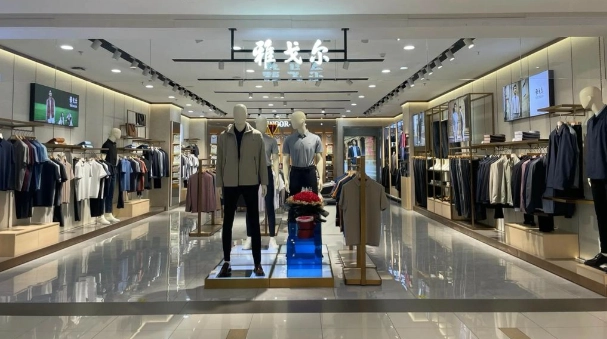
Youngor Apparel Manufacturing Changes Leadership: Second-Generation Heir Steps Back to Move Forward in Power Transition
Youngor's second-generation leader Li Hanqiong steps down as legal representative of the manufacturing subsidiary, focusing on brand acquisitions and capital operations, repositioning the fashion core business by retreating to advance.
Chinese private enterprises are collectively experiencing a wave of second-generation succession from within the establishment, and the passing of the baton at the menswear empire Youngor is unfolding in a profoundly subtle manner befitting its capital-driven character, advancing quietly beneath the surface. The latest business registration changes shown on Tianyancha App indicate that Youngor Garment Manufacturing Co., Ltd. has recently undergone registration modifications, with Li Hanqiong, the daughter of Li Rucheng and aged forty-nine, stepping down as the company's legal representative and chairwoman, replaced by Hu Ganggao, while she retains the title of vice chairwoman.
This pivotal resignation at the top of the manufacturing segment is by no means a simple bout of management turmoil. At this critical juncture, as leadership transitions and Youngor's market value hovers around the tens of billions of yuan mark while seeking brand reinvention, Li Hanqiong's strategic retreat is, in essence, a maneuver to free up her capacity at the higher group level to restructure her severely imbalanced core fashion business landscape.
The prevailing consensus in the industry, driven by trend-following, holds that a second-generation heir stepping down from the top post at a manufacturing subsidiary may signal hiccups in the succession process or a weakening of family control. Such superficial assessments vastly underestimate the institutional bulwark that founder Li Rucheng has constructed around this transfer of power. Not long ago, the seventy-five-year-old Li Rucheng explicitly stated in his letter to shareholders in the annual report that the board's upcoming reelection will place a new generation in charge of Youngor's operations. As president of the listed company, Li Hanqiong's position as successor is already unshakable. Her decision at this time to hand over this garment manufacturing subsidiary—established in 2000 and jointly held by Youngor Fashion and New Ma Garments—to veteran executive Hu Ganggao is aimed at completely liberating herself from the burdensome, low-margin terminal production and manufacturing affairs.
What Li Hanqiong faces is not preservation but a fashion shell urgently in need of stemming losses and infusing fresh oxygen.
For an extended period, due to the stagnation of the domestic menswear market, Youngor has been mired in the quagmire of declining core business self-sustainability. In its latest financial report, while the entire company maintains net profits attributable to shareholders exceeding 2.4 billion yuan, the vast majority of that is compensated by the investment operations Li Rucheng built over decades, while the fashion segment, as the foundation, has seen its profits shrink dramatically. Without the massive capital reserves at the backend pumping in support, the substance of its apparel core business would already be facing a crisis. Li Hanqiong previously climbed up through the retail front lines within Youngor, spearheading a series of billion-yuan acquisitions targeting an overseas multi-brand portfolio. For her, the future battlefield lies not in how sewing machines and assembly lines are scheduled at the Ningbo factories, but in how to convert these newly acquired international fashion labels and e-commerce channels into a fashion machine capable of directly reclaiming free cash flow.
By piercing through the capital base of this subsidiary via Tianyancha, its registered capital of over 72 million US dollars and its deep joint-venture background prove that it remains an extremely important production powerhouse for Youngor.
Although Li Hanqiong has yielded the legal representative role of this manufacturing entity, her retained vice chairmanship actually represents a rigid core control over supply chain influence. Her successor, Hu Ganggao, as a senior executive stepping in to handle the grueling operational details, ensures that traditional segments such as workshops and logistics maintain compliant internal controls at minimal cost during cyclical adjustments. This dual-pronged strategy of outsourcing daily production management to professional agents while keeping the family's core will elevated over asset-light layers such as brand acquisitions and capital deployment is the most classic engineering solution for asset intergenerational risk avoidance among Yangtze River Delta family enterprises.
The evolution of business has never trusted purely sentimental handovers. In this brutal cycle where survival truth is defined by real-time profit margins and market responses, a paper succession is merely the first step in an endless marathon.
This line of executive change recorded in the Tianyancha archive provides a sobering footnote for all established domestic brands mired in heavy-asset quagmires and eager to transform. So-called succession is not about sitting back and reaping rewards with a silver spoon, but about rolling up one's sleeves to conduct pixel-level divestiture and restructuring of burdensome traditional assets. Li Hanqiong is attempting to gamble her father's accumulated investment surplus on a diversified fashion endgame driven entirely by her own will, and this transition occurring on the eve of midsummer is her coldest and most rational consolidation of authority before she fully opens up a second battlefield.