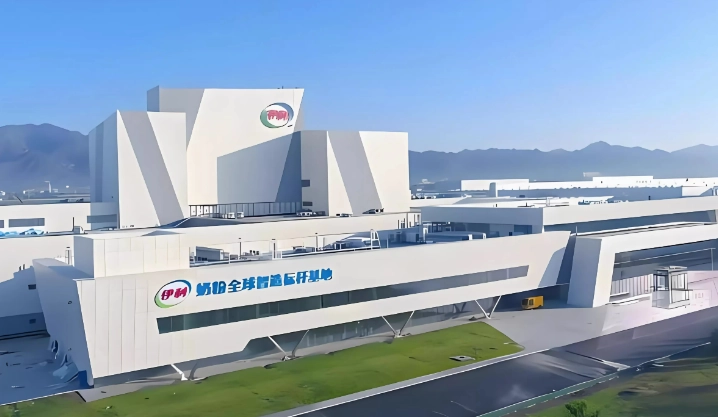
Yili acquires full control of Jinhan Dairy with 500 million yuan investment in Northeast milk belt, focusing on food additives and tech R&D to fortify supply chain dominance.
The stock-killing battle between the two dairy giants took a brutally sharp turn in midsummer 2026, forcibly cranking the intensity of capital-heavy operations to a level that left competitors gasping for air. While most major consumer goods companies were still scrambling as households tightened their wallets and raw milk prices stayed mired in a long-term slump—many even offloading experimental off-balance-sheet assets to dress up their profit margins—dairy behemoth Yili Group (600887) chose to drop a bombshell deep in Northeast China that sent shockwaves across the entire industry.
The latest corporate filing changes in Tianyancha App have laid bare Yili's long-game ambitions in core supply chain defense and the broader health-derived track: Heilongjiang Jinshan Yili Dairy Co., Ltd., established only two months ago, has seen its registered capital surge from an initial exploratory 20 million RMB to a staggering 500 million RMB,a capital increase of a jaw-dropping 2,400%.
This massive infusion of physical capital—soaring against the grain and defying conventional logic during a downcycle in the dairy sector—is absolutely not the routine pumping of numbers to satisfy local government performance reviews. Rather, it is an ice-cold move by Yili Group to consolidate resources and stake out new territory once the dividends from infant formula and premium liquid milk have been drained dry.
Traditional observers who are used to clinging to room-temperature milk shelves and sizing up the industry through liquid milk gross margins tend to read this move as a routine regional book-keeping reshuffle, or simply as plant expansion to boost capacity. That shallow reading badly underestimates the deep-seated anxiety that Yili's core management team is wrestling with as they face prolonged structural oversupply in domestic milk sources and the urgent need for cross-cycle breakthroughs in specialty dairy technology.
This capital game—a hard pivot from pure dairy trading toward hardcore food technology and global commerce—has its real profit chain and defensive lines hiding in plain sight within the clearly registered operational details on the Tianyancha system.
Tracing the shareholding chain down through the Tianyancha system, Heilongjiang Jinshan Yili Dairy, located in Heilongjiang's golden milk belt, is 100% wholly owned by Inner Mongolia Yili Industrial Group Co., Ltd., with legal representative Duan Huibin, a battle-hardened supply chain executive from within Yili's ranks, personally at the helm. Opening the operational matrix registered in the Tianyancha system, a hardcore panorama dripping with cross-border ambition and technological sovereignty jumps straight off the page: beyond traditional food production and food sales, food additive production, mechanical parts and components sales, goods import/export, and high-density technical services and consulting now occupy the core shelf space.
Why would a dairy titan that has long made its money by collecting raw milk, processing it, and pushing product through retail shelves on fast-moving consumer goods margins be pouring such terrifying capital intensity into a brand-new shell entity in its Heilongjiang stronghold, one written all over with "food additive production" and "technology R&D"?
The Core Driver: Shifting from Raw Milk Scale to High-Tech, High-Value-Added Biological Assets
The core driver lies buried in the unforgiving survival rule of the dairy industry's shift from "competing on raw milk scale" to "competing on high-tech, high-value-added biological assets."
Heilongjiang boasts the finest golden raw milk production zones in all of mainland China. But if the raw milk is simply hauled out and processed into ordinary room-temperature white milk, the razor-thin margins have already been crushed by exorbitant cold-chain logistics and nationwide depreciation costs. For Yili to preserve a durable premium on its balance sheet, the only path forward is to deep-process premium upstream raw milk on-site, force it through purification, and replace it with high-margin biotech assets—such as probiotics, lactoferrin, and various specialty food additives. These are the true upstream chips that hard-lock pricing power over premium dairy products and even choke-supply the bakery and infant formula supply chains.
This massive 500 million RMB physical increment is, at its core, Yili welding shut an "independent supply chain supremacy hub" and an "international trade firewall" outside its own balance sheet.
The "goods import/export" and "food additive production" registered on Tianyancha plainly exposes Yili's defensive privileges in raw milk restructuring and global raw-material trading going forward. Through this clean entity injected with half a billion in real cash, Yili can bypass complex cross-provincial administrative friction entirely, and with the absolute sovereignty of an independent legal person, source top-tier equipment, acquire technology patents, and conduct centralized purchasing and distribution of specialty milk-based raw materials across the Northeast and even the Far East. Even if the C-end consumer market continues to flounder in the muck of a zero-sum game, this capital-heavy technology and trading entity can convert traffic into massive returns from premium B-end industrial goods at extremely low internal transfer prices—so that a single point of weakness in room-temperature milk can never rock the foundation of the parent company's long-term risk control.
The dairy story in the second half of 2026 has long since left behind the false prosperity of blindly building plants and ranches, or buying consumers' time with sentimental storytelling. With the scale dividend of crude expansion fully squeezed dry, the ultimate test of an industry hegemon's survival is no longer the flashy number of terminal retail points announced at press conferences—but rather the cleanliness of its core entities and the cross-industry turnover efficiency of its core technology assets.