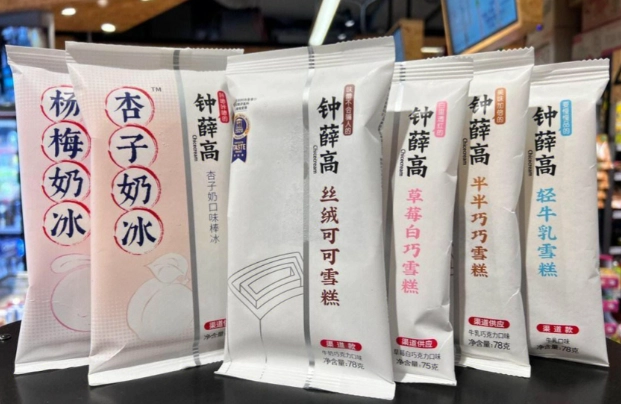
The Digital Remains of an Ice Cream Empire: Xue Zhonggao's 500 Trademarks Auctioned Off
Xue Zhonggao's 508 trademarks were auctioned at 21.1 million yuan, revealing how brand assets crumble when capital recedes and defensive trademark strategies fail against shifting consumer values.
On May 12, when Zhong Xue Gao founder Lin Sheng responded on camera to the auction of the company's intangible assets, the ice cream assassin that once lorded over convenience store freezers had already undergone a cold, ruthless commercial liquidation. Five hundred and eight intangible assets under the Zhong Xue Gao name changed hands at a starting price of 21.1 million yuan. That sale price not only shattered the valuation myth of this once-celebrated new-consumption star, but also laid bare the fragility and emptiness of brand assets when capital retreats.
As a buzzy internet company that once touched the ceiling of its trend, its true downfall was not a simple death by price war, but a death driven by a nearly pathological defensive anxiety.
Through the comprehensive intellectual property landscape disclosed by Tianyancha, we can read the frantic campaign of symbolic land grabbing that defined the company at its peak. Zhong Xue Gao filed applications for over 700 trademarks in total, with more than 490 successfully registered. The trademark matrix quietly sitting in Tianyancha's database forms a staggering spectacle of corporate defensiveness: from "Zhong Bu Gao" and "Zhong Xue Di" to "Zhong Xue Bu Di" and "Zhong Xue Xiao Gao," its reach extended not only into its core convenience food category, but also sprawled into entirely unrelated categories such as advertising and sales.
Looking at the deeper causes, this pixel-level trademark defense network is a classic symptom of the traffic-driven brand-building era. In the wave of new consumption, capital and founders desperately sought to cement a high-premium symbol built on marketing into an unassailable commercial sovereignty. They naively believed that by locking down every possible counterfeit variation with cold legal documentation, they could fend off the erosion of brand premiums in lower-tier markets. The roughly 200 trademark applications that were flatly rejected also document the compliance red lines this defensive war brushed up against.
But that is precisely the most fatal flaw in traffic-centric thinking: intellectual property can only deter the most basic copycats; it can never deter consumers from waking up to a disconnect between price and value.
In the sound of the auction hammer falling on those trademarks, the industry's long-held cliché that the more trademarks a company holds, the deeper its moat, has been completely shattered. When a company's supply chain collapses and its cash flow dries up, those 500 meticulously registered defensive trademarks on Tianyancha instantly become a row of digital epitaphs incapable of generating any free cash flow. The 20-plus-million-yuan sale price is less a market valuation of those names than a bargain entry ticket for the buyer to attempt one final harvest of the lower-tier market using the residual black-and-red traffic of Zhong Xue Gao.
The evolution of business has never cared how grand a conceptual fortress you build. The trademark relics left in Zhong Xue Gao's Tianyancha file are a blood-soaked bill for the ebb of new consumption. It serves as a cold reminder to every entrepreneur trying to maintain dignity through premium pricing and symbolic dominance: in a stock-cycle market defined by supply chain efficiency and repurchase rates, if an ice cream cannot convince consumers on taste and cost, then no matter how many "Zhong Bu Gao" trademarks you register, you will ultimately end up exposed and stripped bare on the capital auction table.