Jia Guolong's wife has pledged her entire equity stake in Xibei, reflecting the restaurant giant's credit lifeline and contraction pains.
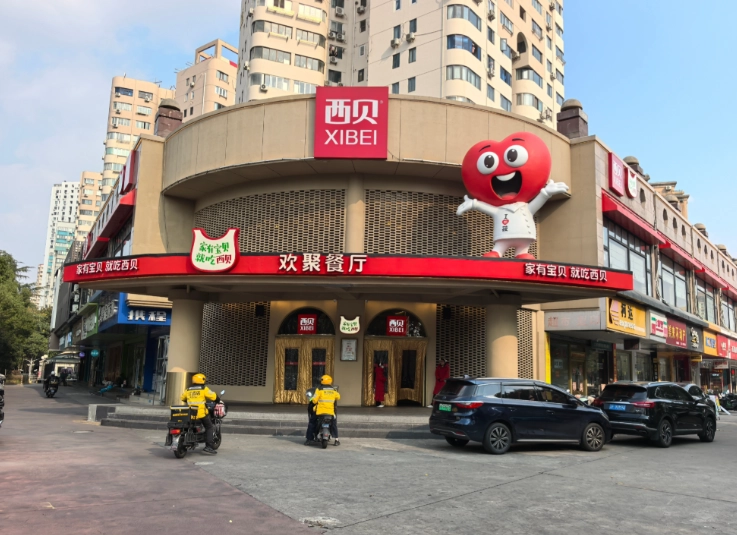
The Jia Guolong family, long known in business circles for daring to think and invest boldly, quietly placed a heavy bet on the industrial and commercial credit system in early autumn. Zhang Liping, a director of Inner Mongolia Xibei Catering Group Co., Ltd. and the wife of Jia Guolong, pledged all of the 5.400005 million yuan in equity she held under her name to the Hohhot Ruyi Development Zone Sub-branch of the Industrial and Commercial Bank of China. This pledged equity not only corresponds to her entire 5.1959% equity stake, but also appears in the enterprise pledge registration ledger as fully effective.
Behind the major shareholder family's decision to pledge all of its equity under individual names to a major state-owned bank is not an ordinary personal asset allocation, but a key leap by this leading domestic chain restaurant giant—amid setbacks in cross-sector experimentation and tightening listing channels—to exchange liquidity lifelines from banks through the real controller's credit backstop.
Following the underlying industrial and commercial registration traces to penetrate the capital skeleton of this private catering leader, its centralized family governance characteristics are fully exposed in Tianyancha records. Tianyancha industrial and commercial data show that Inner Mongolia Xibei Catering Group Co., Ltd. was established in October 2017, with Jia Guolong as its legal representative and registered capital of approximately 104 million yuan. In the business scope penetrated by Tianyancha, the enterprise not only firmly holds catering service and food production licenses, but also spans many fields including internet sales, enterprise headquarters management, and even investment with its own funds.
The fact that all of Zhang Liping's 5.400005 million yuan capital contribution has been pledged means the real controller family has pushed the entire direct equity value at the group parent level onto the front line of bank risk control.
In commercial banks' risk control logic for real-economy enterprises, the non-tradable equity of unlisted private catering companies is usually rarely accepted independently as core collateral because it lacks public market realization channels and secondary-market liquidity. The reason ICBC's local sub-branch accepted this full pledge clearly points to the parent entity applying for a sizable working capital loan or comprehensive credit line.
In the process of a core enterprise applying for a large low-interest loan, a major shareholder pledging all personal equity and adding unlimited joint and several guarantees has always been a precondition for financial institutions to implement penetrating risk control and force the real controller into deep debt binding with the enterprise.
This heavy equity pledge intuitively reveals the triple survival tug-of-war facing leading full-service restaurants in the current consumption climate.
The first is the direct-operated large-store heavy-asset model suffering a double squeeze from customer spending per order and table turnover rate. For decades, Xibei has cultivated core mall locations, relying on spacious and bright open kitchens, large dining areas, and per-customer spending above 100 yuan to support its myth of high sales per square meter. However, as current consumer behavior becomes more pragmatic and value-for-money fast food aggressively diverts traffic, the frequency of family-style high-ticket full-service dining has declined significantly.
The rigid monthly rent amortization, high-standard labor compensation, and cold-chain ingredient costs of direct-operated large stores pose an unprecedented test to stores' ability to self-circulate daily cash flow.
The second is the heavy financial burden left by multiple rounds of aggressive experimentation. From the early Xibei Oat Noodles, Super Roujiamo, and Gong Chang Zhang, to the costly Jia Guolong Kung Fu Dishes and Jia Guolong Chinese Burger, Xibei repeatedly fought and repeatedly lost on the road to exploring a second growth curve in fast food and retailization. The process of frequently opening stores to test the waters and then quickly closing them to cut losses poured astonishing real money into heavy-asset central kitchen construction, production line research and development, and store breach penalties.
These sunk costs accumulated in the early stages cannot be recovered in the short term through fast-food volume growth, and ultimately evolved into financial leverage that the group must continue to repay or digest internally.
The more critical turning point lies in the complete failure of the path to resolve debt through the capital market. Jia Guolong once publicly stated that he intended to push Xibei toward the capital market, but as domestic and overseas markets tightened listing review standards for traditional consumer companies, especially heavy-asset franchise chain enterprises, the door to relying on equity financing to replace early investment or replenish ammunition has basically closed. At a time when primary-market venture capital institutions avoid high-valuation catering, Xibei can no longer tell stories relying on capital premiums as it once did, and can only retreat to traditional banking syndicates and indirect credit financing, using family physical assets and equity to keep the enterprise alive.
This equity pledge in early autumn conveys the most realistic survival rule to the entire Chinese catering camp: the wealth-creation myth of the past, relying on high-turnover expansion and individual empiricism with high-profile, high-leverage moves, has already ended. When external equity capital recedes and profits from large offline stores are continuously compressed, even a full-service dining overlord with nationwide appeal must use the credit leverage of traditional major banks to reinforce its breakwater.
How to protect each store's real operating cash flow under the cold reality of consumption stratification and quickly shed the debt aftermath left by diversification is the answer sheet that Jia Guolong and his wife must submit after this pledge.