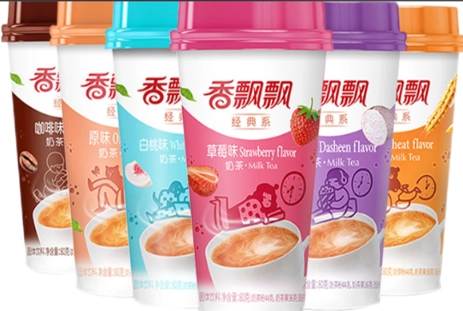
Breaking the Seasonal Curse: How Xiangpiaopiao's Industrial Capital Navigates the Stock Dilemma
Xiangpiaopiao invested 63.31 million yuan to establish a venture capital fund, using off-balance-sheet investments to hedge against the seasonal curse of its main business and seek a second growth curve.
When traditional consumer giants venture into investment, it is often not to tell a romantic diversification story, but rather an extremely pragmatic defensive asset restructuring after the core business hits a ceiling. Recently, Suzhou Xingjuchuangda Venture Investment Partnership (Limited Partnership) quietly came into being, with its capital contribution set at a distinctly actuarial-sounding figure—63.31 million RMB.
This seemingly low-key capital move instantly exposed the deep anxiety of Xiang Piao Piao, the pioneer of instant milk tea, as it attempts to use external venture investments to find its next second growth curve after bidding farewell to its high-growth myth.
Most ordinary observers, accustomed to sizing up Xiang Piao Piao on supermarket shelves during winter, tend to view this contribution as a routine financial investment or idle fund management. That superficial reading seriously underestimates the deep strategic pain this veteran cup-based milk tea giant faces amid the frenzy of price wars across new-style tea drinks online and its heavy reliance on seasonal turnover.
To fully understand the underlying interest chain and rationale behind this 63.31 million RMB capital migration, one must penetrate the partnership's foundation through Tianyancha.
Tianyancha data clearly shows that the executive partner of this newly established venture investment partnership is Suzhou Weitelixin Venture Investment Management Co., Ltd., while the contributor camp behind it is jointly controlled by A-share listed company Xiang Piao Piao, along with partners such as Qi Yaqin and Feng Dong. Turning to its registered business scope on Tianyancha, venture investment and equity investment go hand in hand. This means Xiang Piao Piao is not building new production lines in Suzhou, but rather handing over this tens-of-millions-level cash ammunition to seasoned investment professionals to incubate more explosive new consumer, new retail, or hardcore supply chain tracks externally.
The core driver behind Xiang Piao Piao's decision to open its wallet and act as a limited partner (LP) is precisely to hedge against the unavoidable "seasonality curse" of its main business.
As a national brand that rose on the strength of "selling over one billion cups a year," Xiang Piao Piao's survival has long been constrained by an extremely lopsided revenue model: winter is the absolute peak season for instant milk tea, while once summer arrives, its traditional cup-based solid instant business hits a freezing lull. Although the company has frequently launched ready-to-drink liquid milk tea and fruit tea over the past few years to fill the summer gap, the premium pricing of traditional ready-to-drink products is being relentlessly diluted in the face of head-to-head competition from freshly made teas priced at 9.9 RMB or even lower.
In a cycle where the main business's cash generation is caught in a battle over a shrinking pie, it makes more sense to set aside cash for reasonable risk isolation rather than continue pouring it into traditional advertising with diminishing return on investment (ROI).
Through the partnership structure visible on Tianyancha, Xiang Piao Piao is essentially building itself an agile "industry probe." A 63.31 million RMB stake is hardly a giant in a capital market accustomed to large-scale M&A deals, but for external trial-and-error, it is an extremely flexible pool of leveraged funds. Leveraging the professional perspective of venture capital institutions, Xiang Piao Piao can extend its reach into youthful food technology, healthy light meals, or digital retail services that its internal R&D bandwidth cannot cover. Should a promising dark horse emerge, the parent company can not only reap gains from equity appreciation but also secure priority rights to eventually absorb it into the group's supply chain system over the long term.
As the tide of consumer dividends recedes, what tests the vitality of a traditional major player is no longer the catchy ad slogans of yesteryear, but its ability to finely calibrate capital at a granular level. Xiang Piao Piao's reverse capital move is a clear warning of an industry shift: in the second half of the traditional FMCG battle, the competition is no longer just about channel push on store shelves. Whoever can first learn to use capital tools to build an anti-cyclical moat of interests externally will be the one to truly stabilize the safety of the entire balance sheet in the coming industry reshuffle.