The million-yuan lawsuit over Wong Fei-hung IP opens in court, a judicial reckoning for time-honored brand trademark licensing and trademark free-riding.
When "Wong Fei-hung," a century-old grandmaster symbol carrying the legacy of Lingnan martial arts and Southern-style medicine, is once again pushed to the defendant's seat by a court summons involving 1.026 million yuan, this infringement lawsuit scheduled for a November 11 hearing is by no means an ordinary trademark dispute between two local small and micro businesses. The plaintiff, Guangzhou Wong Fei-hung Brand Promotion Co., Ltd., directly accuses the two involved enterprises of infringing its core registered trademark exclusive rights, demanding joint and several compensation of one million yuan in economic losses and a public apology.
This judicial show of force has torn open the most brutal profit-cutting war between the brand owner and downstream free-riding hangers-on after China's historical and cultural celebrity IP went through reckless licensing and cross-industry authorization.
The Plaintiff's Trademark Moat and the Defendants' Trade Name Free-Riding
Following publicly available judicial information to penetrate the property rights foundation behind this lawsuit, the plaintiff's strategic moat is clearly documented in Tianyancha archives. Tianyancha business data shows that Guangzhou Wong Fei-hung Brand Promotion Co., Ltd. has densely built a three-dimensional trademark defense network under its name. It not only holds the core registered trademark No. 3183324 for "Wong Fei-hung," but has also registered film, television, and folk derivative symbols such as "Wong Fei-hung Po Chi Lam," "Wong Fei-hung Thirteenth Aunt," and "Young Wong Fei-hung" as exclusive assets.
By contrast, the two defendants—Wong Fei-hung (Guangzhou) Traditional Chinese Medicine Technology Co., Ltd. and Guangzhou Kung Fu Smart Wellness Technology Co., Ltd.—have directly embedded core labels such as "Wong Fei-hung" and "Kung Fu" into their trade names, and have entered high-gross-margin big health tracks such as traditional Chinese medicine technology and smart wellness.
The plaintiff is willing to pay notarization fees and attorney fees this time and to launch a maximum claim of one million yuan. The commercial motive behind this is piercingly clear: big health and traditional Chinese medicine wellness are currently the most profitable monetization enclaves for the broadly defined Wong Fei-hung IP, and the plaintiff absolutely cannot tolerate its core money-printing machine being quietly siphoned off by outsiders.
Wong Fei-hung IP Commercialization Path and the Free-Riding, Borderline Tactics
Wong Fei-hung's IP commercialization path is highly unique in the history of China's fast-moving consumer goods. What the public knows well includes peanut snacks, Thirteenth Aunt herbal tea, and plasters, dit da jow, and wellness tonics derived from the Po Chi Lam name. In the perception of end consumers, such products naturally carry a trust filter of folk herbal medicine and Southern-style bone-setting and trauma treatment.
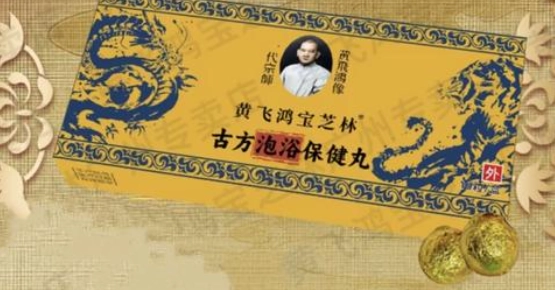
However, because Wong Fei-hung is a real historical figure with extremely high public-domain fame, a large number of latecomers try to exploit the administrative gap in enterprise trade name registration by registering the three characters "Wong Fei-hung" as the prefix of a company name in business registration, and then under the names of "supervised by a certain traditional Chinese medicine technology company" or "produced by Kung Fu Smart Wellness," they recklessly peddle licensed plasters, herbal teas, and even massage devices on e-commerce platforms and in private-domain pharmacies.
This kind of borderline free-riding tactic inflicts fatal double bleeding on the legitimate trademark holder.
Channel Profits Are Cut Away
First, channel profits are cut away outright. In high-gross-margin fields such as big health that rely heavily on mind-share endorsement, the physical raw material cost of producing a box of herbal plasters or tonic herbal tea is often only a few yuan, but the terminal retail price can reach dozens or even hundreds of yuan. By extremely downplaying their own full names on packaging and promotional materials and amplifying the visual elements of "Wong Fei-hung" and "Kung Fu," the defendant enterprises can trick consumers into trusting and placing orders at extremely low traffic-acquisition costs, directly carving up the market cake of the official authorization system.
Systemic Risk of Quality Control Explosions
Second is the systemic risk of quality control explosions. For a brand promotion company possessing a full set of defensive trademarks, its core asset is the authorization premium of the brand's intangible assets. But traditional Chinese medicine technology companies on the market that unauthorizedly fly the grandmaster's banner often rely heavily on workshop-style external licensed manufacturing. Once the non-standard medicated diets, external patches, or wellness equipment they produce cause allergic reactions, exceed harmful substance limits, or even engage in false advertising and are investigated by regulators, the public's anger in the court of public opinion will instantly pour onto the mother brand "Wong Fei-hung," damaging in turn the business confidence of legitimate licensees.
The Essence of the Lawsuit: A Battle for Survival to Kill the Chicken to Warn the Monkey
Therefore, the plaintiff's choice to bind the two upstream and downstream collaborating infringing entities together, send them to the defendant's seat, and seek joint and several compensation is essentially waging a battle for survival to kill the chicken to warn the monkey at high litigation cost. The claim of one million yuan is not only to fill in the royalty losses from having its own revenue diverted, but also, through the formation of a court precedent, to deter nationwide the gray-market chains that try to treat traditional martial arts IPs such as Wong Fei-hung and Huo Yuanjia as free cash machines.
Warning Bell and Fundamental Trump Card
This million-yuan confrontation on Guangzhou's intellectual property battlefield has sounded a warning bell for the entire derivative products industry chain of time-honored brands: the public halo of a historical celebrity is not an immunity token beyond the law, and the arbitrage game of harvesting big health IQ taxes by registering borderline trade names is now facing a thunderous judicial reckoning. But for the plaintiff holding a pile of defensive trademarks, merely suing to defend rights everywhere still cannot conceal its long-term absence from its own substantive business.
How to truly precipitate physical products with hardcore R&D barriers from being a mere rent-collecting brand authorization intermediary is the fundamental trump card for safeguarding the name of a century-old grandmaster.