27 Hardcore Majors and 8,800 Institutions at a Life-or-Death Crossroads: The Brutal Clear-Out of Vocational Education's Forced Asset-Heavy Shift
The Ministry of Education has added 27 hardcore majors, forcing vocational institutions to shift from asset-light to asset-heavy models, with high barriers set to eliminate many small and mid-sized players lacking capital.
When humanoid robots, the low-altitude economy, and hydrogen energy engineering are pushed into vocational education enrollment catalogs by strong policy will, the market's attention should by no means remain fixed solely on the grand vision of industrial upgrading. This specialty expansion, led by the Ministry of Education, is essentially an extremely ruthless structural crackdown launched against the supply side of China's vocational education sector, which has long relied on cheap courses to make quick money.
For a long time, a large number of lower-tier vocational institutions have been mired in a highly distorted, high-margin business cycle. What they offer are typically low-barrier, generic programs such as basic e-commerce, administrative management, and junior graphic design. The core profit chain of this model lies in extreme "asset-light operations": no expensive industrial lab equipment, no senior engineers with cutting-edge hands-on experience on faculty—just a few classrooms and a set of outdated textbooks are enough to keep harvesting tuition fees from young people eager to learn a marketable skill.
Under these rules of the game, the weight of ground-level recruitment and admissions marketing far exceeds the actual output of teaching itself.
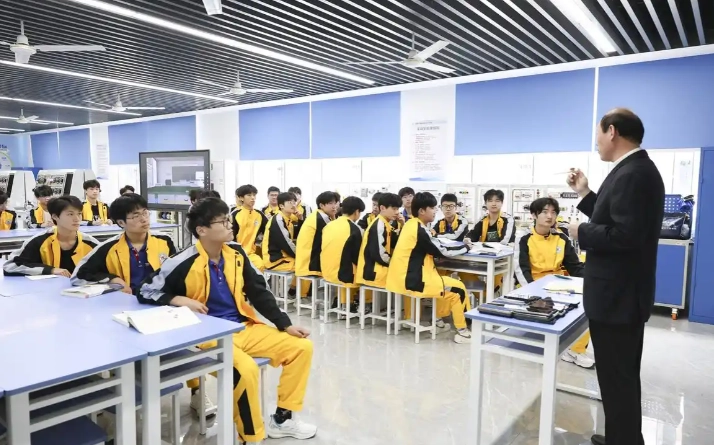
However, the rollout of these 27 cutting-edge new specialties directly yanks the barrier to entry in vocational education from asset-light services all the way up to asset-heavy appendages of high-end manufacturing.
No institution can teach students how to calibrate an industrial-grade humanoid robot with just a blackboard, nor can it produce competent hydrogen energy technicians in an environment lacking real test benches. These specialties, which directly serve the hard demands of the digital economy and high-end equipment, require educational institutions to embed themselves deeply in the real front lines of industry. This means that any school attempting to offer these programs must shell out tens of millions of real dollars to purchase training equipment on par with what major manufacturers use, and must recruit teaching and research teams with frontline engineering experience at premium salaries.
This enormous capital expenditure and technology depreciation burden will instantly puncture the fragile profit base of traditional vocational institutions.
Looking at the underlying business registration data on Tianyancha, the reality of this capacity mismatch is especially glaring. Through Tianyancha's industry mapping, it is clear that the total number of active vocational education-related enterprises nationwide is only just over 8,800. Although traditional manufacturing powerhouses like Guangdong and Shandong rank at the top in sheer numbers thanks to their massive employment bases, these few thousand market players are packed with micro-level training programs barely surviving on information asymmetry.
Facing the enrollment exam for the new specialties set to launch in 2027, among these 8,800 enterprises, only a handful genuinely possess the heavy capital investment capacity and the ability to build industry-education integration communities alongside leading companies. The vast majority of small and medium-sized institutions, lacking both capital leverage and the technological capability to sustain themselves, are doomed to be swept into a desperately brutal wave of bad-money elimination in the face of this top-down overhaul of specialties.
If they stubbornly push ahead with the new specialties, the exorbitant hardware costs will immediately snap their capital chains. If they cling to traditional programs, their graduates will stand no chance against the labor demands of new quality productive forces.
Using the most cutting-edge industrial demands to force a reshuffling of the educational supply side is the fastest way to sever the lifelines of inefficient diploma factories. The next half of the game in vocational education is no longer a traffic business of handing out flyers and selling certificates. As the education system becomes fully embedded in the core gears of advanced manufacturing, the motley players still trying to fob off the market with stale textbooks and rock-bottom costs will ultimately be ground to dust in this brutal asset-heavy gear shift.