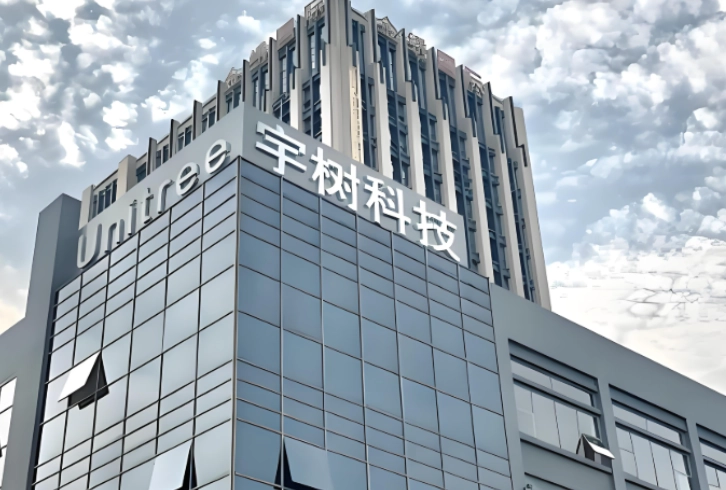
The Frenzy and Perils of a $440 Billion Market Value: Unitree's Wealth Miracle and the Battle for Physical AI
Unitree's listing with a $440 billion market value has sparked capital frenzy, centered on finding a physical carrier for AI, but high valuations and industrial implementation remain concerns.
When a company focused on legged robotics pushed its market value to a jaw-dropping 440 billion yuan on the very first day of its stock market debut, the broader capital markets had already descended into a near-irrational frenzy of panic buying. The 470,000 yuan paper profit per lot and founder Wang Xingxing's instant leap into the billionaire club were hardly a generous reward from the secondary market for a smart manufacturing firm's current quarterly earnings.
This extreme wealth-creation frenzy peeled back the curtain on the voracious hunger of various capital players for embodied intelligence, the ultimate trend du jour. They are willing to pay any price to find a physical body that can walk in the real world for large language models floating in the cloud.
Over the past several years, the core of tech narratives has been trapped inside screens and servers. However, as the dividends of artificial intelligence in text and image domains hit their ceiling, tech giants have realized with alarm that if algorithms cannot step down and intervene in the real physical environment, their ceiling for commercial monetization will be firmly locked. Unitree Robotics has managed to support a valuation on par with established internet giants precisely because capital views it as the critical hub connecting the virtual and physical worlds.
The market's pricing anchor is no longer how many thousands of robot dogs or humanoid robots it sells each year, but rather treats it as the mobile terminal of the next era—essentially paying a sky-high entry fee for a restructuring that is about to sweep across the entire labor market.
The Encirclement of Capital Titans
Looking past this dazzling veil of wealth to examine the interest map behind this newly minted giant, the encircling formation of capital titans has long taken shape. Following the business registration and shareholder filings disclosed by Tianyancha, within Unitree Robotics' registered capital pool of over 360 million yuan, in addition to founder Wang Xingxing's absolute shareholding, the entry of external capital such as Hanhai Information Technology (Shanghai) Co., Ltd. is especially critical.
At the tail end of this equity chain captured by Tianyancha, internet giants like Meituan are clearly visible. The real calculation behind why these local life services and logistics giants placed hefty bets early on is brutally cold: They must lock in hardware production capacity in advance that will one day replace food delivery riders and warehouse sorters. This is a proxy war among tech giants—whoever can master low-cost, highly reliable robotic bodies first will shake off the bottomless pit of labor costs for good in the future.
Cost Disruption and the Industrial Inflection Point
Shifting focus back to the industrial fundamentals, the core technological inflection point underpinning this 100-billion-yuan valuation lies in the full localization of the hardware supply chain and the disruption of costs. For a long time, overseas robotics pioneers have been mired in the quagmire of exorbitant manufacturing costs and commercial deployment challenges. Unitree's breakthrough was not about performing some stunning acrobatic stunt in the lab, but rather leveraging China's highly mature industry chain for motors, reducers, and batteries to forcibly compress equipment that once cost millions down to the tens of thousands or even tens of thousands of yuan—an accessible price range.
This extreme cost compression has given smart robotic equipment, for the first time, the confidence to go head-to-head on cost-effectiveness against human labor in scenarios like security inspection, industrial manufacturing, and even home companionship.
Concerns Beneath the Sky-High Valuation
However, leveraging a staggering market value of over 400 billion yuan to front-load an industrial future that is not yet fully mature is itself an extremely dangerous high-wire act. When the tide of capital pushes Wang Xingxing onto the throne of a billionaire, the market's patience will also become brutally demanding. If those backflips and sprints performed under the spotlight cannot quickly translate into reliable commercial execution in highly complex factory floors and muddy construction sites, the towering valuation built up by today's feverish sentiment could come crashing down at any moment in the face of ruthless order defaults.
In this ultimate marriage of computing power and mechanics, the sky-high bell-ringing ceremony is merely the prologue to a brutal knockout tournament.