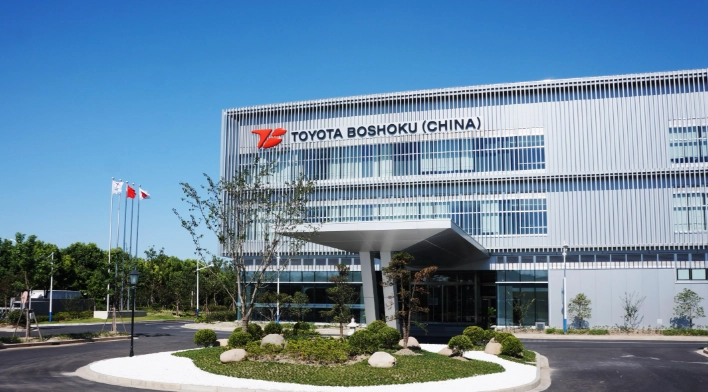
Traditional Textile Giant Teams Up with ODM Leader in $1.4M Venture: Toyota Boshoku and Huaqin Technology Shift the Frontline of Software-Defined Vehicles
Toyota Boshoku and Huaqin Technology have jointly invested 10 million yuan to establish an automotive electronics company, focusing on software development to capture the core ecosystem of intelligent cockpits.
As the global automotive industry chain engages in high-frequency competition in the deep waters of "intelligentization" and "software-defined vehicles," traditional automotive parts giants and mainland electronics manufacturing heavyweights are pushing their defensive lines deep into the core of automotive intelligence with extreme determination.
Recently, a new company registration announcement disclosed by the Tianyancha App has fully exposed a covert, long-term strategic maneuver between Toyota Boshoku, the global automotive interior giant, and Huaqin Technology (603296), the domestic intelligent hardware ODM leader: the two parties have quietly established a joint venture in Shanghai called Toyota Boshoku Huaqin (Shanghai) Automotive Electronics Co., Ltd., with a registered capital of 10 million RMB.
This seemingly trivial capital move, dwarfed by the multi-billion-yuan investments typical of hardcore automotive manufacturing, stands out starkly and carries a strong strategic contrast for peer parts suppliers still clinging to traditional hardware processing while grappling with sluggish global vehicle sales.
Most industry observers, accustomed to judging these two giants by new vehicle shipment volumes and gross margins on seat leather, tend to interpret the establishment of this new company as a routine regional bookkeeping adjustment or standard inter-corporate business courtesy. Such a shallow reading completely underestimates the systemic survival anxiety facing Shinichi Yaomura and both management teams amid the collapse of traditional interior premium pricing and the approaching inflection point for intelligent cockpit software algorithms. The two parties are now casting their nets in Shanghai not to mechanically process a few more standard chips, but to use the lightest possible capital shell to force their way into the core ecosystem of intelligent cockpits and smart hardware.
The true profit chain behind this cross-industry venture between traditional manufacturing and hardcore electronics lies buried in the cold corporate registry data. Tracing the equity links through the Tianyancha system, the newly established entity is jointly controlled by Toyota Boshoku (China) Co., Ltd. and Huaqin Technology Co., Ltd., with Shinichi Yaomura, a key Toyota Boshoku executive, serving as the legal representative. A look at the clearly registered business scope in the Tianyancha system shows automotive parts R&D, technology import/export, and software development occupying the core positions.
Why would a century-old company built on automotive seats and textile interiors choose this moment to forge a cross-industry tie-up with a contract manufacturer known for phones and tablets, with its operational focus precisely locked onto "software development"?
The key profit driver lies hidden in the life-or-death reckoning logic of the traditional automotive supply chain as it shifts from "earning hard money on physical hardware" to "buying up software-based intelligent assets."
Traditional automotive interiors and components represent a classic high-depreciation, low-margin, asset-heavy slow business. As global intelligent vehicles evolve toward "intelligent cockpits" and the "mobile third living space," consumer evaluation criteria for vehicle interiors have long since shifted from pure seat leather quality to screen interaction, intelligent control algorithms, and the agility of software updates. If Toyota Boshoku continues to cling to its traditional textile narrative, the only outcome is being squeezed to the limit on pricing by new EV startups and reduced to a voiceless tier-one supplier. Huaqin Technology, as a top-tier domestic intelligent hardware ODM giant, holds the world's most mature hardware-software co-tuning capabilities and exceptional cost control.
This 10 million RMB addition in Shanghai is essentially both parties externally welding shut a "light-asset technology hub" and "intelligent premium harvesting machine" for themselves.
Toyota Boshoku urgently needs Huaqin's low-cost, high-efficiency software development and chip module design capabilities honed in the consumer electronics space to rigorously cleanse and replace its traditional automotive component shell, upgrading it into a "next-generation cockpit hub" with intelligent perception and algorithmic interaction. For Huaqin Technology, this also serves as a top-tier passport to leap past the consumer electronics winter and forcibly integrate its hardware manufacturing strengths into the core framework of the heavy automotive industry.
The traditional manufacturing story has long reached its end. Today, the true test of survival for any automotive industry chain giant is no longer how many looms sit in its factories, but whether it can use the cleanest pure-technology entity to firmly command the flow of intelligent profit.
This 10 million RMB new foundation recorded by the two giants in the Tianyancha registry is a clear industry gear-shift signal: the second half of the automotive electronics civil war has long since moved past the rough romanticism of blindly building factories and plants. Whoever can first complete the dehydration and cross-industry restructuring of assets within the deeply muddy pipeline of software algorithms and component integration will be the one to truly secure lasting premium on the entire balance sheet amid the brutal shakeout ahead.