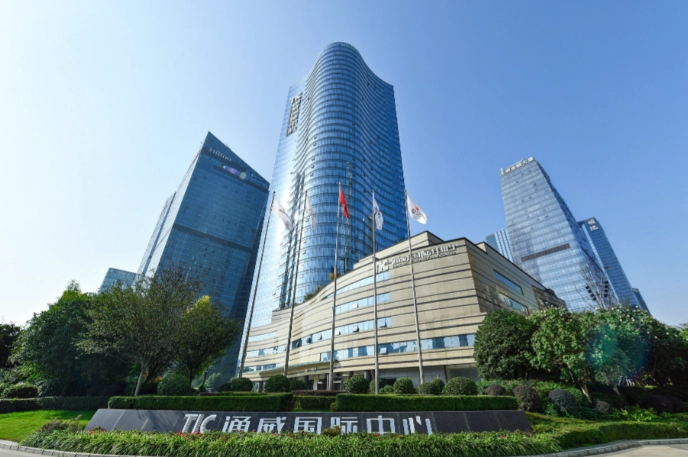
Behind the 540,000 Tax Penalty: Tongwei's Cyclical Gravity and Internal Control Stitches
Tongwei's 540,000 tax penalty reveals internal control shortcomings amid a cyclical downturn, as the giant's compliance costs rise, underscoring the need for financial nerves to keep pace with regulatory rhythm in an era of stock competition.
For an industrial giant with registered capital of 4.5 billion RMB and annual revenue routinely exceeding 100 billion, a tax penalty of just 540,000 yuan doesn't even register as a rounding error on its financial statements. Yet the fine recently imposed on Tongwei Co., Ltd. by the Third Inspection Bureau of the Chengdu Municipal Tax Service still landed like a fine silver needle, precisely piercing the internal control weakness of this dual leader in the photovoltaic and feed industries amid the depths of its cycle.
Public attention is often misled by the amount of the fine, assuming this is merely an incidental friction in the machinery of a giant's finances. But in the context of the new energy and commodity markets entering 2026, any minor compliance crack is a visible signal of underlying operational pressure transmitting upward.
Over the past few years, the photovoltaic industry has undergone an extremely brutal, large-scale capacity clearance. Even Tongwei, with its cost advantages, has inevitably seen tremendous pressure on its once-vaunted cash flow amid silicon price volatility and overseas trade challenges. When a company is forced to squeeze efficiency from every operational segment and every financial granularity, the tension between traditional tax planning and local compliance boundaries magnifies. The underlying cause of this fine is by no means simple tax evasion — it is a technical failure where internal audits lagged behind external regulatory intensity during the giant's extreme financial maneuvering in the industry downturn, or during capital allocation across multiple business divisions.
This awkward moment in the spotlight stands in stark contrast to its massive and stable capital foundation.
Tianyancha operational risk information shows that Tongwei Co., Ltd. has been rooted in the market since 1995. Beyond its parent company Tongwei Group, prominent capital entities such as Hong Kong Securities Clearing Company Ltd. also hold top positions on its core shareholder roster. In the evolutionary history of this established giant, one can clearly trace its distinctive profit chain driven by the dual engines of "agriculture plus photovoltaics." However, since the baton was passed to the young second-generation leader Liu Shuqi, this vast machinery has had to contend not only with the iron-fisted reckoning of the photovoltaic cycle, but also with the razor-thin margins of asset-heavy agricultural segments like traditional feed processing in an era of stock competition. When the management team attempts to restructure the entire industry chain's financial systems with digital tools, the gap between old and new compliance systems often gets called out in the form of tax inspection red flags recorded in Tianyancha's archives.
The conventional wisdom commonly repeated across the industry always emphasizes that companies should strengthen internal management. But this consensus overlooks the hard-core gravity of nationwide comprehensive digitalization of tax administration and pixel-level penetrating supervision by mid-2026. In today's survival environment where credit defines truth, the compliance costs facing giants have risen exponentially.
This 540,000-yuan fine is precisely a bill presented to all traditional conglomerates attempting to ease financial suffocation at the cycle's bottom through marginal planning. The blemish left on Tongwei's Tianyancha record proves that in the iron-blooded baptism of the stock cycle, no throne enjoys absolute immunity. As the myth of crude expansion collapses, how to bring the internal financial nerve endings up to the absolute compliance deadline of the rule of law will be the hard-core tuition Liu Shuqi and her vast empire must pay before returning to a growth trajectory.