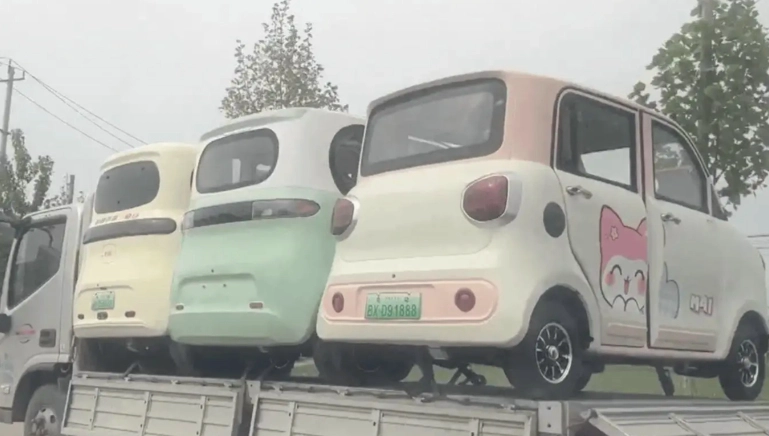
Small workshops in Jinxiang, Shandong, assemble low-speed vehicles that mimic luxury cars using discarded batteries, selling them for as little as 10,000 yuan to rural elderly, exposing a regulatory vacuum and black-market chain.
When an electric vehicle resembling a Lamborghini or Rolls-Royce shows up at a village entrance in Jinxiang, Shandong, for under 10,000 yuan, this is not the democratization of industrial civilization—it is a targeted hunt against vulnerable elderly populations. The recent exposé by CCTV Finance has stripped away the facade, turning the term "hand-built car," which carries a certain artisanal ring, into a bloody footnote in an illegal supply chain.
Through the business registration data presented by Tianyancha App, we can clearly trace the survival logic of these underground workshops. The involved Jinxiang County Zhongxin Commercial Trading Department was established in April 2025, barely a year old at most. Its registered business scope is filled with high-sounding categories such as "daily necessities wholesale" and "high-efficiency energy technology research and development," yet not a single word mentions automobile manufacturing. This classic case of "selling dog meat under a sheep's head" reflects that such workshops were designed from the outset with the intention of evading regulatory oversight.
The "Short-Lived" Gamble Beyond Registered Capital
Why has this workshop only been in operation for a year? Digging deeper, this short lifecycle is not due to poor business performance but rather a proactive risk-avoidance strategy by those in the illegal trade. Within the low-speed electric vehicle industrial cluster formed in certain counties of Shandong, this "hit-and-run" shell company model is extremely prevalent. One year is enough to complete the cycle from sourcing scrapped parts, rough assembly, to harvesting the rural market. Once media scrutiny tightens or regulatory pressure increases, individual business owners like Liu can quickly deregister and vanish, only to reappear under a new name in a neighboring town.
This status of abnormal operation or short-term existence, as shown on Tianyancha, is essentially a physical firewall for the illegal supply chain to hedge against legal risks. They exploit the information isolation of rural areas, forcibly stitching together used power batteries and cheap motors into low-quality steel shells, then affixing a flashy luxury car exterior. This so-called "hand-building" is, at its core, a savage trampling of industrial standards and life safety.
"No License, No Plates": A Fabricated Demand Blue Ocean
The driving force behind this profit chain lies in the malicious exploitation of the "last mile" pain point in rural transportation. As regulation of legitimate electric vehicles tightens, driver's licenses have become a barrier for many rural elderly. These workshops have precisely captured this psychology, packaging "no license required, no plates needed" as an alleged industry advantage. Tempted by the low price of around 10,000 yuan, what the elderly purchase is not just a mobility scooter, but a one-way ticket into a regulatory blind spot for traffic safety.
The reason these workshops dare to build cars illegally outside their registered scope is their reliance on a highly covert "internal circulation" of parts. These used batteries often come from scrapped new energy vehicles, flowing through unofficial channels into these underground workspaces. For the workshop owners, this is nearly a zero-cost premium business; but for the users, every battery is an unstable bomb buried under the seat. This black-market output generated by resource misallocation is a serious provocation against the order of China's new energy vehicle recycling industry.
The Necrosis of Regulatory Capillaries
The Jinxiang hand-built car incident exposes the helplessness of grassroots regulatory capillaries when facing mobile illegal operations. How could a business registered as a "daily necessities wholesaler" openly engage in automobile manufacturing for an entire year? This severe mismatch between business activities and registration information shows that our industrial and commercial inspections and on-site supervision still have enormous blind spots in lower-tier markets.
If we merely shut down a few workshops without tracing the flow of those used power batteries or cutting off the supply chain of those substandard motors, these "three-no vehicles" will keep sprouting like weeds that cannot be uprooted. On the Tianyancha map, we can see countless similar micro business entities forming a vast gray ecosystem. When the dividends of technological progress fail to reach remote areas, illegal operations will quickly fill the vacuum by exploiting cost advantages.
The endgame of commerce should not be the bad driving out the good. These industrial waste products disguised as "luxury cars" are, in essence, a targeted plunder of rural retirement assets. While the Lius of the world calculate their thousands of yuan in profit per vehicle, they are reaping the peace of mind of an entire family. This exposé by CCTV is not just a warning for Jinxiang alone, but a long-overdue reckoning for the entire low-speed electric vehicle industry.
What we need to be wary of is not hand-building itself, but the greedy logic that exploits regulatory loopholes and manufactures safety hazards to squeeze out surplus value. Under the spotlight of the law, these "flash-in-the-pan" workshops that exist for only a year will eventually reveal their primitive and ruthless speculative nature. Since they have chosen to dance on the edge of safety standards, what awaits them is inevitably the harshest legal judgment and the complete bankruptcy of market credibility. This reckoning over "three-no vehicles" should not stop at deregistering a few accounts or sealing off a few factories; it should be a deep restructuring of the entire grassroots governance logic.