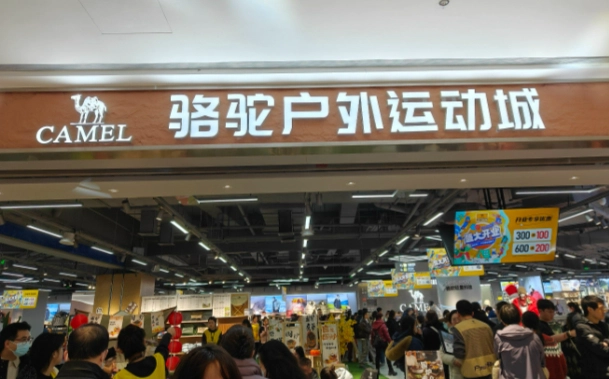
Camel Outdoor increases capital by 200 million yuan, shifting from traffic-driven marketing to heavy-asset supply chain management, with self-built smart factories to withstand industry price wars.
As outdoor jackets evolved from hardcore gear into all-weather everyday wear, the outdoor products sector entered its most brutal stock-market reckoning in mid-2026. The latest business registry changes shown by Tianyancha App indicate that Camel (China) Outdoor Products Co., Ltd. has recently completed a major capital increase, with its registered capital doubling directly from RMB 100 million to RMB 200 million.
This 100% full-scale capital injection is far from a simple bookkeeping move. Stripping away the PR veneer of outdoor apparel relying on big-brand knockoffs and marketing blitzes, the underlying cause is that, as traffic dividends hit their ceiling, companies are trying to use hard asset weight to build a final supply chain defense line.
Industry consensus generally holds that Camel leads in e-commerce platform sales, and that the capital increase is meant to handle larger order volumes. But this optimism ignores the most lethal profit squeeze in the digital retail context. In recent years, the outdoor jacket segment has rapidly devolved into brutal price wars. Under a light-asset operating model that relies purely on buying traffic on short-video platforms and slashing prices in livestreams, profit margins have long been eroded by soaring customer acquisition costs and rising fabric prices.
A more severe inflection point lies in technology: consumer perception of outdoor jackets has fully shifted toward pixel-level scrutiny of metrics such as rainstorm resistance and moisture permeability. Camel previously swept the market through extreme economies of scale, but when imitators launch saturation attacks at cost-line prices, the giant must, to hold its ground, move the battlefront entirely from front-end marketing spectacles to the heaviest back-end manufacturing lines.
Looking closely at the business scope disclosed on Tianyancha, the entry "apparel production using computer-integrated manufacturing systems" is telling. It exposes the intent behind this RMB 200 million capital bet: Camel is staging an all-out sprint to expand digital smart factories and eliminate outsourcing across the board.
In a garment industry that prizes fast-response cycles and inventory control, whoever can leverage computer-integrated systems to streamline fabric cutting, flexible production scheduling, and smart logistics will squeeze out more profit. Through capital backing from shareholders including the entity led by Wan Jingang and Guangzhou Rongke Yin Investment, Camel is pouring funds into self-built factories and smart manufacturing upgrades—essentially using high capital barriers to choke out light-asset players who rely purely on OEM and lack resilience. This is a sober asset hedge: rather than paying tribute to traffic platforms, it is better to convert profits into hard assets like land, machinery, and proprietary algorithms.
The endgame of business competition never promises warmth. In this contest where survival is defined by supply chain flexibility and the production cost of each garment, the narrative of the outdoor jacket is regressing from a new-consumption traffic story to the most classical heavy-industry efficiency battle. The RMB 200 million capital increase recorded in the Tianyancha file is Camel's defensive wall built before the storm. Those speculative brands still clinging to light-asset traffic buying and unwilling to get their hands dirty in the manufacturing trenches will ultimately pay the most expensive exit bill under the efficiency crush of heavy-asset giants.