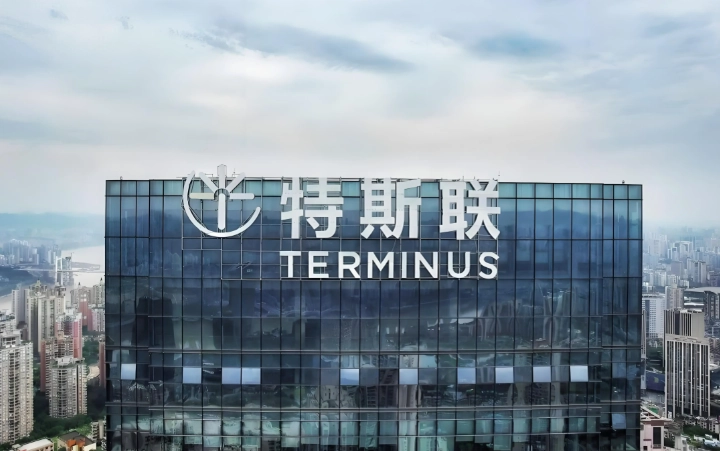
As General Algorithms Bubble Bursts, Terminus Anchors Industrial AI Moat with Heavy Hardware
Terminus invests 319 million yuan to set up a limited partnership in Tianjin, doubling down on hardware infrastructure to deliver city-level intelligence through industrial AI, countering the general algorithm bubble.
While founders in the large-model startup track are still elbowing each other to pitch ethereal code interfaces to investors, the hardcore players truly trying to cram artificial intelligence into the concrete-and-steel jungle are frantically strapping extremely heavy physical shackles onto themselves with real money. Terminus Group recently made a quiet move in Tianjin—what looks like a mundane compliance filing on the surface actually tears open the cold, asset-heavy underbelly of city-level AI infrastructure.
Tracing backward through the corporate equity grid flowing through Tianyancha, this newly established Tianjin Chenguang Zhilian Technology Partnership has its capital contribution set with pinpoint precision at 319 million yuan. In a tech circle where billion-valuation hype is routine, this three-plus-hundred-million in cash is hardly astronomical. But look closely at its organizational form, and this "limited partnership" structure, funded jointly by Terminus Group and its wholly owned smart-investment subsidiary, is essentially an extremely seasoned capital-isolation sandbox.
For a unicorn like Terminus, whose core chassis is AIoT, laying the underlying computing-and-network infrastructure in an old industrial heavyweight like Tianjin is nowhere near as simple as selling a few system software packages. It requires massive sensor fleets, edge computing nodes, and an intelligent hardware network dense enough to cover an entire park. A limited partnership vehicle of this kind is often the super-sleeve used to house bulky hardware assets and long project settlement cycles. It cleanly seals off the high-friction receivables and sunk costs from the early stages of building a city-level intelligent computing center or smart campus, isolating them from the main operating parent and preventing long-tail compliance risk from local heavy assets punching upward through the core income statement.
What gives this 300-million-plus injection real teeth is the hidden thread inside the licensed business categories. Tianjin holds a vast but desperately outdated stock of industrial capacity and logistics distribution networks awaiting cleanup. Terminus is pouring serious money here not to build consumer-grade conversational robots floating in the digital cloud, but to forcibly implant an extremely hardcore industrial brain into the city's traditional robotic arms, warehouse conveyor belts, and aging, energy-hungry power grids.
With manufacturing export tariff barriers and internal cost pressures pushed to the limit, the old profit chain built purely on cheap-labor differentials has completely collapsed. What large state-owned enterprises and local governments now urgently need is a form of embodied intelligence and a new computing-power foundation capable of taking over the physical world and orchestrating fully data-driven operations.
This is the cruelest meat-grinder logic of the second half of city-level AI. Generic algorithm interfaces are becoming cheaper by the day; the only true moat is whoever can nail computing power and hardware deep into the physical chassis of local governments and enterprises. This is a brutally hard, back-breaking business of stooping low. You have to deal with complex municipal utility networks, haggle with workshop managers at traditional factories, and fight for control of every data interface.
In this winter defined by real-world delivery and hardware uptime rates, pure-software teams lacking physical-world reach will be mercilessly purged amid inflated valuation bubbles. That initial 300-million-plus stake is nothing more than Terminus's asset-heavy letter of allegiance on the North China Plain. As frenzied capital gradually cools, tech giants have finally woken up to a cold commercial truth: whoever can weld the city's foundation tightest with the heaviest steel and silicon will be the one who earns a long-term seat at the main table in the coming computing-power turf war.