After being fined 800,000 yuan for substandard contract-manufactured products, Tensil Red Bull swiftly replaced its leadership, exposing compliance risks around its Blue Hat approval and quality-control hazards in its contract-manufacturing model.
When Guangzhou Yaonengliang Beverage Co., Ltd., the core entity of the Thai Tencel camp, swiftly completed the change of its legal representative and manager—with the former head stepping down and a new person in charge taking over—this was by no means an ordinary rotation of multinational executives. Just in July of this year, the company had been issued a fine of 800,000 yuan by the Yuexiu District Market Supervision Administration in Guangzhou because a commissioned production batch failed the pantothenic acid test.
Quickly completing the separation at the industrial and commercial registration front after the administrative penalty landed, this swift legal representative succession exposed Tencel’s extreme vigilance in its decade-long tug-of-war in China over the rightful claim to Red Bull’s orthodox status—specifically, the compliance risks lurking around its most critical moat piece: the health food “Blue Hat” approval.
Blue Hat: Tencel Red Bull’s Fatal Weakness and Moat
To understand the fatal weakness of Guangzhou Yaonengliang’s position within the Tencel Red Bull system, one must unpack the longest trademark and licensing shadow war in the history of China’s functional beverage industry. After Reignwood Red Bull fell out with Tencel, its biggest constraint was the trademark infringement dispute; and if Tencel wanted to openly fill and sell functional beverages bearing the Red Bull name within China, its greatest fatal weakness was its own lack of a health food approval number approved by the national food and drug regulatory authority (commonly known as the “Blue Hat”).
Without a Blue Hat, a functional health beverage not only cannot legally claim core effects such as anti-fatigue on its packaging, but also cannot enter major pharmacies, special channels, and some strictly regulated chain supermarkets.
Guangzhou Yaonengliang was precisely the key springboard that Tencel spent heavily to acquire back then in order to break through its unlicensed predicament.
Capital Thread and Approval Springboard
Following the traces left at the industrial and commercial foundation to penetrate this foreign-funded entity’s capital thread, its weight is clearly preserved in Tianyancha records. Tianyancha industrial and commercial data show that Guangzhou Yaonengliang Beverage Co., Ltd. was established in July 2012, with registered capital of as much as US$39 million, wholly controlled by an overseas entity registered in Singapore, TCPSG. Among its approved business scope, the most core pillar is health food sales.
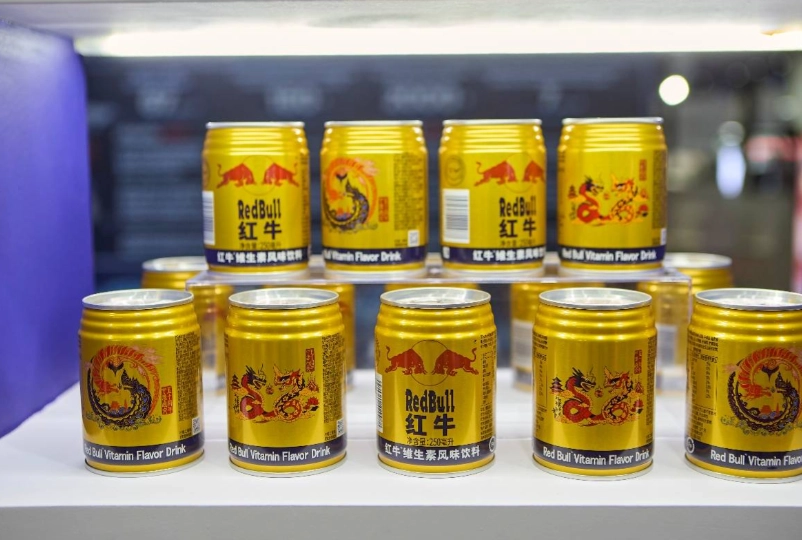
It was precisely by relying on the health food registration approval originally held by Yaonengliang that Tencel was able to smoothly launch a series of products such as “Red Bull An奈吉” and “Red Bull Vitamin Flavor Beverage,” engaging Reignwood Red Bull in all-out positional warfare on the shelves.
OEM Model: The Root Lesion Behind the 800,000 Yuan Fine
However, Tencel’s long-term adoption in the Chinese market of a “light-asset commissioned OEM” production organization model constituted the root lesion behind this 800,000 yuan fine.
In order to rapidly distribute nationwide and seize the mom-and-pop stores and gas station freezer cabinets firmly held by Reignwood, Tencel relied heavily on large domestic OEM factories such as ORG and Shengyuan for private-label canning. But in the game of OEM canning, once it involves the proportional addition of micronutrients such as B vitamins, pantothenic acid, and taurine, it depends extremely heavily on the OEM workshop’s engineering quality control in premixing, homogenization, and online testing.
When the commissioned production product was sampled and judged unqualified by regulators on the pantothenic acid indicator, it directly tore open the institutional crack in quality control consistency under Tencel’s China supply chain outsourcing model.
The Fine’s Chain Risks and Compliance Firewall
For an ordinary fast-moving consumer goods company, an administrative penalty of 800,000 yuan may be merely a faint figure in non-operating expenses; but for the Red Bull system, which is in the decisive phase of trademark litigation and the sensitive stage of a sprint toward listing, a failed health food sampling inspection means a devastating blow to the legality of the approval and the image of product safety. Every confrontation between Reignwood and Tencel at the terminal is conducted with a magnifying glass in search of the opponent’s compliance loopholes.
Once this administrative penalty is used by competitors on the channel side as public opinion ammunition to attack its unstable OEM quality and chaotic approval management, it will directly trigger dealers’ wavering on large-volume orders.
Rapidly replacing the legal representative and the top manager of the operating team is a classic compliance firewall tactic.By having the old team bear responsibility and exit at the industrial and commercial level, and installing new senior executives to restructure internal controls, Tencel not only submitted to the local regulatory authorities a closed-loop proof of internal accountability and rectification, but also attempted to physically isolate the public opinion impact of the quality incident within the previous term of office.
Industry Lesson: Changing People Cannot Eliminate the Hidden Reefs of OEM
This change of leadership after the midsummer fine sends the coldest industry lesson to the entire functional beverage track: tens of billions in revenue built on buying approval documents and external OEM manufacturing may look invincible while sprinting, but it has always been suspended on a fragile tightrope of quality control. When the battle for Red Bull China shifts from early courtroom trademark offense and defense fully down to every milligram of formula compliance on OEM production lines, if Tencel cannot truly grasp the reins of quality control in its own hands, merely changing personnel at the industrial and commercial level will still not eliminate the continued backlash of OEM hidden reefs against its Blue Hat assets.