Taoli Bread Raises 280 Million for Southern Expansion, Seeking Growth Amid Baking Industry Consolidation
Taoli Bread injects 80 million yuan into its Guangxi subsidiary, boosting capital to 280 million yuan, accelerating its South China production layout amid a reshuffle in the short-shelf-life baking sector.
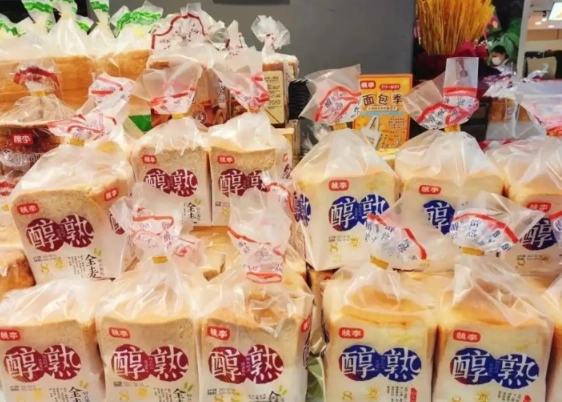
In a brutal cycle where the short-shelf-life bakery sector has sunk into a zero-sum game of existing market share and a wave of internet-famous bakery brands have shuttered one after another, the heavy-asset bets placed by traditional baking giants have sharply exposed the underlying forces reshaping the industry's structure. Recently, Guangxi Toly Bread Co., Ltd. underwent a highly significant business registration change, with its registered capital surging from 200 million RMB to 280 million RMB—a jump of 40%.
This new infusion of 80 million RMB in cash ammunition signals not only that the "King of Northeast Baking," Toly Bread, is launching a fresh heavy regrouping in its long-troubled southern expansion map, but also marks the start of deep operational and production-capacity suppression across the South China hinterland by its asset-heavy "central factory + wholesale" model.
Many casual observers, accustomed to viewing the bakery industry through the lens of retail storefronts and afternoon tea, tend to dismiss this major capital increase as routine day-to-day operations for a regional subsidiary. Such shallow logic completely underestimates the deep strategic anxiety Toly Bread has endured in breaking into the southern market after leaving behind its northern comfort zone.
To fully grasp the underlying interest chain and rationale behind this 80 million RMB capital injection, one must use Qichacha to dig into the company's core structure.
Guangxi Toly Bread Co., Ltd., established in February 2016, has Xiao Zhanwei as its legal representative and is wholly owned by A-share listed company Toly Bread. According to the business scope disclosed on Qichacha, food production, food sales, and online food sales form its core business loop. This means the Nanning-based entity is not a mere sales office but a manufacturing hub that Toly Bread heavily relies on as its South China stronghold.
Why would a subsidiary that has already weathered a decade of market development in Guangxi suddenly choose now to forcibly expand its capital base by 40%?
The core driver lies in the ice-cold law of "logistics and production radius" in the short-shelf-life bread industry. The shelf life of short-shelf-life bread is typically only 5 to 7 days, and the viability of this business hinges entirely on how fast the central factory can physically reach surrounding supermarkets and convenience store distribution networks. While Toly Bread holds absolute dominance in the north, its southern push has long been hampered in the South China market by fierce competition from Dali Foods, Meibeichen, and various local brands—resulting in low capacity utilization, high distribution costs, and consequently shrinking gross margins in what amounts to a "southern friction" penalty.
This time, directly pouring in massive capital to push registered capital up to 280 million RMB bluntly reveals Toly Bread's cold calculus of shifting in the South China market from "probing attacks" to "scale-based suppression."
These funds will be channeled directly into automation upgrades for factory production lines, expansion of cold-chain logistics capacity, and aggressive acquisition of shelf share in core South China commercial zones. At a juncture when the bakery industry is undergoing consolidation and numerous independent baking workshops lacking scale economies are exiting the market due to cost inflation, Toly Bread's counter-cyclical production expansion is essentially an attempt to leverage its deep capital moat, using lower per-unit production costs and denser distribution networks, to forcibly absorb the market gaps left behind.
When the dividend from physical consumption has peaked, what tests the vitality of an established manufacturing giant is no longer new-retail concepts on PowerPoint slides, but its ability to squeeze maximum value from a heavy-asset supply chain. The sudden thickening of Guangxi Toly's capital framework is a clear industry warning: the second half of the battle in the short-shelf-life bakery track has completely devolved into a capital attrition war among giants. Industry oligarchs armed with massive funding are, through high-frequency counter-cyclical production expansion, rebuilding their own market moats in the deep waters of the south.