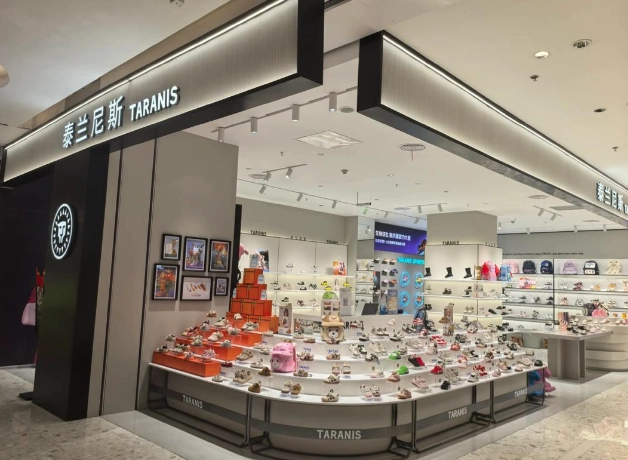
A Distorted Social Tax and a Fabricated Hermès: The Capital Hunt Behind Tailanis's Downfall
Tailanis's failed advertisement exposed its factory price of 37.8 yuan yet retailing at nearly 2,000 yuan, with repeated quality control issues under OEM production, revealing a severe imbalance between marketing and quality.
A subordinate handed a black shoe card to his female boss, as a fawning voice-over rang out: "Thank you for your guidance at work; I'll take care of the baby's little feet."
This cringe-worthy ad, which forcibly wedged children's shoes into the power dynamics of the workplace, instantly enraged countless workers. Behind the tidal wave of public outrage, the high-priced children's shoe brand Taranis is facing a reckoning with its reputation. A pair of stability running shoes, often priced at nearly 2,000 yuan, not only had the fig leaf of a 37.8-yuan ex-factory cost torn off but also exposed its long-standing reliance on OEM manufacturing and recurring quality control failures.
The deeper cause of this absurd spectacle is the pathological struggle of the maternal and infant sector amid a shrinking overall market. When comfort-based storytelling could no longer justify the premium, Taranis attempted to turn children's products into gift items, aiming to seize leverage in workplace favor-trading. It bet on workers' compromises under promotion anxiety and the irrational faith of middle-class parents in a faux-light-luxury halo.
However, beneath the expensive exterior lies an industrial shell riddled with flaws. Through business data disclosed by Tianyancha, we can clearly see the cold technological reality of this high-premium giant. In the intellectual property files of its affiliated company, Hangzhou Taitong Trading Co., Ltd., as many as 90 percent of the patents are nothing more than design patents with no technical barriers. Moreover, Tianyancha shows it has been sued for infringing on others' design patents and has repeatedly flashed quality red flags from regulators.
Just last year, the company was penalized for producing and selling products that failed to meet national standards for safeguarding human health and personal safety. From 2020 to 2025, Taranis' OEM shoe models repeatedly failed core quality indicators, including detachable small accessories and support shanks. A defective shank can cause the shoe to deform and impair foot development, while loose small accessories carry the fatal risk of choking for toddlers.
This tragedy, recurring over five years across OEM factories in several different provinces, punctures the founder's claims of automotive-grade engineering logic and black-tech myths. It proves that Taranis' core asset is not R&D but a traffic-assembly machine operating on a massive information gap. With an ex-factory price of just over 30 yuan and franchisee margins reaching up to 70 percent, the enormous price difference is all funneled into relentless, blanket advertising.
Commercial evolution has never recognized premium pricing without a bottom line. Taranis' biggest crisis is not a tacky ad withdrawn overnight but the severe mismatch between its marketing spend and its underlying quality control. Against a 1,140-yuan administrative fine, the high price tag looks deeply ironic, and the low cost of breaking the law has become a breeding ground for the brand's audacity as a white-label player.
When a children's shoe product no longer prioritizes an absolute safety line and instead tries to teach adults how to sustain personal favors in undignified ways, its brand narrative has already gone completely off the rails. In the rational-consumption reckoning of 2026, no middle-class family is willing to keep paying for this arrogance of a 38-yuan cost with a 2,000-yuan price tag. This public-relations train wreck has not only ripped off Taranis' pseudo-premium mask but also sounded a jarring alarm for every brand attempting to harvest premiums by manufacturing workplace anxiety.