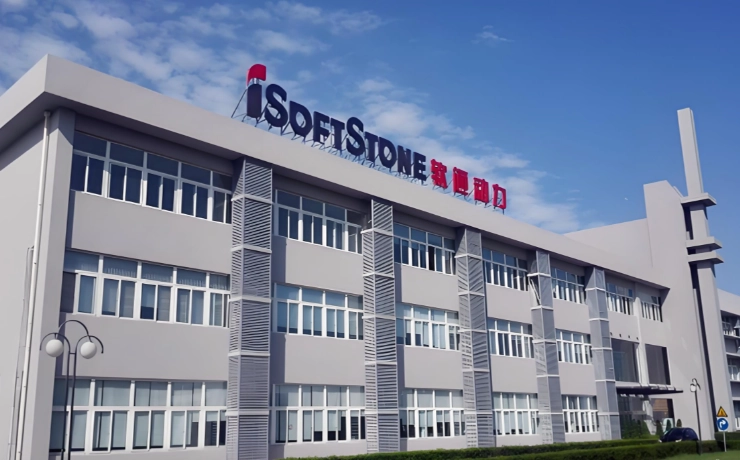
Softong Power increases capital by 90 million yuan, shifting from software outsourcing to hardware computing power, responding to AI's impact on the manpower model.
When the grand and sophisticated large-model algorithms ultimately need to land on heavy-industry assembly lines and the sprawling legacy systems of government and state-owned enterprises, the big tech companies have suddenly discovered that what they lack is not scientists writing papers, but tens of thousands of "technical grunt workers" who can pull all-nighters to deliver code.
iSoftStone, the nation's longest-running leader in software outsourcing, recently completed a critical capital expansion. According to the business registration changes shown on Tianyancha App, this IT outsourcing giant with a market capitalization of over 100 billion yuan has officially increased its registered capital from 950 million yuan to 1.04 billion yuan. This net increase of approximately 90 million yuan, a 9 percent rise, might look like nothing more than a routine earnings-to-capital conversion or capital reserve-to-share transfer by a major company. But if you project this against the sweeping transformation in which iSoftStone will fully absorb Tsinghua Tongfang Computer by the end of 2025 and pivot entirely to becoming a "software-hardware integrated computing power provider," this 90 million yuan is actually an extremely urgent "arrears payment for delayed military buildup."
Many securities analysts who are accustomed to reading charts in the secondary market tend to interpret this capital increase as a routine liquidity boost, or as a qualification top-up to meet the bidding requirements of a new round of large-scale informatization procurement by state-owned enterprises. This consensus, which stays on the surface of financial metrics, completely ignores the devastating gravity that the traditional software outsourcing model faces by mid-2026 — AI code agents are systematically swallowing up the jobs of junior programmers.
If you dig into the top-tier governance structure of iSoftStone on Tianyancha, its legal representative and core driving force remains Liu Tianwen to this day, while the shareholder roster includes a mix of foreign capital such as CEL Bravo and HKSCC Nominees. This giant, which built its fortune by supplying massive outsourced labor to Huawei and internet giants, has spent the past two decades profiting at its deepest level from the demographic dividend of China's R&D workforce. But now, the old closed-loop business model of simply piling up headcount and profiting from hourly billing differentials has been completely shattered by the algorithmic inflection point.
iSoftStone's strategic deliberations over the past year or two have been extremely aggressive. It has spared no expense in restructuring Tsinghua Tongfang's hardware assets, launching self-branded servers under names like Mechrevo, and attempting to tightly bind itself to Huawei's Kunpeng and Ascend ecosystem for domestic computing power.
However, between selling software headcount and selling hardware computing power servers lies an extremely brutal abyss of asset-heavy cash flow. Hardware manufacturing requires fronting massive procurement costs for upstream chips, while the payment cycles for downstream government and enterprise clients routinely stretch to a year or more. The business scope items listed on Tianyancha, such as software development and information system operations and maintenance, now each require heavy fixed-asset depreciation to sustain. The deep underlying pressure behind this 90 million yuan capital infusion is precisely the extreme compliance gravity bearing down on supply chain financing and accounts receivable turnover during the transition from software to hardware.
It must present a more robust capital base to all banks, upstream chip manufacturers, and core partner corporations in the public credit system, in order to hedge against the long-tail litigation risks and financial leverage risks brought on by asset-heavy hardware manufacturing.
The rules of the business world have never believed in the myth of pure asset-light operations. In this brutal cycle where full-stack controllability and computing power purity define who lives and who dies, the old-school software factories that rely purely on reselling junior labor, lack a hardware manufacturing foundation, and lack algorithmic stitching capabilities will ultimately pay the most expensive exit bill in this wave of intelligent cleansing. This new ten-figure number left in iSoftStone's Tianyancha file is not a casual capital dividend, but rather a series of extremely heavy footprints left on the beach as a vast human labor empire relocates to a silicon-based computing power empire.