Seres' August sales plummeted 43.96%, exposing the customer diversion among HarmonyOS Intelligent Mobility's multiple brands and the fragility of the contract-manufacturing model, as AITO's model-changeover gap met an onslaught of extreme value-for-money rivals.
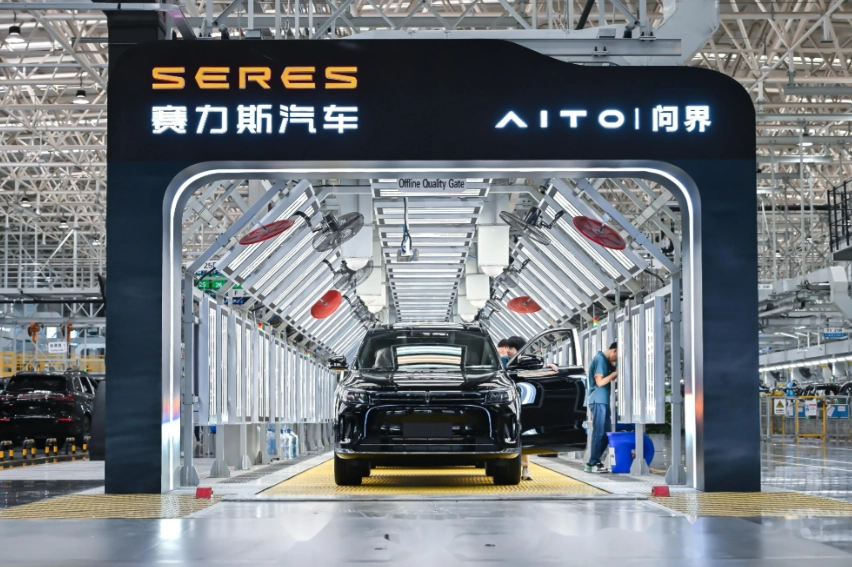
As major domestic automakers密集 released their August sales figures, with BYD steadily expanding at 440,000 vehicles and Leapmotor surpassing 100,000 in a single month to lead the new forces camp, Seres, listed in both A-shares and H-shares, instead delivered a rather chilly production and sales bulletin: August new energy vehicle sales were only 24,244 units, a sharp year-on-year drop of 43.96%. A cliff-like decline of nearly 45% formed a glaring scissors gap with the overall new energy market's volume growth during the same period.
If this single-month anomaly is simply attributed to a brief fluctuation from the high-temperature holiday or production line optimization, then the dramatic shift underway in the smart car landscape is completely underestimated—this is by no means an ordinary delivery shock, but the most severe pain test yet for a traditional vehicle manufacturer that is deeply bound to Huawei and relied on AITO to stage a turnaround, as its core hit model enters a model-change window, HarmonyOS Smart Mobility's multiple brands accelerate diversion, and the entire industry besieges it with extreme cost-effectiveness.
From Spring Shock Absorbers to a Hundred-Billion Market Cap: A Comeback Script
Seres once staged the most incredible comeback script in the capital history of China's auto industry. From Xiaokang Industrial, which made spring shock absorbers in the mountains of southwest China in its early years, to a traditional manufacturing entity that sold low-priced microvans and commercial vehicles in volume, Zhang Xinghai staked his fortune on embracing Huawei's Smart Selection car model, achieving runaway sales for the AITO M7 and M9 in the high-end SUV market. Between 2024 and 2025, AITO almost single-handedly upheld the discourse power of high-end luxury smart cars, and pushed Seres to the peak of a hundred-billion market cap and a secondary Hong Kong IPO that raised more than HK$14 billion.
However, this alliance structure, which fully entrusts its soul and product definition rights to a giant, naturally carries an extremely fragile dependence on the technology clock: once the life cycle of a core volume model encounters a facelift switch, or an external competitor launches a more cost-effective rival model, the vehicle contract manufacturer's resilience to terminal fluctuations is instantly knocked back to its original form.
The Manufacturing Foundation and Hard Asset Skeleton at the Business Registration Level
Following the traces left at the business registration level to penetrate the industrial chassis of this southwest vehicle manufacturing entity, its manufacturing foundation, which has undergone several name changes, is clearly presented in Tianyancha archives. Tianyancha business registration data shows that Seres Group Co., Ltd. was established in May 2007, with registered capital of approximately RMB 1.742 billion, legal representative Yin Xianzhi, and registered address in Shapingba District, Chongqing.
In the business registration name-change records preserved by Tianyancha, its transformation path is clearly recorded, from "Chongqing Xiaokang Automobile Group Co., Ltd." to "Chongqing Xiaokang Industrial Group Co., Ltd." and then to "Seres."
The group has invested in 17 enterprises externally, holds 2,278 trademarks and hundreds of intellectual property patents, and completed more than HK$14 billion in H-share fundraising last year, forming the hard asset skeleton that supports the operation of its tens-of-billions-level super smart factory.
However, this enormously expensive super manufacturing machine has its capacity utilization and per-vehicle profitability highly parasitic on the single AITO brand.
Four Brands of HarmonyOS Smart Mobility on the Same Stage: From Single-Core Era to Multi-Core Diversion
Looking at the full-series delivery data of HarmonyOS Smart Mobility for the same August period, the entire alliance delivered 42,101 vehicles. This means that within HarmonyOS Smart Mobility's overall pie, although Seres still contributed the largest share, it could no longer reproduce the monopolistic dominance of the past, when it routinely captured 30,000 to 40,000 vehicles in a single month.
The deeper diversion pressure comes from the "four brands on the same stage" and resource倾斜 within Huawei's Smart Selection car business.
As Luxeed, developed by Huawei with Chery, Stelato, developed with BAIC, and Maextro, developed with JAC through heavy investment, successively reached mass production, HarmonyOS Smart Mobility has彻底 moved from the early "Seres single-core era" into a multi-core distribution period of multi-party competition. Stelato's carving up of the high-end executive sedan market and Luxeed's downward push into the mainstream 200,000 to 300,000 yuan sports sedan and SUV market not only directly diverted the extremely limited display car slots and top sales energy at Huawei's offline terminal stores, but also invisibly weakened the absolute exclusivity AITO enjoyed within Huawei's intelligent driving ecosystem.
The Pincer Siege from Leapmotor and BYD
An even more brutal squeeze on the battle line is directly reflected in the pincer siege from full-stack self-developed automakers such as Leapmotor and BYD.
Taking Leapmotor, another comparison automaker disclosed by Tianyancha, as an example, this young automaker, which started from security giant Dahua Technology and has paid-in capital of RMB 4.708 billion, sold 103,129 vehicles in August, firmly ranking first among new forces. Relying on full-domain self-development, Leapmotor directly pushed high-level lidar intelligent driving, 800V high-voltage fast charging, and extended-range large space into the mainstream price band of 120,000 to 180,000 yuan. With an almost suicidal piling up of all configurations, it created a strong upward suction effect on the family SUV market originally in the 200,000 to 300,000 yuan range.
For family consumer groups, when the experience gap in smart cockpits and high-level assisted driving is rapidly erased by major players, the emotional premium AITO previously established through HarmonyOS car machines and ADS intelligent driving begins to face diminishing marginal utility. Consumers no longer blindly pay unlimited amounts for the brand halo above 300,000 yuan, but instead compare every configuration cost with a magnifying glass. AITO's old main models gradually showed fatigue under repeated attacks from competitors, while the all-new facelifted models had not yet fully seamlessly connected capacity ramp-up with terminal absorption, directly causing Seres's August shipment rhythm to suddenly stall.
The Coldness of the Capital Market: The Fatal Shortcomings of Heavy Assets and a Single Channel
The coldness of the capital market also silently spreads through the balance sheet and valuation logic.
Seres absorbed tens of billions of funds through its Hong Kong listing, and the promise it made to the capital market was to grow into a global high-end new energy giant with sustained independent profitability. However, the reality of a 43.96% year-on-year decline in single-month sales directly exposed to investors its fatal shortcoming of being highly vulnerable to fluctuations in a single channel. The depreciation of tens-of-billions-level heavy-asset factories and massive supply chain material preparation require an extremely stable production and sales scale to dilute fixed costs;
once delivery scale retreats significantly during the switch between off-peak and peak seasons or in the industry price war, the net profit statement that had finally turned profitable thanks to scaled volume could be backlashed by fixed expenditures at any time.
Warning Bell: The Fate of Contract Manufacturing and the Life-or-Death Task
This nearly 40% single-month rout at the turn of summer and autumn sounded the deepest warning bell for the entire Chinese smart car manufacturing camp: deeply embracing the ecosystem empowerment of a tech giant can indeed produce the most stunning acceleration, but the giant's traffic pool is never a permanent safe harbor for any contract manufacturer. When the four brands are all assembled and involution in the auto circle pushes downward to the limit of underlying manufacturing costs, the dividend of relying solely on brand co-branding and terminal store exposure has been exhausted.
How to truly convert the tens of billions of Hong Kong dollars raised into independently controllable chassis technology heritage, build an irreplaceable manufacturing engineering barrier within the Smart Selection car system, and shed the fatal dependence on a single model cycle as soon as possible—this is the life-or-death task Seres must answer when facing the brutal elimination endgame in the second half of the year.