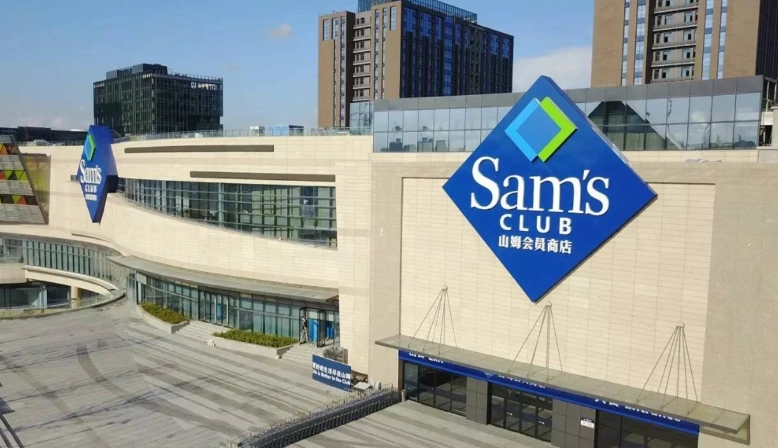
Behind Sam's Club's Rent Arrears in Nanjing: A Brutal Game of Traffic Hegemony and the Real Estate Cycle
Sam's Club in Nanjing has been sued for 8.87 million yuan in unpaid rent, exposing the struggle between retail giants and property developers amid the cycle, where traffic hegemony and credit crisis intertwine.
In the judicial auction listing for the North District of Yuhua Living Mall in Nanjing, a name has appeared that strikes regular consumers of premium lifestyle brands as almost absurd: Sam's Club. As a leading player in the warehouse club sector, Sam's Club is synonymous on social media with a high-markup lifestyle. Yet in the court documents of the Yuhuatai District Court in Nanjing, it appears as the property portfolio's biggest "problem tenant," owing 8.87 million yuan in unpaid rent.
This nearly nine-million-yuan rent delinquency is far from a simple case of "not being able to pay." It is a cold, calculated business hedge. When a commercial IP with enormous monetization power meets a commercial real estate asset heading for the auction block, the interests connecting the two have long ceased to be a simple contractual relationship. What is unfolding is a deep game of liquidity and survival space.
Strategic Rent Withholding Under Traffic Hegemony
In traditional retail logic, "anchor tenants" like Sam's Club and Decathlon have always wielded outsized negotiating power. To attract such traffic-generating giants, developers have historically offered extremely long leases—such as the twenty-year term disclosed in this case—and even deeply discounted rent. But in the 2026 commercial environment, this once mutually beneficial relationship is undergoing a mutation.
The deepest reason Sam's Club is withholding rent lies in the collapse of the commercial developer's creditworthiness. Once the property owner (the North District of Yuhua Living Mall) sank into debt and ultimately headed to judicial auction, its commitment to mall operations, maintenance, and future business expectations fell to rock bottom. For Sam's Club, 8.87 million yuan in rent is likely a rounding error against the output of a single store. But at a moment when ownership of the asset is about to change hands and creditor relationships are deeply tangled, continuing to pay rent would be tantamount to throwing cash into an unpredictable black hole.
This is a highly aggressive strategy of self-preservation. By leveraging its irreplaceable status as the core traffic driver, Sam's Club is withholding rent to offset the operational risks posed by the landlord's default. In this game, giants like Sam's Club are not simply defaulting—they are exercising a form of "operational right of defense."
Management Growing Pains and Compliance Anxiety Under the Tianyancha Lens
Through the corporate data disclosed by Tianyancha, we can more clearly trace the complex structure behind the Nanjing Sam's Club store operated by Walmart (Jiangsu) Commercial Retail Co., Ltd. This store, established in 2017, underwent a key management change in June 2025, with Niu Chaoyang replacing his predecessor. Such a leadership transition during a sensitive period typically signals that the company is undergoing audits, compliance reviews, or strategic asset restructuring internally.
The risk disclosures also reveal deeper difficulties for this giant in the Nanjing market. Within the list of legal proceedings shown on Tianyancha, in addition to the customary product liability disputes arising from high transaction volumes, labor disputes appear with notable frequency. This suggests that beneath the external conflict over rent, internal management friction and discord have also reached the point where litigation has become unavoidable.
For a multinational commercial machine like Walmart, the level of prudence applied to every financial outlay far exceeds that of an individual business. When the rent payment chain breaks, it often points to deeper contract disputes or challenges to the legitimacy of the original property holder's claims. The litigation records on Tianyancha are, in effect, a real-time portrait of a company continuously patching its own credit firewall amid management pressure and market upheaval.
The Collapse of the Anchor Effect in Commercial Real Estate
There was a time when landing a Sam's Club meant a solid position for a commercial district. Now, that "anchor effect" is becoming a liability for the property side.
When a commercial complex goes to auction, the core of its value should be stable rental income. Yet Sam's Club, as the largest tenant, taking the lead in withholding rent deals a heavy blow to the assessed value of the asset. This reveals a harsh reality: in a downward economic cycle, the interests of retail giants and commercial landlords are not always aligned. When a giant realizes the landlord can no longer sustain the operational quality required for a premium consumer environment, it will move quickly to "cut ties" through legal or financial means.
Decathlon's and Sam's Club's twenty-year leases, in the context of an asset auction, serve both as "bait" to attract potential buyers and as a ticking time bomb. If a new buyer cannot resolve the rent disputes left by the previous owner, or cannot meet the increasingly demanding conditions of giants like Sam's Club in the 2026 consumption environment, these long-term leases could become the very force driving the asset to fail at auction or sell at a discount.
The truth about the business world is often buried in cold financial statements and tangled litigation documents. The Nanjing Sam's Club's eight-million-plus-yuan arrears represent an awkward collision between the myth of middle-class consumption and the heavy weight of the real estate cycle. It is a reminder to all business observers that no brand can truly stand apart from the financial nature of land. When the commercial real estate foundation begins to shake, even a warehouse club that basks in social media glory must put aside the mask of civilized competition and seek the coldest possible point of survival in the mire of legal disputes and financial obligations.
The final outcome of this judicial auction will determine whether this nearly nine-million-yuan rent debt is transferred as a creditor's right or swallowed whole in complex bankruptcy restructuring. For ordinary consumers, what they care about may simply be whether they can still buy that Swiss roll on the weekend. Few realize, however, that the underlying financial structure supporting these consumption scenes is already as fragile as a cicada's wing in late autumn.