Childcare for 1.23 Million Operators: How Public Programs Are Reshaping Working Families' Childcare Costs
The expansion of public childcare is squeezing commercial providers, exposing a supply-demand mismatch among 1.23 million operators and pushing low-quality providers toward an industry upgrade.
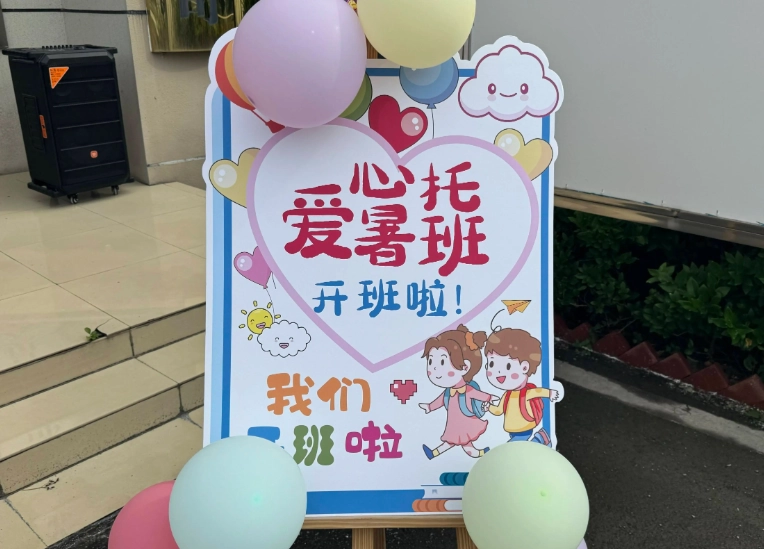
When community-run childcare programs are set up directly in logistics parks, mining areas, and industrial parks dense with factories, using schedules that seamlessly match workers' shift rotations to support working families, such initiatives are often viewed as routine community public services. However, if we look past these warm volunteer-led childcare efforts and examine the millions of commercial childcare providers in the real market, it becomes clear that this push of childcare services into industrial workplaces and underserved areas, backed by strong public resources, is tearing through the awkward deadlock that has long left traditional commercial childcare institutions unable to serve working-class families effectively.
During the two-month summer gap, childcare has become a major hidden cost for dual-income frontline workers and those in new forms of employment. Over the past decade or more, driven by tighter regulation of after-school tutoring and the childcare anxiety of dual-income families, the private childcare industry has gone through a period of runaway expansion. However, most commercial childcare providers, in order to cover high street-front rents and labor costs, typically charge thousands of yuan per month, and their hours are rigidly locked into the traditional nine-to-five white-collar schedule.
For blue-collar workers who earn by piece rate and work rotating three-shift schedules, as well as ride-hailing drivers and food delivery riders who are on call at all hours, this kind of high-priced, inflexible commercial service simply does not add up financially.
Behind this severe mismatch between supply and demand lies a stagnant pool of low-barrier commercial childcare operators. Data from Tianyancha Professional Edition shows that the number of active childcare-related businesses in China has surpassed 1.237 million, with over 134,000 new registrations this year alone. According to the registration trends disclosed by Tianyancha, this sector has kept expanding over the past five years and hit an all-time high in 2025.
Geographically, the three provinces of Shandong, Guangdong, and Anhui lead the pack by a wide margin, each with hundreds of thousands of registered businesses.
This highly dense regional distribution maps precisely onto the labor base of China's manufacturing hubs and populous provinces. But this massive number of businesses has not led to a large-scale upgrade in service quality. On the contrary, many small childcare operators remain trapped in low-level competition marked by vague facility qualifications, high staff turnover, and a persistent trust deficit over safety.
When the Communist Youth League system partners with party and community service centers, using idle public spaces and bringing in university volunteers, the public sector is essentially using a cost-effective combination of rent-free space and low-cost labor to directly displace the lowest-cost segment of the commercial childcare market. Moving classrooms into logistics parks and mining areas not only eliminates the friction of commuting to pick up and drop off children, but also leverages public credibility to resolve parents' deepest concern about childcare safety: trust.
This normalization of public childcare support is reshaping the boundaries of the entire childcare market ecosystem. The small workshops that have long profited from information asymmetry, offering little more than basic supervision and low-quality meal services in residential neighborhoods, are now seeing their room to operate rapidly reduced by a dense network of public care points. As basic childcare needs are effectively absorbed by public services, commercial childcare providers that fail to build real premium capabilities in specialty study tours, specialized enrichment programs, and age-appropriate care will inevitably face the bitter outcome of being abandoned by both parents and the market amid this wave of public service expansion.